


















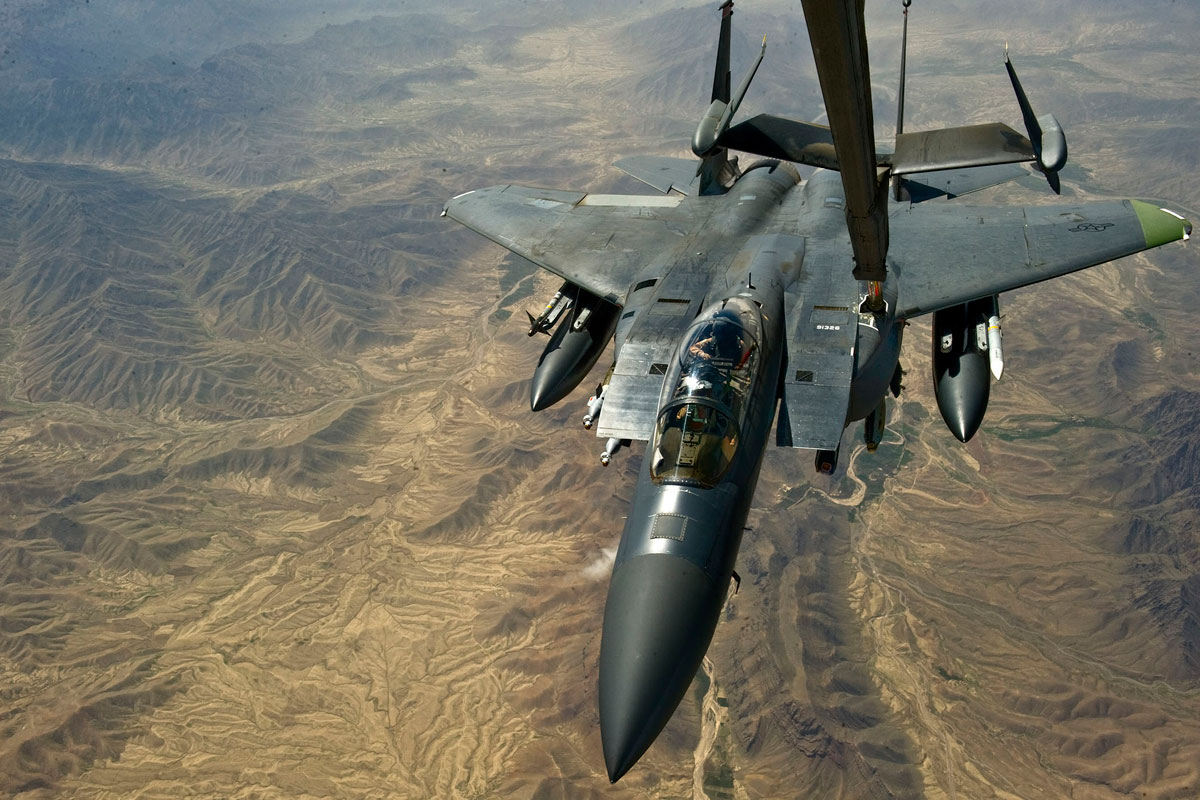
A United States Air Force F-15E Strike Eagle crashed in Kuwait on March 2 during Operation Epic Fury, with the pilot ejecting safely but sustaining apparent injuries. The aircraft came down near the Iraqi border in a sparsely populated area, avoiding civilian casualties. While officials have confirmed the crash, no formal explanation has yet been issued regarding its cause.
The absence of an official statement has fuelled speculation at a time of intense regional conflict. Iranian state media claimed responsibility for the incident without providing evidence. At the same time, circulating footage appears to show the jet spiralling in a manner consistent with a surface-to-air engagement, raising the possibility of a friendly fire incident involving a Patriot air defence battery.
If verified, the episode would mark a serious and deeply troubling development: an American aircraft potentially downed by an American missile system while operating from the territory of a key ally in a war initiated by Washington.
A Pattern Rooted in History
This would not be an unprecedented failure.
During the 2003 invasion of Iraq, Patriot missile batteries were responsible for two fatal fratricide incidents within twelve days. On March 23, a British Royal Air Force Tornado GR4 was shot down while returning from a mission, killing Flight Lieutenant Kevin Main and Flight Lieutenant Dave Williams. On April 3, a U.S. Navy F/A-18C Hornet was destroyed by another Patriot engagement, killing Lieutenant Nathan White.
Subsequent investigations concluded that the system’s radar had misidentified friendly aircraft as hostile ballistic missiles.
More than two decades later, the same system remains deployed across the Gulf, operating under strikingly similar conditions.
A Saturated Battlefield
The current conflict has created the most congested air defence environment the region has ever witnessed. Iranian forces have launched unprecedented barrages of ballistic missiles and drones, overwhelming radar systems and stretching interception networks to their limits.
Hundreds of aerial objects have been tracked simultaneously, including ballistic missiles, cruise missiles, loitering munitions, and returning allied aircraft. In such conditions, the challenge of distinguishing friend from foe becomes exponentially more difficult.
Patriot systems were primarily designed to counter ballistic missile threats. When confronted with mixed aerial traffic and high-speed engagements, their Identification Friend or Foe mechanisms face extreme operational strain, far beyond most peacetime testing scenarios.
Military analysts warn that under these pressures, automated engagement protocols can become dangerously reactive, increasing the risk of catastrophic error.
Human and Strategic Consequences
The pilot’s survival in this incident has been widely described as fortunate. A different outcome would have meant the loss of life at the hands of allied defences, a scenario that carries profound moral and operational implications.
The wider human cost of the conflict is already significant. Iranian strikes in the Gulf region have killed three American service members and seriously wounded five others, while host nations have absorbed repeated attacks on their soil.
Kuwait, in particular, finds itself in an increasingly precarious position. By hosting American forces, enduring enemy fire, and now potentially witnessing allied systems down American aircraft, it bears a burden far beyond conventional alliance expectations.
Diplomatic Fallout and Systemic Risk
If the crash is confirmed as a Patriot engagement, it would expose a vulnerability that cannot be easily corrected in wartime. Software updates, revised protocols, and retraining take time. None is readily available in the midst of active conflict.
More troublingly, it would suggest that systems purchased at enormous cost to defend against mass missile attacks may struggle to distinguish between incoming threats and outgoing responses when it matters most.
For regional allies, this raises uncomfortable questions about the balance between protection and risk. No partner state expects to face danger from both adversaries and protectors simultaneously.
Waiting for Answers
At present, the incident remains under investigation. Until official findings are released, conclusions remain provisional. Yet the available evidence, historical precedent, and operational context make the possibility of friendly fire impossible to dismiss.
What is clear is that this crash has exposed the fragile margins within which modern air defence operates. In an environment of saturation warfare, even advanced systems can fail with devastating consequences.
The pilot survived this time.
The next crew may not.





