
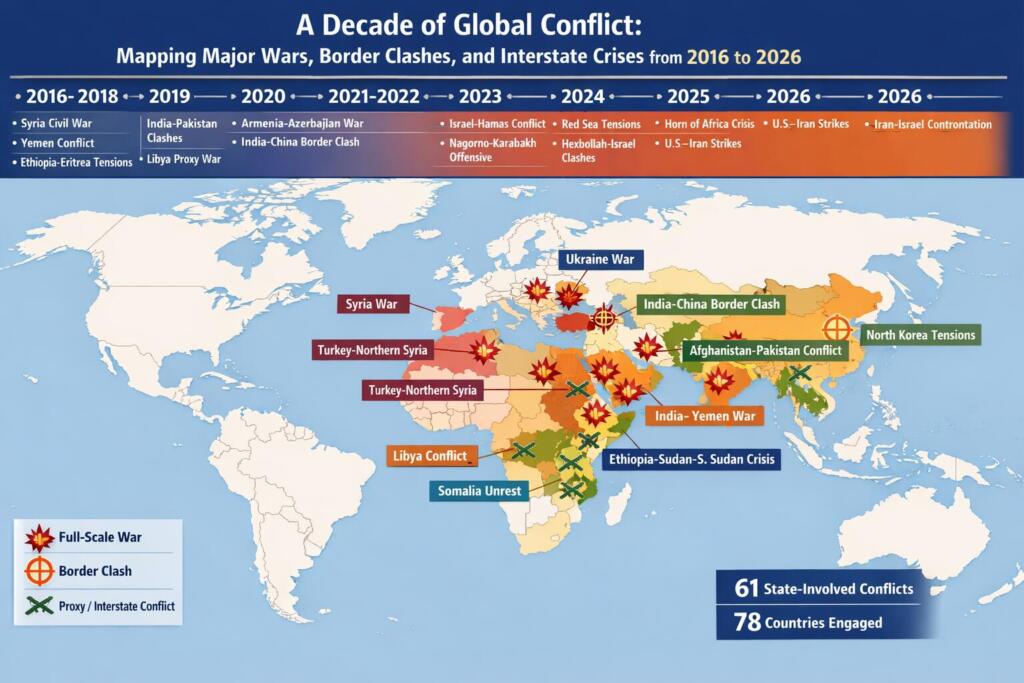
Over the past decade, armed conflict between sovereign nations has returned as a defining feature of global affairs. Between 2016 and 2026, multiple regions witnessed direct military confrontations that challenged the belief that large-scale interstate war had become obsolete. From Europe to the Middle East, from Asia to Africa, governments increasingly turned to military force to resolve disputes, defend territory, and project power.
At the heart of this shift was the full-scale invasion of Russia into Ukraine in February 2022, the most consequential European war since 1945. Alongside it, escalating violence in the Middle East, renewed fighting in the Caucasus, and dangerous standoffs in Asia and Africa revealed a world drifting away from diplomacy and toward confrontation.
These conflicts have killed hundreds of thousands, displaced millions, disrupted global trade, and reshaped political alliances. Together, they have redrawn the map of international security.
Europe’s Defining War
The Russian assault on Ukraine transformed Europe’s security landscape overnight. What began as a rapid offensive evolved into a prolonged war of attrition marked by trench fighting, drone warfare, missile strikes, and widespread destruction of civilian infrastructure. Entire cities were reduced to ruins, energy networks were targeted, and millions of Ukrainians were forced to flee.
The war triggered major economic sanctions, accelerated military spending across Europe, and led to the expansion of Western security alliances. Beyond a regional conflict, Ukraine became a symbol of a broader struggle over sovereignty, borders, and the rules governing international conduct.
The Middle East’s Expanding Battle Lines
In the Middle East, longstanding disputes erupted into repeated cycles of warfare. Large-scale confrontations between Israel and the State of Palestine, particularly in Gaza, intensified after October 2023, producing catastrophic humanitarian consequences. Hezbollah in Lebanon joined the fighting with rockets and drones, while Israel responded with cross-border airstrikes.
Israel’s rivalry with Iran escalated into direct exchanges of missiles, drones, and cyber operations across multiple countries. These confrontations, although often undeclared, repeatedly brought the region to the brink of broader war.
Saudi Arabia’s involvement in Yemen sustained a cross-border air campaign, turning an internal civil war into a prolonged regional crisis. Turkey conducted multiple military operations in northern Syria, clashing with Syrian forces and allied groups over territory, refugees, and security concerns.
In early 2026, joint U.S.–Israel strikes on Iranian territory triggered missile and drone retaliations, marking one of the most serious direct confrontations in the region in decades.
The Caucasus: Short Wars, Lasting Impact
Conflict between Armenia and Azerbaijan reshaped the South Caucasus. The 2020 Nagorno-Karabakh war ended decades of frozen conflict, with Azerbaijan reclaiming significant territory using drones and precision strikes. A further offensive in 2023 consolidated this shift, displacing thousands and collapsing Armenian control in the region. Border skirmishes in 2022 and 2023 highlighted the fragility of peace.
Asia’s Fragile Frontiers
In Asia, border disputes between major powers escalated into deadly confrontations. In June 2020, India and China clashed along the Himalayan Line of Actual Control, resulting in fatalities for the first time in decades and prompting sustained troop deployments.
Further west, Afghanistan and Pakistan experienced repeated airstrikes, border incidents, and militant attacks. In early 2026, Pakistan launched operations across the border, leading to open conflict with significant casualties reported.
The Korean Peninsula remained tense, with North and South Korea conducting missile tests and border confrontations, raising the risk of escalation despite no full-scale war.
Africa’s Overlooked Interstate Conflicts
Africa witnessed several conflicts with clear interstate dimensions. Eritrean forces intervened in Ethiopia’s internal war, reviving historic rivalries and heightening regional instability. Sudan and South Sudan engaged in intermittent clashes over borders, oil resources, and political influence.
The Horn of Africa experienced a broader multi-state crisis between Ethiopia, Sudan, South Sudan, Somalia, Eritrea, Egypt, the UAE, and Saudi Arabia, destabilizing the region. Renewed Ethiopia–Eritrea tensions in 2026 further threatened to escalate hostilities.
Other conflicts, including in Somalia, Mali, the Democratic Republic of the Congo, and Boko Haram-affected zones, had significant cross-border implications.
Limited Wars and Major Power Confrontations
Beyond full-scale invasions, states increasingly relied on limited military actions to assert influence. U.S.–Iran confrontations in 2020 and beyond involved missile strikes, drone attacks, and naval incidents that stopped short of open war but carried serious escalation risks.
Russia continued to occupy regions in Georgia, while Turkey conducted regular strikes in Iraq. Azerbaijan and Iran experienced border flare-ups during military drills. These episodes reflect a trend toward precision strikes, proxy operations, and rapid retaliation.
A New Pattern of Warfare
The past decade demonstrates a transformation in warfare. Conventional battles are now combined with cyber operations, economic sanctions, information warfare, and proxy forces. Frontlines extend beyond physical borders into digital networks and financial systems.
Many conflicts remain technically undeclared, blurring the line between peace and war, making disputes harder to contain and easier to reignite.
The Human and Global Cost
Behind every strategic calculation lies profound human suffering. Families were separated, livelihoods destroyed, and generations grew up amid violence in Ukraine, Gaza, Yemen, Syria, and the Caucasus. Refugee flows strained neighbouring countries, while disrupted supply chains drove food and fuel prices worldwide.
International efforts to prevent or contain these wars often struggled against competing national interests, leaving civilians exposed to prolonged insecurity.
Global Conflict Context
The decade saw record levels of global conflict, with 61 state-involved armed conflicts and over 78 countries participating in cross-border engagements by 2024. Civil wars with international involvement, including Myanmar, Syria, Somalia, the Central African Republic, and Colombia, further complicated regional and global security.
A Decade That Redefined Global Security
Since 2016, at least a dozen major interstate conflicts erupted across four continents, involving over twenty countries. Together, they reshaped regional power balances and weakened confidence in collective security.
The central lesson is clear: state-to-state war has not disappeared. It has returned in new, complex forms, driven by unresolved territorial disputes, nationalism, and rivalry among major powers.
Unless sustained diplomatic engagement and conflict prevention mechanisms are strengthened, the pattern of the past ten years is likely to continue. Peace between nations can no longer be taken for granted, and once broken, it proves painfully difficult to restore.