
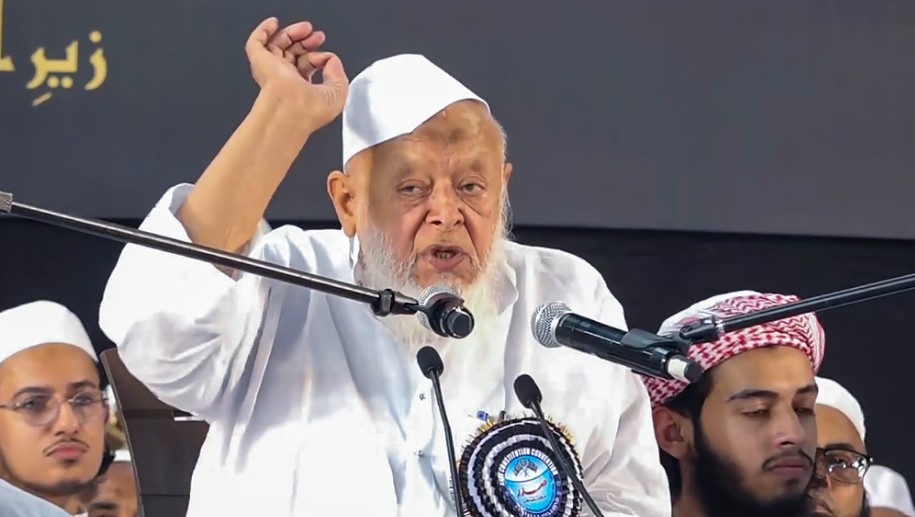
The largest Muslim organisation in the country, the Jamiat Ulama-i-Hind, on Thursday described the BJP-led central government’s new guidelines, mandating the singing of all six stanzas of the national song Vande Mataram as a ‘blatant attack on religious freedom.’
Muslim leaders raised objections claiming that the community only worships one god and cannot accept associating anyone with Allah, therefore, making Vande Mataram compulsory is a clear assault on the Constitution, religious freedom, and democratic principles.
This came after the Centre on Wednesday issued fresh guidelines making the playing of Vande Mataram compulsory at government programmes, schools and other important events. As per the directives, everyone present will be required to stand and pay respect, similar to the protocol followed for the national anthem Jana Gana Mana.
Jamiat President Maulana Arshad Madani pointed out that certain verses of Vande Mataram, written by Bankim Chandra Chatterjee, depict the motherland as a deity and stated that this portrayal conflicts with the core principles of monotheistic religions.
“The Central Government’s unilateral and coercive decision to make Vande Mataram the national song and to mandate all its stanzas in all government programmes, schools, colleges, and functions is not only a blatant attack on the freedom of religion guaranteed by the Constitution of India but also a systematic attempt to curtail the constitutional rights of minorities,” his post read.
Explaining his objection, Madani said that Muslims do not prevent anyone from reciting Vande Mataram or playing its tune, but argued that certain lines in the song are rooted in polytheistic belief and portray the motherland as God, which conflicts with the monotheistic tenets of Islam.
He stated that compelling a Muslim, who worships only one Allah, to recite the song amounts to a violation of Article 25 of the Constitution and the decisions of the Supreme Court.
“Muslims do not prevent anyone from singing or playing Vande Mataram; however, some verses of the song are based on beliefs that portray the homeland as a deity, which contradict the fundamental belief of monotheistic religions. Since a Muslim worships only one Allah, forcing him to sing this song is a clear violation of Article 25 of the Constitution and several judgments of the Supreme Court,” posted Madani on X.
Targeting the government, Madani said that making the song mandatory and seeking to impose it on citizens does not reflect patriotism, but rather amounts to “electoral politics, a communal agenda, and a deliberate ploy to divert public attention from core issues.”
He added that genuine love for the motherland is demonstrated through character and sacrifice, citing what he described as the “unprecedented struggle of Muslims and Jamiat Ulama-e-Hind” as evidence.
“Making this song mandatory and attempting to impose it on citizens is not an expression of patriotism; rather, it reflects electoral politics, a sectarian agenda, and a deliberate effort to divert public attention from fundamental issues. The true measure of love for one’s country lies not in slogans but in character and sacrifice. The shining examples of which can be seen prominently in the historic struggle of Muslims and the Jamiat Ulama-i-Hind. Such decisions weaken the country’s peace, unity, and democratic values and undermine the spirit of the Constitution,” his post added.
The post further read, “It must be remembered that Muslims worship only one God; they may endure everything, but they cannot accept associating partners with Him. Therefore, making Vande Mataram compulsory is a clear assault on the Constitution, religious freedom, and democratic principles.”
Notably, the BJP has consistently pushed for the inclusion of the stanzas that were omitted when Vande Mataram was adopted as the national song in 1937. Those portions were excluded at the time due to concerns that they could hurt the religious sentiments of non-Hindus, as they portrayed the motherland as the goddess Durga, a depiction seen as conflicting with the beliefs of several faiths, including Islam.
Meanwhile, on Thursday the All India Muslim Personal Law Board also raised strong objection to the central govt’s recent notification mandating the recitation of all six verses of ‘Vande Mataram’ at official functions and in schools before the National Anthem, Jana Gana Mana.
The AIMPLB termed the decision “unconstitutional and contrary to religious freedom” and demanded that the govt immediately withdraw the notification or else it will challenge it in the court. Left parties like CPI(M) and CPI also came forward to oppose the MHA order. CPI(M) demanded that the govt “uphold the spirit of the Constitution and immediately withdraw this order”.
The CPI(M) accused the BJP-led union govt of attempting to create an “unnecessary controversy concerning the national song and the national anthem with ulterior motives” and that the “BJP govt should not be allowed to play with such historic cultural symbols.”
Explaining the reasons for opposition, AIMPLB general secretary, Maulana Mohammed Fazlur Rahim Mujaddidi, alleged that the MHA order was “unconstitutional, against religious freedom and secular values, contrary to Supreme Court judgment, and directly conflicting with the religious beliefs of Muslims.”
“A Muslim worships only one God, Allah, without partners, and Islam does not permit any form of associating partners with God,” the AIMPLB general secretary emphasised.