













The India–US announcement of an interim trade deal framework on Saturday, February 7, not only strengthens New Delhi’s economic position through favourable trade terms but also delivers a clear diplomatic signal that reinforces India’s stance on long-standing regional issues.
The trade deal has been viewed as unsettling and a setback for Pakistan, not only because New Delhi secured more favourable terms on tariffs, but also because of the diplomatic implications it carries for Islamabad.
As India has long maintained, Jammu and Kashmir is an inseparable part of the country and requires no external validation of its territorial claims. As much as Pakistan debates this simple fact, the most hard-hitting acceptance has come from one of its most trusted allies and the biggest superpower, the United States.
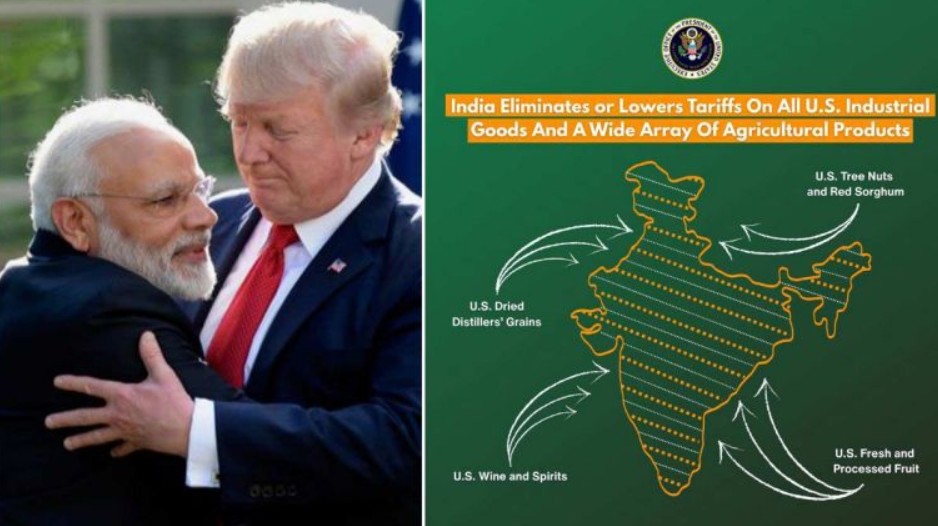
After the interim trade pact was unveiled on Saturday, the Office of the United States Trade Representative released a map of India that clearly delineated the country’s territorial boundaries.
https://x.com/USTradeRep/status/2019902587416240529
The map, shared from the official X handle, depicted the entire Jammu and Kashmir region, including areas under Pakistan’s illegal occupation (PoJK) as part of India.
The depiction reinforces India’s longstanding claim over the region and is being viewed as a signal that Washington aligns with New Delhi’s official political map, reflecting a shift away from positions that have previously acknowledged competing territorial claims.
Why the Latest US Map Matters and How is it a Blow to Pakistan?
Earlier maps released by US agencies, including the State Department, often clearly marked Pakistan-occupied Kashmir (PoK), reflecting Pakistan’s stance. This time, however, there was no such distinction. The entire region was shown as part of India, sending a strong diplomatic signal that many observers say undercuts Pakistan’s long-standing claims.
The timing of the release is equally significant. India and the United States are seeking to reset ties after a rocky phase. In August last year, US President Donald Trump had imposed steep 50% tariffs on Indian goods amid disagreements over India’s continued purchase of Russian oil.
Trump had also spoken about bringing India and Pakistan back into the same strategic frame — a position previous US administrations had moved away from. Against this backdrop, the new map marks a clear departure from earlier messaging.
The latest map also shows Aksai Chin, a region in eastern Ladakh that China forcibly occupies. India’s Ministry of External Affairs has repeatedly objected in the past to what it called incorrect depictions of its borders by foreign agencies. Many now see the updated US map as addressing those concerns.
The move sparked a strong reaction on social media. Defence analysts and geopolitical authorities have reacted positively, highlighting its significance. Others see it as a major setback for Pakistan, especially at a time when Islamabad has been actively engaging Washington.
US Ambassador Sergio Gor on Saturday lauded US President Donald Trump and Prime Minister Narendra Modi for the India-US joint statement.
In a post on X, he said, “A new day! All credit to President Trump and Prime Minister Modi for their leadership and vision in achieving this.”
Pakistan Army Chief Asim Munir has visited the US at least twice recently and even met President Trump, including a high-profile lunch in June last year, efforts that now appear overshadowed by Washington’s latest diplomatic messaging.
The Kashmir issue has been a longstanding point of tension between India and Pakistan. In recent years, there have been ups and downs in India-Pakistan relations, including ceasefires and brief escalations along the border. The U.S. has at times offered involvement in discussions, though India prefers direct bilateral talks with Pakistan.
Meanwhile, the trade deal marks an important milestone in India’s economic relationship with the United States. After years of negotiations, the framework suggests both sides see value in closer economic cooperation, even as debates continue over market access, tariffs, and protection of local industries.