
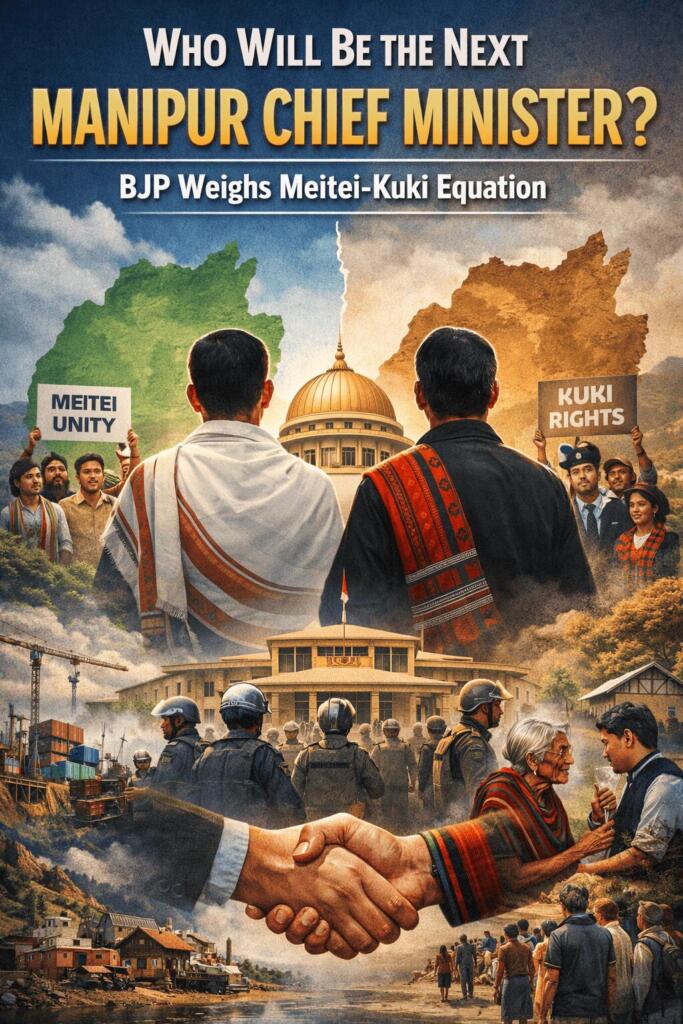
Political circles in the northeastern state are closely watching the developments around the selection of the next Manipur Chief Minister as the Bharatiya Janata Party navigates a delicate social and ethnic balance. The decision carries weight far beyond routine leadership change because the state has witnessed prolonged tensions between Meitei and Kuki communities. The choice of the next Manipur Chief Minister is therefore being seen not only as an administrative matter but as a signal of the party’s strategy to restore stability and rebuild trust across communities.
The BJP leadership is reportedly engaged in careful consultations with state leaders, central observers, and community representatives. The task before the party is complex. Manipur’s political landscape has always been intertwined with ethnic identity, regional aspirations, and security concerns. In such a context, the identity and political approach of the next Manipur Chief Minister could influence how effectively the government addresses grievances and ensures peace.
The Meitei community, largely concentrated in the Imphal valley, has traditionally played a central role in state politics due to demographic and political weight. At the same time, the Kuki tribal population in the hill districts has been asserting its demands more strongly in recent years. The BJP’s challenge is to pick a Manipur Chief Minister who can project inclusivity and reassure both sides that governance will not tilt unfairly in any direction. This balancing act is crucial to prevent further polarization.
Party strategists are believed to be weighing several factors including administrative experience, acceptability across ethnic lines, and the ability to coordinate with the central government. A Manipur Chief Minister with a reputation for dialogue and firm governance may be preferred, as law and order remains a key concern. The state’s recovery depends heavily on rebuilding normalcy, reopening economic activity, and ensuring safe movement for citizens in both valley and hill areas.
Another factor influencing the choice of Manipur Chief Minister is the national political narrative. The BJP has positioned itself as a party capable of delivering development and security in the Northeast. The leadership decision in Manipur will be examined as a test of that claim. A leader who can effectively implement central schemes, attract investment, and improve infrastructure while managing ethnic sensitivities would strengthen the party’s image.
Grassroots voices are also shaping the conversation. Civil society groups, student organizations, and community bodies have been vocal about the need for healing and equitable governance. The next Manipur Chief Minister will inherit the responsibility of initiating confidence building measures. These may include rehabilitation of displaced families, restoration of local administration in affected areas, and dialogue platforms that bring together representatives from different communities.
At the same time, political arithmetic inside the assembly cannot be ignored. The BJP must ensure that its legislative support base remains intact. Internal factional dynamics, alliance considerations, and regional loyalties all play a role. Selecting a Manipur Chief Minister who commands respect within the party while also being acceptable to allies is a delicate process that requires consensus building.
Security agencies and administrators emphasize that sustained peace requires both firmness and sensitivity. The next Manipur Chief Minister will need to work closely with security forces to prevent violence while also addressing underlying causes of unrest. Development initiatives in hill districts, employment opportunities for youth, and fair resource distribution will be essential components of long term stability.
Observers note that symbolism matters as much as policy in such moments. The background, public statements, and outreach style of the incoming Manipur Chief Minister will be closely scrutinized. Early gestures of inclusiveness, visits to affected areas, and engagement with community elders could set the tone for the government’s tenure. A leadership approach rooted in consultation rather than confrontation may help lower tensions.
Ultimately, the BJP’s decision will shape the state’s political direction in a sensitive period. The stakes go beyond party politics and touch upon social cohesion and public confidence. Whoever assumes the role of Manipur Chief Minister will face the immediate task of steering the state toward reconciliation while keeping development on track.
The coming weeks are likely to bring more clarity as discussions progress. For the people of Manipur, the hope is that the new leadership can move beyond divisions and focus on governance that is fair, transparent, and people centric. The selection of the Manipur Chief Minister could prove to be a defining moment in the state’s effort to move from conflict toward stability and shared progress.