

















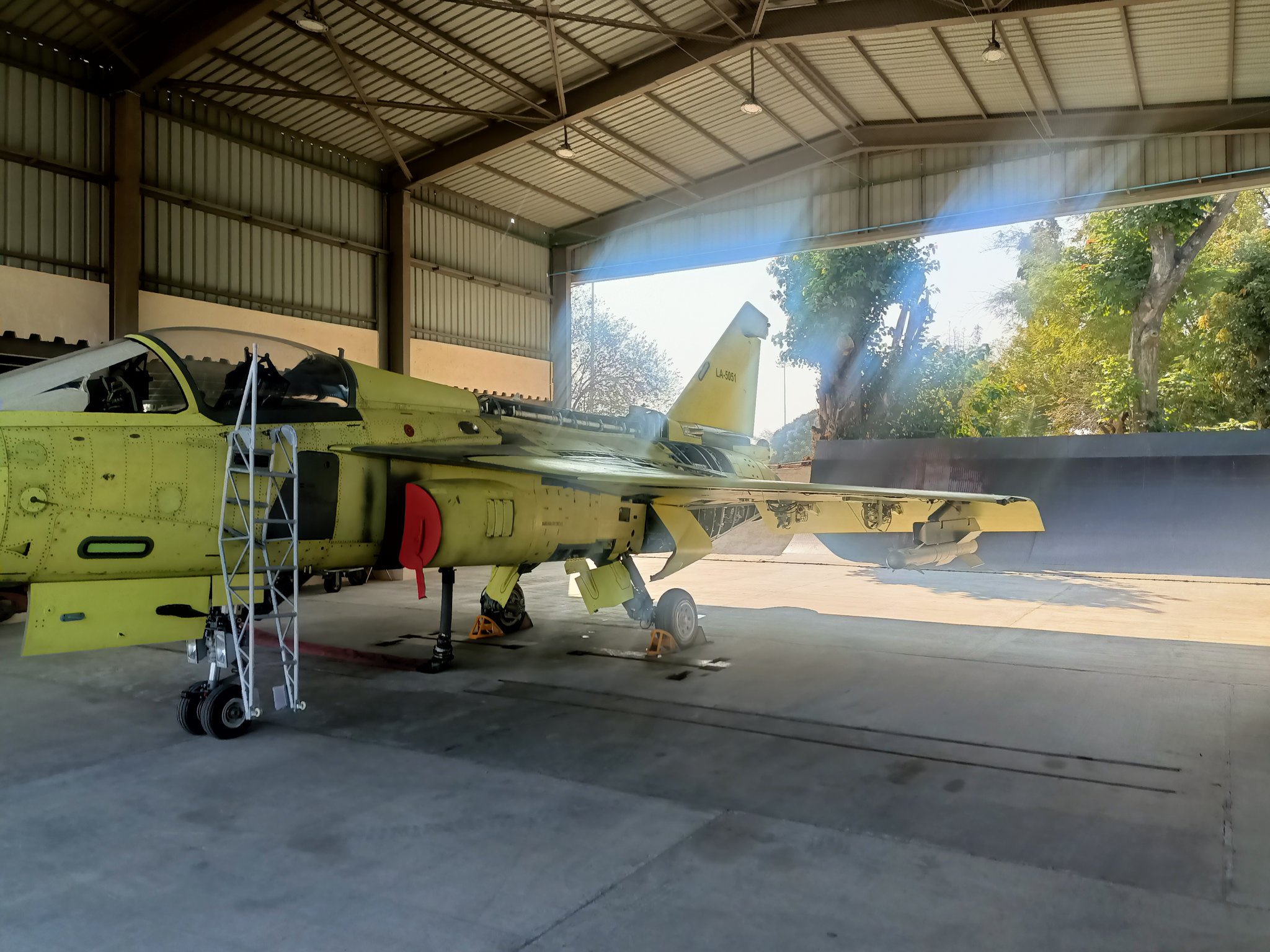
Once again, Tejas Mk1A has found itself at the centre of discussion after a photograph surfaced on social media. The image, showing an LCA Mk1A, was shared by Alpha Defense and several other defence portals and social media handles. What immediately stood out was the tail number visible on the aircraft is LA5051.
Tejas Mk1A tail numbers begin from LA5033, which makes the aircraft seen in the image the 19th airframe to have reached the coupling stage. This strongly suggests that around 19 aircraft have already been built, meaning that at least one full squadron exists on paper. Naturally, this leads to an obvious and uncomfortable question. If these aircraft are already built, why are they still not being delivered to the Indian Air Force? And why does HAL keep pushing timelines forward?
When “Manufactured” Is Not the Same as “Accepted”
An aircraft that has been fully coupled is considered complete from a manufacturing perspective. But from the Indian Air Force’s perspective, that same aircraft is incomplete until it meets every capability committed by HAL at the time of signing the contract. This distinction lies at the heart of the Tejas Mk1A issue.
The Air Force has already clarified that it will conduct a review in May, and only after being fully satisfied will it begin accepting deliveries. As a result, the first batch of Tejas Mk1A fighters — originally expected to enter service in March 2024 — is now unlikely to be inducted before June or July, even under the best-case scenario.
This delay also reflects the fact that HAL has already missed multiple timelines associated with the programme.
HAL’s Claims, and the Air Force’s Reservations
HAL continues to maintain that five Tejas Mk1A aircraft are ready for delivery, and based on the photograph, ten more airframes appear to be built. According to HAL, the remaining bottleneck is the delayed supply of engines from General Electric.
However, the Indian Air Force does not share this assessment.
According to sources, several issues remain unresolved, and in its current configuration, the aircraft does not fully meet ASQR — Air Staff Qualitative Requirements. The Air Force has therefore made it clear that it will not accept deliveries until HAL delivers the promised configuration and complete integration.
HAL, sources say, even offered the Air Force the option of accepting the aircraft in its present configuration, with assurances that weapon integration and radar-related work would continue later. There are precedents for such an approach.
Even the 36 Rafale acquired from France entered service without certain capabilities, including the X-Guard towed decoy.
But Tejas Mk1A is being treated differently and for a reason.
The Air Force has already waited for years, and with squadron strength steadily declining, Tejas Mk1A is expected to form the backbone of India’s future fighter/ Intercepter fleet. From the Air Force’s point of view, accepting an aircraft that is not fully ready after such prolonged delays would be a strategic compromise. Given the time already granted to HAL, this position is difficult to fault.
Integration, Engines, and the Real Bottleneck
Much of the technical debate has centred around Astra Mk1, the primary BVR missile for Tejas. HAL states that weapon trials are complete and that Astra has been integrated with the Israeli radar.
The Air Force, however, views integration more holistically. Integration is not merely about launching a weapon — it requires the radar to be fully synchronised with all onboard systems. According to the Air Force, full system-level integration has not yet been achieved.
Before any fighter is inducted, two non-negotiable steps must be completed.
First: all technical and integration issues must be resolved and certified.
Second: the aircraft must undergo acceptance trials, during which the Air Force flies and evaluates it in operational conditions a process that can take days or even weeks.
In this case, the Air Force is not the limiting factor. It urgently needs these aircraft. Its only condition is that they must be fully ready, because enough time has already been given.
HAL’s own statements indirectly reinforce this concern. The company has said that five aircraft are ready with major contracted capabilities, notably not “full” or “complete” capabilities.
HAL has also acknowledged that design and development issues are still being resolved, which inevitably raises questions about maturity and preparedness at this stage.
Beyond the first batch, the larger challenge lies in numbers, and that problem cannot be solved without engines.
When GE received the engine order in 2021, the F404 production line had already been shut down. A new line had to be restarted, but the COVID-19 pandemic disrupted global supply chains. As a result, GE has repeatedly missed commitments. So far, only five engines have been delivered, and none have arrived this year.
This engine shortage has become HAL’s single biggest challenge. The HAL Chief’s recent visit to GE’s production facility in the United States, and the opening of an additional production line, are attempts to resolve this bottleneck. The finalisation of the India–US trade deal is also expected to help streamline pending issues.
The current plan is to receive 24 engines by the end of the year. If four to five engines arrive by June or July, around ten aircraft could be delivered, since the airframes are already built.
If GE adheres to this schedule, the Indian Air Force could end the year with 24 Tejas Mk1A fighters. Until Tejas Mk2 or additional Rafales arrive, these aircraft — armed with Astra Mk1 and Mk2 — will be crucial in maintaining operational capability during a particularly fragile phase for the fighter fleet.