





















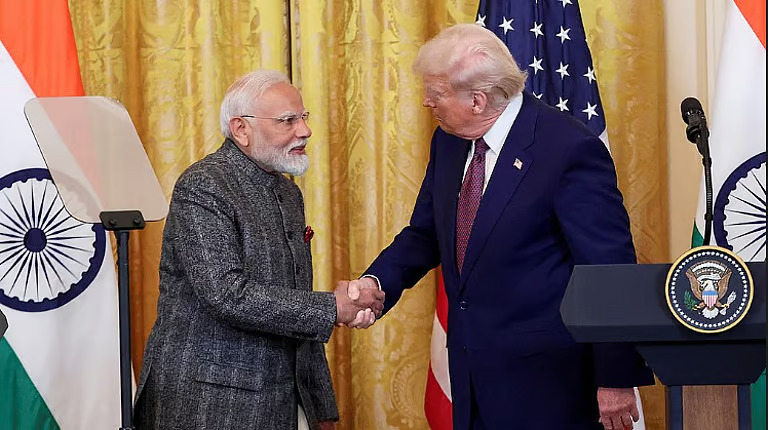
A significant shift in global trade dynamics is emerging after a high level Modi-Trump conversation reportedly paved the way for the United States to reduce tariffs on a range of Indian goods to 18 percent. The development signals a major economic opening for India at a time when global supply chains are being restructured and businesses are looking beyond China for reliable partners. The Modi-Trump engagement is being viewed not just as a diplomatic exchange but as a strategic economic move with long term implications for Asia and the wider world.
The tariff reduction gives Indian exporters a measurable pricing advantage in the American market. Sectors such as textiles, pharmaceuticals, engineering goods, auto components, and specialty chemicals are expected to benefit most. With the new rate undercutting several competing Asian economies, Indian manufacturers can now offer more competitive landed prices in the United States. Trade analysts say the Modi-Trump understanding could help India expand its footprint in product categories where China has traditionally dominated.
For India, the timing is critical. The country has been positioning itself as a global manufacturing hub through initiatives aimed at boosting domestic production and attracting foreign investment. Lower US tariffs align closely with these goals by improving market access to the world’s largest consumer economy. Following the Modi-Trump outreach, Indian industry bodies have expressed optimism that export volumes could see a steady rise over the next few quarters, especially if supply chains continue shifting away from single country dependence.
From the American perspective, the tariff adjustment reflects a broader strategy of diversifying sourcing partners. Policymakers in Washington have increasingly emphasized resilient supply chains, fair trade, and strategic partnerships with democratic nations. The Modi-Trump channel appears to have reinforced India’s role in that framework. By easing trade barriers, the US also gains from more stable sourcing options, competitive pricing, and deeper economic ties with a rapidly growing market of over a billion people.
China’s relative position may feel the impact most directly. Higher tariffs and geopolitical frictions have already complicated Chinese exports to the US in several sectors. With Indian goods now entering at more favorable rates, American importers may accelerate supplier diversification. Experts believe the Modi-Trump trade momentum could subtly alter purchasing patterns in electronics components, industrial inputs, and consumer goods where margins are sensitive to tariff differences.
Beyond immediate trade flows, the move carries symbolic weight. It suggests that sustained political communication can translate into concrete economic outcomes. The Modi-Trump equation has often been framed around strategic and security cooperation, but this development underlines the economic dimension of that relationship. Investors tend to interpret such signals as indicators of policy stability, which can encourage new investments in export oriented manufacturing in India.
Small and medium enterprises in India stand to gain as well. Many of these firms operate as suppliers within larger export value chains. Lower tariffs can improve order volumes and cash flows, helping them scale operations and invest in technology upgrades. Trade economists note that if the Modi-Trump initiative leads to more predictable trade terms, Indian companies may be more willing to commit to long term contracts with American buyers.
However, challenges remain. Tariffs are only one component of trade competitiveness. Logistics efficiency, quality standards, regulatory compliance, and currency movements will continue to influence export performance. Indian policymakers may need to complement the opportunity created after the Modi-Trump dialogue with domestic reforms that reduce production costs and improve ease of doing business. Without parallel improvements at home, part of the potential advantage could be diluted.
Diplomatically, the development reinforces the idea that bilateral ties can produce results even in a complex global environment. The Modi-Trump interaction highlights how personal leadership engagement can unlock bureaucratic processes that might otherwise move slowly. Observers suggest that continued engagement at multiple levels could open the door for further sector specific agreements in areas like technology, energy, and digital trade.
In the broader Asian context, the tariff reduction introduces a new competitive variable. Countries that have relied on preferential access or cost advantages may need to reassess their trade strategies. India’s growing integration with Western markets could reshape regional supply networks over time. If the momentum generated by the Modi-Trump exchange continues, it may mark the beginning of a more balanced trade architecture in which India plays a central role.
Ultimately, the tariff cut represents more than a percentage point adjustment. It reflects shifting geopolitical alignments, evolving economic priorities, and the increasing importance of trusted partnerships. Whether this leads to a sustained surge in Indian exports will depend on execution and follow through on both sides. For now, the outcome of the Modi-Trump conversation has clearly given India a stronger hand in the competitive landscape of global trade.