
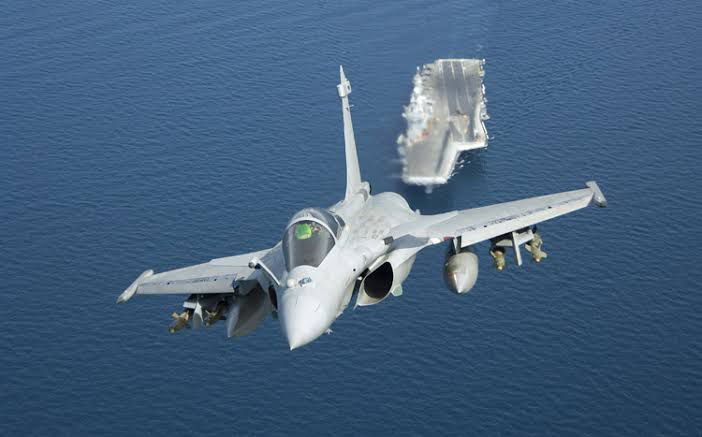
India is set to procure 31 Rafale-Marine (Rafale-M) aircraft for the Indian Navy, in addition to the 114 Rafales for the Air Force for which a deal is likely to be signed during President Emmanuel Macron’s visit to New Delhi later this month.
If the deal is finalised, then India’s total Rafale fleet will rise to 145 jets. French daily La Tribune confirmed the report and said that India could be looking to procure 31 Rafale Marine fighter jets to be operated from INS Vikrant and INS Vikramaditya.
As per reports, the order placed in April 2025 marked the first acquisition of the naval variant of the Rafale, making the country the first international operator of this model. The deal also covers pilot training, flight simulators, weapons, essential equipment, and long-term maintenance support.
The defence ministry had then said the acqusition of Rafale-M jets will also improve the Navy’s ability to prevent adversaries from gaining maritime domain awareness, weakening their ability to provide targeting information to other platforms.
Rafale-M is a powerful, advanced fighter jet designed to operate from aircraft carriers. Unlike regular fighter jets that take off from land, this aircraft can launch from and land on moving ships, even in tough sea conditions. At present, the Air Force operates two squadrons of Rafale jets.
Last April 2025, India and France signed a Rs 64,000 crore deal for 26 Rafale-Ms for the Navy, which also includes weapon systems, spares, and other ancillary equipment. The jets are expected to be deployed on the INS Vikrant and are likely to be delivered within five years.
Rafales to be Built in India
The Rafale, which is a 4.5-generation twin-engine multirole fighter aircraft designed by the Dassault Aviation, will be built in India as per the agreement. Of the 114 fighter jets, 18 will be delivered in a fly-away condition, and the rest will be manufactured in India.
According to ANI, Defence Secretary Rajesh Kumar Singh said that the 96 Rafales will be manufactured with 40 to 50 per cent localisation under the ‘Make in India’ initiative.
“It also enables us to induct fighter aircraft relatively quickly because the first of the Rafale Marines will start coming in ’28, and after that, over a period of time, you will see that about three and a half years from now, the first of these Air Force Rafales will also start coming,” Defence Secretary told ANI.
The agreement also allows for the integration of Indian weapon systems in the aircraft.
What About Indigenous Twin‑Engine Deck‑Based Fighter (TEDBF)?
The TEDBF project is India’s ambitious effort to build a home‑grown naval fighter tailored specifically for operation from aircraft carriers. It is designed around India’s own operational needs and industrial base, aligning with long‑term self‑reliance goals in defence manufacturing.
If the reports of this upcoming deal for Rafale-M jets are true, it could possibly undermine India’s efforts to come up with an indigenous deck-based fighter, the Twin Engine Deck-Based Fighter programme.
The TEDBF programme aims to develop a home-grown 4.5-generation carrier-based multirole fighter for the Indian Navy, led by the Aeronautical Development Agency (ADA) in collaboration with Hindustan Aeronautics Limited (HAL).
Although unconfirmed by the Indian side, if the reports of India seeking more Rafale-M jets are true, there are apprehensions that this could pose a risk to the TEDBF programme, even as the programme is expected to undergo a Critical Design Review (CDR) this year.
How Rafale‑M Orders Affect TEDBF?
With the 31 + 26 Rafale‑M orders, the Navy’s fleet will consist of around 57 Rafale‑M fighters along with 45 MiG‑29Ks. This combination is widely assessed as sufficient for the two existing STOBAR carriers in the medium term, covering air defence, strike and reconnaissance roles without waiting for TEDBF.
Because of this short‑term capability needs are met and Rafale‑M fills the current gap and strengthens carrier air wings now. Moreover, the urgency to deploy an indigenous fighter immediately has eased, but this also means TEDBF must justify its role as a long‑term platform rather than a near‑term replacement.
Also, instead of plugging a capability gap now, TEDBF must now compete on future capability, advanced technology and lifecycle cost advantages over Rafale‑M imports.
In effect, TEDBF remains India’s long‑term vision for indigenous carrier fighters, but its induction is years away and the new Rafale‑M fleet ensures the Navy is not left without modern aircraft in the interim.