


















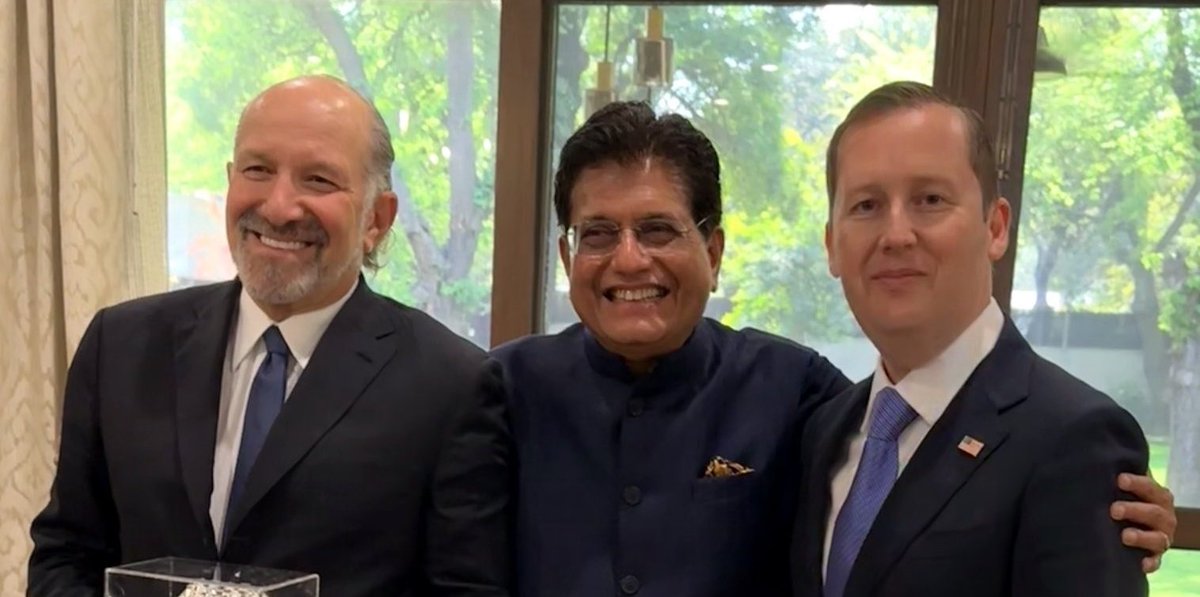
In the wake of a major judicial setback to Washington’s trade policy, US Commerce Secretary Howard Lutnick made an unplanned visit to New Delhi on Thursday and held what both sides described as a “highly productive” lunch meeting with India’s Commerce and Industry Minister Piyush Goyal. The engagement came days after the Supreme Court of the United States struck down sweeping global tariffs imposed earlier by former President Donald Trump, disrupting a carefully negotiated India-US trade timeline.
The meeting took place at a sensitive moment for bilateral ties, as both countries sought to navigate legal uncertainty and stabilise economic relations following the court’s February 20 verdict.
Diplomatic Signals and Official Responses
The development was confirmed through posts on X by the US Ambassador to India, Sergio Gor, and Goyal. Sharing a photograph from the meeting, Gor said, “A highly productive lunch with @howardlutnick and @PiyushGoyal. So many areas of cooperation for our two nations!” Goyal echoed the sentiment, stating that he had “engaged in very fruitful discussions to expand our trade and economic partnership.”
According to a statement from the US Commerce Department, the two sides “discussed ways to deepen the trade and economic relationship between the United States and India.”
Later in the day, Lutnick travelled to Jodhpur to attend the wedding of Ayesha Arora, daughter of technology executive Nikesh Arora, and Jack Hughes, according to people familiar with the matter.
Tariff Ruling Alters Trade Trajectory
The Supreme Court invalidated Trump’s use of emergency powers under the International Emergency Economic Powers Act to impose tariffs, forcing his administration to seek alternative legal routes. Trump subsequently invoked Section 122 of the Trade Act of 1974 to impose a fresh 10 percent global tariff, with provisions to raise it to 15 percent.
As of Thursday, the levy stood at 10 percent on all trading partners, over and above prevailing most-favoured-nation rates, and remains valid for 150 days.
The ruling upended an existing framework under which Indian goods faced combined reciprocal and punitive duties of up to 50 percent. A February 6 joint statement had envisaged reducing these to 18 percent in return for India restricting Russian crude imports and granting preferential access to selected American products.
India’s chief negotiator, Darpan Jain, and his team were scheduled to visit Washington from February 23 to finalise the legal text of the interim agreement. The visit was postponed after both sides agreed to “evaluate” the ruling and its implications. The first phase of the deal had been expected to be signed next month.
Legal Limits and Global Impact
Constitutional expert Abhishek Rastogi said tariff arrangements must respect constitutional limits. “The authority of the executive to agree on tariff rates is not unfettered,” he said. “Any tariff commitment that exceeds statutory delegation or violates constitutional limits would be legally unsustainable.”
He added that tariff-setting authority rests with Congress, not the executive.
Meanwhile, Trump has warned countries to honour existing agreements and threatened higher duties on nations that “play games”. The lack of clarity has triggered confusion worldwide, prompting governments and corporations to reassess their trade exposure. Major partners, including India and the European Union, have paused negotiations.
With an interim agreement unsigned and fresh tariffs in place, Lutnick’s surprise visit highlights India’s growing centrality in shaping the next phase of India-US trade relations amid a shifting global order.