
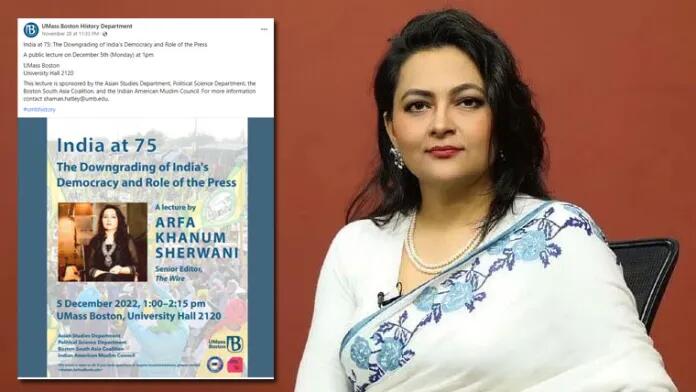
The recent encounter between Hindu women in Noida’s Sector 15A and Arfa Khanum Sherwani — senior editor with The Wire — has drawn fresh attention to the deep fractures in Indian public discourse around religion, media narratives, and local civic issues. At the centre of the debate was a seemingly simple demand: the construction of a temple on a designated plot in a local park — a demand that Hindu women in the community insisted was legitimate and long overdue, and which they argued should not be twisted into a broader “majoritarianism” controversy by external commentators.
Local Hindu women made headlines on Sunday when they decisively challenged Arfa Khanum’s framing of the dispute as an example of “Hindu majoritarianism,” a term she repeatedly used in her questions during the interaction in Sector 15A. They emphasised that their call for a temple was grounded in the area’s demographic realities — where a large majority of residents are Hindus and have been requesting a place of worship for decades — and not some abstract political ideology.
This episode, though anchored in a single neighbourhood’s protest, highlights broader tensions in how media outlets like The Wire and their commentators approach issues of public space and religion in India. Arfa Khanum’s attempts to cast the desires of Hindu women as an exclusionary demand were met with palpable pushback, as residents challenged both her questions and her underlying assumptions. One woman responded to her queries about religious rights of minorities by simply saying that “first, let us think about the 90 per cent” of residents who are Hindus — a statement that encapsulated the grass-roots sentiment in the community.
Critics argue that such media interventions often overlay national ideological battles on genuine local concerns. Arfa Khanum’s focus on concepts like “majoritarianism” failed to resonate with Hindu women who had long wanted access to a temple for daily worship and community life. One of them underscored that the parkland had originally been earmarked for a temple in Noida’s master plan some 40 years ago, making the demand less about politics and more about fulfilling an existing civic provision.
The exchange between Arfa Khanum and the local residents also spotlighted a disconnect in the interpretation of democratic principles. While she introduced ideas of referendums and equal consideration for different religious structures, Hindu women pointed out that this was a local issue concerning only those who live and pay for improved neighbourhood amenities. “Don’t bring democracy into this,” one resident insisted, arguing that imposing broad political ideologies on a community’s internal matter was neither helpful nor necessary.
It is worth recognising that this conversation is embedded in a broader context where media narratives frequently shape public perception of religious debates across India. For many, the story of Hindu women asserting their community’s voice against an external framing reflects a frustration with what they see as selective scrutiny — where demands by majority communities are labeled negatively while similar asks from minorities are framed as rights. This perceived inconsistency fuels sentiments that local concerns are often misinterpreted through the lens of ideological conflict rather than civic engagement.
Moreover, these events unfold against a backdrop of legal and administrative complexities. While a considerable section of residents supports the temple demand, others in the locality — including environmental activists and concerned citizens — argue that the land should remain parkland and not be used for any religious structure at all. A petition has been filed in the Allahabad High Court opposing the land’s use for a temple, illustrating that this is not a monolithic issue even within the locality.
Notwithstanding these legal contests, the immediate interaction drew national attention because it appeared to many that Arfa Khanum was inserting herself and a broader media narrative into a matter that locals wished to keep straightforward: the right to a temple in their own neighbourhood. Hindu women, in particular, expressed irritation at what they saw as an attempt to make them feel as though wanting to worship was somehow a crime, when for them it was simply a cultural and spiritual necessity.
In the final analysis, the response of Hindu women in Sector 15A illustrates a deeper yearning across many Indian communities to be heard on their own terms. Their interaction with Arfa Khanum serves as a microcosm of a larger debate about the role of media, the interpretation of democracy, and the significance of religious identity in public life. Whether one agrees with the demand for a temple or not, the discourse around it — and the way it was reported — raises critical questions about how narratives are constructed and whose voices are amplified.
As India navigates these complex intersections of religion, media, and civic space, stories like this underscore the need for nuanced engagement rather than reductive labels. The insistence of Hindu women that their demands be understood in the context of their lived experience — not cast through the prism of national ideological battles — reflects a call for more grounded dialogue in a time of heightened polarization.