




















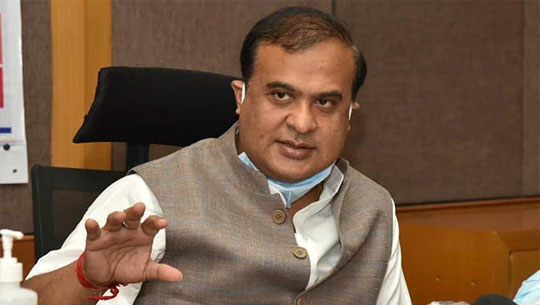
Assam’s political landscape has once again been stirred by strong remarks from Chief Minister Himanta Biswa Sarma, who has taken an uncompromising position on the issue of illegal immigration. Declaring that no political pressure could deter his resolve, Himanta Biswa Sarma stated that those identified as illegal Bangladeshi infiltrators would have to leave Assam. The statement has reignited a long standing and emotionally charged debate in the state, drawing both applause from supporters and criticism from opponents.
Illegal migration has shaped Assam’s politics for decades. Concerns over demographic change, cultural preservation, and access to land and jobs have influenced elections, movements, and policy decisions. Himanta Biswa Sarma has consistently framed the issue as central to protecting the identity and rights of indigenous communities. His recent comments signal that his government intends to continue a strict approach, arguing that unresolved migration questions threaten social balance and administrative fairness.
The historical roots of this issue go back many decades, including the period that led to the Assam Agitation, when large sections of the population demanded the detection and removal of foreigners. That movement left a deep imprint on public consciousness. Today, Himanta Biswa Sarma positions himself as a leader carrying forward those sentiments, promising decisive governance where earlier efforts were seen by some as slow or ineffective.
His remarks also carried a sharp political edge at the national level. By suggesting that even a thousand Rahul Gandhis could not stop his government’s course, Himanta Biswa Sarma portrayed the matter as one of principle rather than partisan negotiation. The comment reflects the broader polarization in Indian politics, where regional issues often become part of a larger ideological contest between ruling and opposition parties.
A central challenge remains the identification of illegal immigrants. Assam has already undergone the complex process of updating the National Register of Citizens, an exercise that involved millions of documents and years of verification. The process revealed how difficult it can be to establish citizenship in regions with long histories of migration, displacement, and poor record keeping. While Himanta Biswa Sarma emphasizes enforcement, legal experts note that each case requires due process, documentation checks, and avenues for appeal.
The language used in political discussions has also drawn attention. References to specific community labels have sparked debate over whether such terms deepen divisions. Supporters argue that Himanta Biswa Sarma is addressing realities that people on the ground discuss openly, while critics caution that leaders must ensure their words do not stigmatize lawful citizens who share cultural or linguistic traits with migrants. This tension highlights how identity and legality often intersect in sensitive ways.
Security concerns form another pillar of the government’s position. Border management in the northeast is a complex task involving terrain, riverine stretches, and international boundaries. Authorities argue that unchecked migration can complicate law enforcement and strain public resources. Himanta Biswa Sarma has linked stronger action on suspected illegal residents with broader governance goals, including accurate delivery of welfare schemes and better planning of state resources.
Economic arguments also play a role. Proponents of strict measures say population pressure affects land availability, employment opportunities, and public infrastructure in a state that is still developing. They believe firm implementation of citizenship laws protects opportunities for local youth. Opponents respond that migration is often driven by economic necessity and that long term solutions require development, education, and regional cooperation alongside legal enforcement.
The tone of modern political communication amplifies such debates. Statements by leaders like Himanta Biswa Sarma quickly spread across television and digital platforms, shaping perceptions far beyond Assam. Strong rhetoric can energize supporters who feel their concerns are finally being voiced, but it can also heighten anxiety among communities who fear being targeted unfairly. Balancing assertive governance with social harmony remains a delicate task.
Legal and diplomatic realities will ultimately shape outcomes. Identifying a person as an illegal foreigner involves tribunals, courts, and documentation. Deportation processes require confirmation of nationality and coordination with other governments. Even as Himanta Biswa Sarma signals firmness, the path forward must operate within constitutional frameworks and judicial oversight.
The renewed focus on immigration shows that Assam’s political identity continues to revolve around questions of belonging and rights. Himanta Biswa Sarma has placed himself firmly at the center of this debate, projecting resolve and clarity of purpose. Whether this approach leads to durable solutions or further contention will depend on how policies are implemented on the ground and how effectively the state balances enforcement with fairness.
In a region shaped by centuries of movement, trade, and cultural exchange, the conversation about migration remains complex. The latest statements ensure that the issue will stay prominent in public life, reflecting both the anxieties and aspirations of Assam as it navigates its future.