






















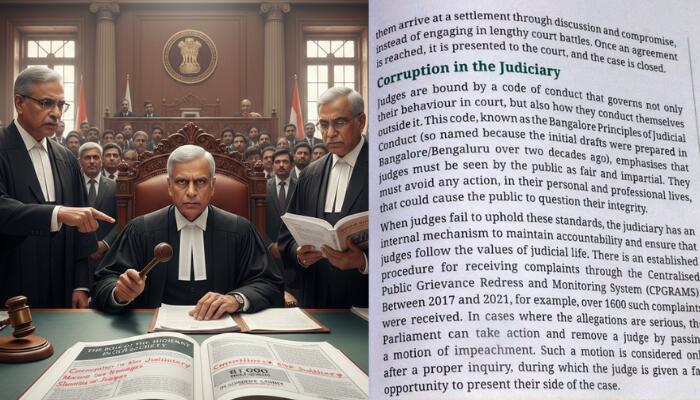
The Supreme Court of India has raised strong objections to the National Council of Educational Research and Training (NCERT) Class 8 social science textbook for including a section on “corruption in the judiciary.” Chief Justice of India Surya Kant described the inclusion as a “calculated move” and declared that he would not allow anyone to defame or denigrate the institution, assuring that the law will take its course.
The matter was brought to the CJI’s attention by senior advocates Kapil Sibal and Abhishek Manu Singhvi, who expressed deep concern over young students being taught about judicial corruption. “The NCERT is teaching Class 8 students about judicial corruption. This is a matter of grave concern. We are here for the bar,” Sibal said. CJI Kant confirmed that he had taken cognisance and issued a suo motu order. He noted that members of the bar, the bench, and even High Court judges were perturbed by the textbook content, and he had received numerous calls and messages regarding the issue.
Chapter Highlights Systemic Challenges
The controversy centres on the chapter titled “The Role of the Judiciary in Our Society,” which moves beyond explaining the court system to examine systemic issues affecting justice delivery. The textbook lists corruption at various levels, massive case backlogs, and a shortage of judges as major challenges. It estimates approximately 81,000 pending cases in the Supreme Court, 62.4 lakh in high courts, and 4.7 crore in district and subordinate courts.
The book also notes that judges are bound by a code of conduct governing their behaviour in court and outside it, and that corruption disproportionately affects the poor and disadvantaged, limiting access to justice. Accountability mechanisms such as the Centralised Public Grievance Redress and Monitoring System (CPGRAMS), which received over 1,600 complaints between 2017 and 2021, are highlighted as efforts to improve transparency. Former Chief Justice B R Gavai is quoted as warning that corruption erodes public confidence, but swift and transparent action can restore trust in the judiciary.
Earlier editions of the textbook primarily focused on the organisation of courts, judicial independence, and delays affecting access to justice, without mentioning corruption. Senior advocate Singhvi criticised the selective focus on judicial corruption, noting it ignored similar issues in politics, bureaucracy, and other public institutions. Justice Bagchi observed that the textbook failed to uphold constitutional integrity in its structure.
NCERT has temporarily made the Class 8 textbook unavailable for sale while the issue is addressed. The Supreme Court’s intervention underlines the judiciary’s commitment to protecting its credibility and ensuring students are educated responsibly about the justice system.