













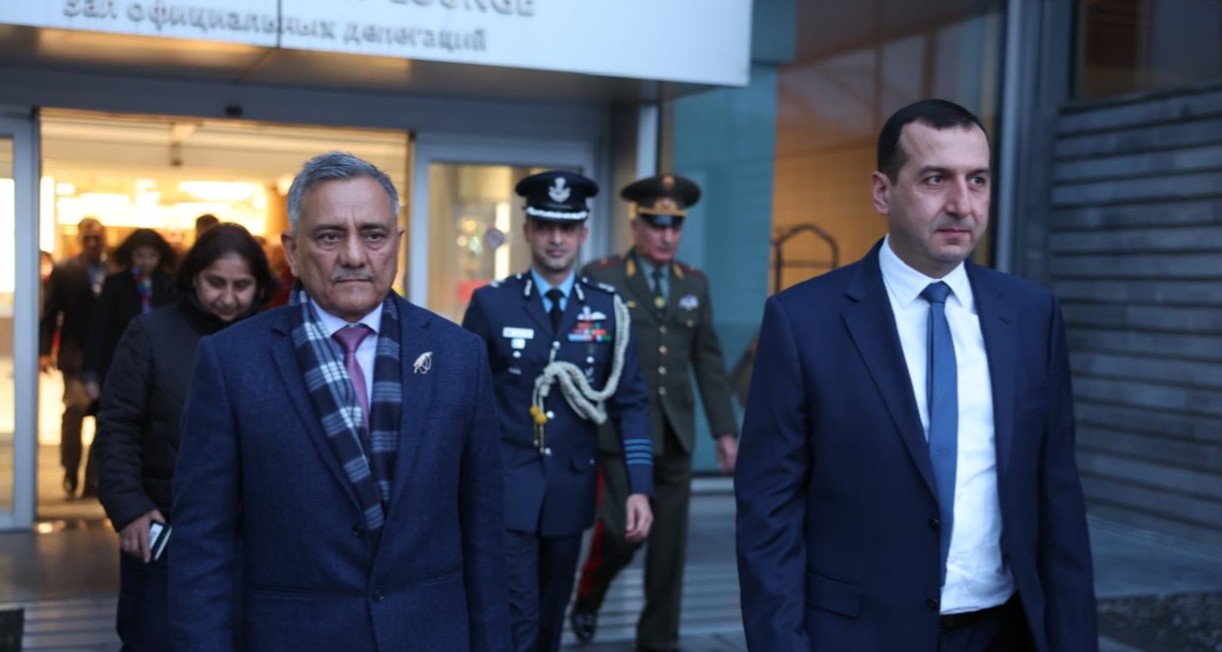
In a first-of-its-kind engagement by senior Indian military leadership, Chief of Defence Staff General Anil Chauhan is leading a high-level defence delegation on a four-day official visit to Armenia aimed at strengthening bilateral defence engagement and long-term security cooperation.
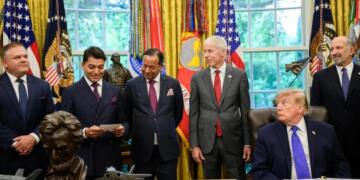
General Chauhan arrived in Armenia on February 1 and was accorded a ceremonial welcome by the Armenian Armed Forces. He was presented with a Guard of Honour accompanied by an impressive military band display at the administrative complex of the Ministry of Defence in Yerevan.
The arrival of the Indian defence delegation was announced by Headquarters Integrated Defence Staff (HQ IDS) on X, stating that General Chauhan reached Armenia for a four-day official visit focused on advancing shared strategic interests and reinforcing long-term defence and security cooperation.

As per reports, the visit also follows a steady deepening of defence engagement between India and Armenia over recent years, shaped by Armenia’s changing security requirements and India’s push to expand defence exports.
General Chauhan, in his visit, laid a wreath at the Armenian Genocide Memorial and Museum in Yerevan, honouring the memory of 1.5 million Armenians who lost their lives in the genocide.
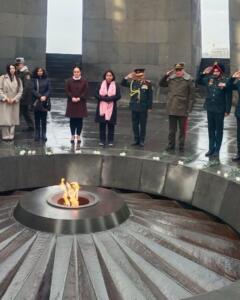
“The Memorial’s symbolic structures and the adjoining museum stand as a poignant testament to human suffering, resilience and the universal importance of remembrance, justice and peace,” said the HQ IDS in a post.
The Armenian Genocide
The Armenian Genocide refers to the systematic mass killing and forced deportation of Armenians by the Ottoman Empire during World War I (1915–1917). Historians estimate that up to 1 – 1.5 million Armenians — a Christian ethnic minority within the predominantly Muslim empire — were killed or died from starvation, disease and exhaustion during death marches out of their historic homelands in Eastern Anatolia.
Scholars consider this one of the first major genocides of the 20th century, with documented evidence from eyewitnesses, official archives, diplomatic reports and survivor testimony supporting the conclusion that it was a centrally planned, ethnically targeted extermination campaign against Armenians.
The genocide carries profound historical and moral weight because it targeted a distinct ethno-religious group (Armenian Christians) for annihilation and has shaped the identity and collective memory of Armenians worldwide. Recognition and remembrance remain central to Armenian national consciousness and diplomacy.
However, modern Turkey (the successor state of the Ottoman Empire) has consistently rejected the term “genocide” for these events and disputes key aspects of the historical record. The Turkish government argues that the deaths occurred in the broader context of World War I upheavals and civil strife, not as a deliberate, centrally directed campaign to exterminate Armenians. Turkish officials have characterised such labels as legally and morally problematic and have resisted international recognition efforts.
This denial has persisted for more than a century. Successive Turkish governments have maintained that there was no genocidal intent and that Armenians were relocated for security reasons amid war conditions. These narratives have been reinforced through education, diplomacy and state policy, and have contributed to ongoing controversy and political tension between Turkey and Armenia, as well as between Turkey and countries that recognise the genocide.
Defence Cooperation Core Pillar of India–Armenia Ties
India–Armenia relations are heavily anchored in defence cooperation, with military cooperation forming one of the key pillars of their strategic convergence. India has become a major supplier of weapons and military systems to Armenia, marking a shift in Yerevan’s defence procurement away from its traditional reliance on other sources.
Since around 2020, Armenia has signed significant defence contracts with India involving major weapon systems. These include Pinaka multi-barrel rocket launchers, Akash surface-to-air missiles, artillery guns, anti-tank missiles, radar systems and other ammunition. The deals collectively run into hundreds of millions to potentially over a billion dollars and reflect India’s emergence as a key military supplier to Armenia.
Armenia’s security needs and regional tensions—especially with neighbouring Azerbaijan and Turkey—have pushed it to diversify its defence partnerships. India’s willingness to supply advanced military hardware and possibly consider future collaborations (including co-development of systems and long-term credit arrangements) aligns with Armenia’s strategic requirement for reliable partners.
As per reports, Armenia’s armed forces have historically relied heavily on Soviet- and Russian-designed military equipment, and this shared legacy has created a natural basis for deeper defence cooperation with India.
Both countries operate and maintain substantial inventories of Russian-origin platforms, and Armenia has explicitly expressed interest in learning from India’s experience in modernising and operating Soviet/Russian equipment, as well as integrating it with newer systems.
Armenian defence officials have noted that India’s successful adaptations of Russian-made systems are “very impressive,” underlining how common operational backgrounds make cooperation practical and beneficial for Yerevan.
Turkey, Pakistan, Azerbaijan Trilateral Cooperation
Turkey, Pakistan and Azerbaijan have developed increasingly close strategic and defence ties in recent years, underpinned by shared geopolitical orientations and mutual support on key regional issues.
The three countries have referred to themselves informally as “three brothers,” a term that reflects historical goodwill and diplomatic solidarity, particularly since Turkey and Pakistan quickly recognised Azerbaijan’s independence after the collapse of the Soviet Union and have supported Baku politically and militarily.
As pre reports, this trilateral cooperation has been manifested in several concrete defence and security developments. During the 2020 Nagorno‑Karabakh conflict, both Turkey and Pakistan provided active military and diplomatic support to Azerbaijan, strengthening defence ties among all three.
Beyond purely military ties, the three states are exploring cooperation in digital infrastructure and cybersecurity, aiming to enhance regional digital ecosystems and resilience.
The growing Turkey–Azerbaijan–Pakistan trilateral partnership has significant implications for India’s regional security and defence posture. The three countries maintain close military, technological, and strategic cooperation, including joint exercises, arms sales, fighter jet programs, and coordination in conflicts such as the 2020 Nagorno‑Karabakh war.
Pakistan, in particular, has long-standing security and defence ties with both Turkey and Azerbaijan, with Turkish technology increasingly integrated into Pakistani weapons systems, which are sometimes shared or exported to Azerbaijan.
Notably, in context of India’s evolving strategic posture, New Delhi’s growing partnership with Armenia is increasingly seen as an open expression of India’s position compared to the trilateral alignment of Pakistan, Azerbaijan and Turkey.
India Strengthens Armenia’s Defence Arsenal
Among India’s most significant defence exports to Armenia is the Akash-1S air defence missile system, with Yerevan becoming the first foreign country to induct the platform. This acquisition marked Armenia’s first major purchase of an Indian surface-to-air missile system and was aimed at addressing critical gaps in its air defence network.
In early 2020, Armenia also placed an order for four Swathi weapon-locating radars from India under a contract valued at approximately Rs 300 crore, with deliveries commencing the following year.
In 2022, Armenia signed a major contract for four batteries of the Pinaka multi-barrel rocket launcher system, in a deal estimated at around Rs. 2,000 crore. The agreement covers the launchers, command-and-control vehicles, logistics support vehicles, and associated ammunition, including guided rockets.
Recently, Defence Minister Rajnath Singh flagged off the first consignment of guided Pinaka rockets for Armenia, which were manufactured by Pune-based Solar Defence and Aerospace Limited.
Reports also indicate that Armenia has expressed interest in procuring additional Indian missile systems, including the indigenous Astra beyond-visual-range air-to-air missile, and has explored options for upgrading its Sukhoi-30 fighter jets. These topics are expected to feature prominently in discussions during the current visit.