
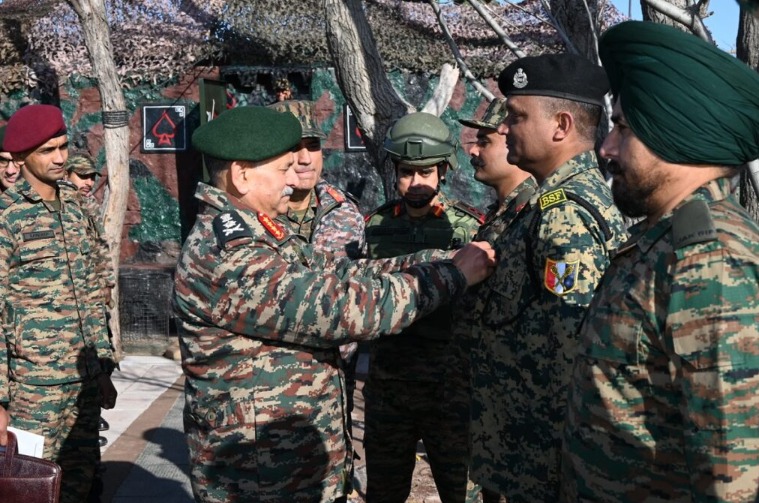
On the first day of his visit, Indian Army Chief General Upendra Dwivedi reviewed security arrangements at the White Knight Corps headquarters in Jammu and in the Nagrota sector. He was briefed on counter-terrorism preparedness, troop deployment and the functioning of the Counter Insurgency Force (R). Senior officers apprised him of surveillance mechanisms, intelligence inputs and the use of advanced technologies to strengthen border management.
The Army Chief stressed the importance of constant alertness, inter-agency coordination and technological support to deal with emerging security challenges. He underlined that close cooperation among security forces and civil authorities remains crucial for maintaining peace and stability in the region.
General Dwivedi visits forward areas in Poonch–Rajouri, lauds troops’ morale and operational preparedness
During the second day, General Dwivedi visited several forward posts in Poonch and Rajouri under the White Knight Corps. He reviewed counter-terrorism operations, deployment patterns and the effectiveness of the security grid along the Line of Control. Officers briefed him on operational readiness and the integration of intelligence and surveillance systems.
Interacting with soldiers posted in difficult terrain, the Army Chief praised their high morale, professionalism and commitment despite harsh weather conditions and continuous operational pressure. He said their dedication reflected the Army’s continued focus on safeguarding borders and ensuring stability in sensitive frontier areas.
Veteran honoured during Army Chief’s visit, highlighting enduring civil-military bond in border regions
A key moment of the visit came when General Dwivedi stopped at Kamsar village in Poonch and met retired Subedar (Honorary Captain) Parvez Ahmed of 18 Jammu and Kashmir Rifles. The two had served together between 2002 and 2005, when General Dwivedi was commanding the battalion. After nearly two decades, they shared a warm reunion, drawing attention from soldiers, villagers and officials present at the site.
Parvez Ahmed joined the Indian Army in March 1991 and retired in March 2019. Official records indicate that he completed over 28 years of service. During his career, he served in multiple operational areas and training institutions and earned recognition for his work as an instructor and field soldier.
Even after retirement, Ahmed remained closely associated with the Army and the local community. During Operation Sindoor, he assisted deployed troops by facilitating logistics, coordinating with villagers and sharing local intelligence. Officials said his familiarity with the terrain and people helped security forces in gathering timely information, reinforcing the role of veterans as the “eyes and ears” of the Army in border areas.
His contribution also extended to strengthening civil-military relations and supporting developmental activities in the region, reflecting the role of ex-servicemen in nation-building efforts.
In recognition of his service and continued support, General Dwivedi presented Ahmed with the Veteran Achiever Award. The ceremony was attended by his family members, fellow veterans, local residents and Army officials.
The Army Chief also interacted with other ex-servicemen, Veer Naris and representatives of the civil administration in Poonch. Discussions focused on welfare schemes, community outreach programmes and the participation of veterans in social and developmental initiatives.
Officials said the interactions highlighted the strong bond between serving personnel, former soldiers and civilians in border districts. Retired servicemen continue to play an important role by sharing local knowledge, supporting intelligence efforts and strengthening trust between the Army and local communities.
General Dwivedi’s visit reaffirmed the Army’s focus on maintaining high operational readiness while promoting cooperation, technological modernisation and community engagement in Jammu and Kashmir’s frontier regions. The tour also reflected the institution’s long-standing tradition of recognising lifelong service and sustaining bonds beyond active duty.