
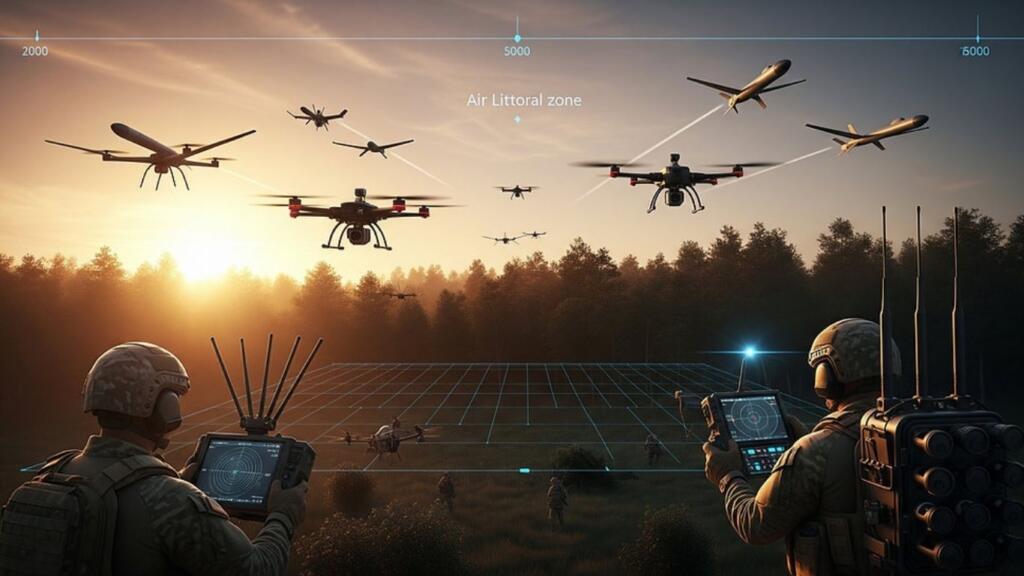
India’s terrain ensures that future conflicts will be fought where air and land are inseparable.
For decades, air power debates in India have been framed around strategic bombing, air superiority, and long-range strike, domains traditionally led by the Indian Air Force (IAF).
Yet India’s most likely wars will not be decided at 40,000 feet or by deep-penetration missions alone. They will be decided much closer to the ground, in the air littoral, the contested layer of airspace stretching from treetop height to a few thousand metres above the battlefield.
In India’s geography, this air littoral is not an abstract concept. It sits over Himalayan ridgelines along the Line of Actual Control (LAC), narrow valleys in Ladakh and Arunachal Pradesh, forested terrain in the Northeast, and densely populated belts along the Line of Control (LoC).
Control, or loss, of this airspace will directly determine whether Indian land forces can move, concentrate, resupply, and survive. This makes the air littoral fundamentally a land forces problem, even though it demands joint solutions.
India’s Wars Will Be Fought Where Air Meets Land
India’s strategic reality limits the likelihood of large-scale manoeuvre warfare on open plains.
Against China, combat will unfold in high-altitude terrain where roads are few, logistics fragile, and every ridgeline dominates movement below.
Against Pakistan, the LoC’s broken terrain, forests, and settlements create a cluttered battlespace where air and land overlap continuously.
Think-tank studies on Himalayan warfare consistently underline one fact: terrain compresses airspace. Mountains force aircraft, helicopters, drones, and missiles into predictable corridors. Valleys funnel movement. Weather reduces visibility and sensor performance.
In such conditions, the distinction between “air” and “land” operations collapses. Every infantry battalion, armoured column, and artillery unit becomes visible and vulnerable from the air.
Modern conflicts have shown that this vulnerability no longer comes only from fighter aircraft. It comes from small drones, loitering munitions, quadcopters, and low-flying UAVs operating persistently in the air littoral. For Indian ground forces, this changes the character of combat fundamentally.
Drones Have Ended the Era of Safe Movement
Indian Army and IAF leadership have publicly acknowledged that drones now dominate the modern battlefield. From Ukraine to Nagorno-Karabakh to Gaza, the lesson is clear: uncontested air littoral means no safe movement on land.
In mountainous terrain, this problem is magnified. A single observation drone hovering over a valley can expose supply convoys, artillery gun positions, troop concentrations, and command posts.
Loitering munitions can then exploit this targeting data in near-real time. Unlike traditional air threats, these systems are cheap, numerous, and difficult to detect.
For Indian land forces operating along the LAC, where logistics chains stretch over hundreds of kilometres, and roads hug valley floors, persistent aerial surveillance is a direct threat to operational viability.
Even without kinetic strikes, drones deny concealment. They slow movement, disrupt tempo, and impose psychological pressure on troops.
This is why the air littoral cannot be treated as an IAF-only concern. The Indian Army is the force that lives and fights permanently inside this contested layer of airspace.
Integrated Air Defence Is No Longer Optional
Open-domain material on India’s counter-drone and integrated air defence efforts shows growing recognition of this reality.
Systems such as Akash, Spyder, VSHORADS, indigenous counter-UAS solutions, and radar-electro-optical networks are increasingly discussed not as strategic assets, but as tactical enablers for ground forces.
In high-altitude warfare, air defence is not about protecting cities or air bases alone. It is about:
• Shielding forward posts and staging areas
• Securing mountain passes and logistics nodes
• Enabling artillery to survive counter-battery and drone spotting
• Allowing reserves to move without being immediately detected
This requires layered air defence deployed with manoeuvre units, not parked far behind the front. Short-range air defence, electronic warfare, soft-kill counter-drone systems, and camouflage/deception must be embedded into brigade and division-level operations.
The Indian Army’s repeated emphasis on drones and air defence in official statements reflects this shift. The Army understands that without control of the air littoral, even the most capable infantry will be pinned down, attrited, and outmanoeuvred.
Mountains Make the Air Littoral a Ground Commander’s Battle
In plains warfare, airspace can be vertically segmented. In the mountains, it cannot. Peaks dominate valleys, and aircraft are forced lower. This brings air assets into direct interaction with ground-based weapons and sensors.
For ground commanders, this means that air littoral dominance becomes a prerequisite for manoeuvre, not a supporting function. A brigade advancing along a valley axis must assume constant aerial observation.
A defensive position on a ridgeline must expect drone-guided fires. Artillery cannot displace freely without aerial cover or denial.
This is why the angle that matters most is operational, not doctrinal. Control of the air littoral determines whether land forces can do their job at all. If they cannot move, hide, or concentrate, they cannot seize or hold terrain, the decisive act in India’s wars.
Jointness Driven From the Ground Up
This is not an argument against jointness. On the contrary, it reinforces it, but with a crucial distinction. The air littoral challenge must be driven by ground operational needs, not by platform-centric thinking.
The IAF brings essential capabilities: air surveillance, strike, electronic warfare, and integrated air defence command and control. But the demand signal comes from the Army.
It is the soldier on the ridge, the artillery commander in the valley, and the logistics officer on a mountain road who feel the consequences of air littoral dominance or its absence.
Effective joint solutions will therefore require:
• Integrated Army–IAF air defence planning at the tactical level
• Shared sensor networks linking ground radars, UAVs, and airborne platforms
• Clear rules for airspace management in congested, low-altitude environments
• Training that treats drones and counter-drones as everyday battlefield realities
Without this integration, India risks repeating a dangerous assumption: that air control can be switched on when needed. In the air littoral, control is continuous, contested, and unforgiving.
Strategic Implications for India’s Future Wars
India’s terrain ensures that wars will still be decided on land, by who controls ridgelines, valleys, and choke points. But whether land forces can fight effectively will depend on who controls the air littoral above them.
Against China, this will shape any future LAC crisis, where escalation may be limited, but surveillance and precision strike will be intense. Against Pakistan, it will define the survivability of forward deployments along the LoC under constant drone pressure.
In both cases, the lesson is the same: the air littoral is where strategy meets tactics, and where neglect is punished immediately.
The Air Littoral Belongs to the Soldier
India’s future wars will not allow a neat separation between air and land domains. The air littoral — low, crowded, and lethal — will be the most contested layer of the battlefield. While air power remains vital, the problem it must solve is fundamentally a land forces problem.
For the Indian Army, contesting, defending, and integrating the air littoral is no longer optional. It is the price of manoeuvre, survivability, and victory in the mountains and dense terrain that defines India’s strategic geography.
In the end, wars will still be decided by soldiers on the ground. But whether they can fight at all will depend on who controls the air just above their heads