




















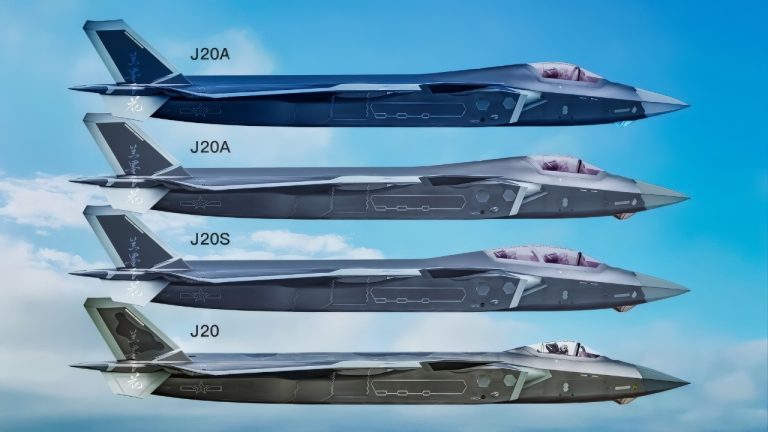
The debate over the future of global air power has intensified as China accelerates the expansion of its fifth-generation fighter force. Central to this discussion is the rapid growth of the J-20 Fleet, which many analysts believe could fundamentally alter the balance of power in the skies by the end of this decade. Long considered the backbone of American air dominance, platforms like the F-22 and F-35 now face a numerically and technologically ambitious challenger emerging from China.
At the strategic level, the J-20 Fleet represents China’s determination to contest air superiority in the Indo-Pacific region. Introduced as China’s first operational stealth fighter, the J-20 was initially deployed in modest numbers. Over time, however, production rates have steadily increased, signaling that the aircraft is no longer experimental or symbolic. Instead, it has become a core element of the People’s Liberation Army Air Force’s long-term planning, designed to counter Western fifth-generation fighters and deny adversaries uncontested access to Chinese airspace.
What makes the J-20 Fleet particularly significant is scale. Estimates suggest that China could deploy close to a thousand J-20 aircraft by 2030 if current production trends continue. This concentration contrasts sharply with the American F-35 program, where aircraft are spread across numerous allied air forces. While the United States and its partners collectively operate more stealth fighters, China’s advantage lies in having a large, centralized force that can be deployed cohesively in a regional conflict, especially around Taiwan or the South China Sea.
Beyond numbers, the J-20 Fleet is increasingly integrated into a wider combat ecosystem. The aircraft is designed to work seamlessly with airborne early warning systems, ground-based radars, satellites, and long-range missiles. Chinese advancements in air-to-air weapons, such as extended-range missiles paired with advanced sensors, mean that J-20s may engage opponents before being detected themselves. This network-centric approach reduces reliance on dogfighting and emphasizes information dominance, a key principle of modern air warfare.
The psychological and strategic impact of the J-20 Fleet also deserves attention. Air superiority has long been a cornerstone of American military strategy, enabling freedom of maneuver and rapid power projection. The emergence of a large, credible Chinese stealth force challenges this assumption. Even if the United States retains qualitative advantages in pilot training and operational experience, the presence of hundreds of J-20s complicates planning and increases risk in any high-intensity conflict with China.
Equally important is how the J-20 Fleet fits into China’s broader military modernization. Alongside stealth fighters, China is expanding its inventory of fourth-generation aircraft like the J-16 and J-10C, building layered air defenses, and testing future sixth-generation platforms. The J-20 serves as the spearhead of this transformation, providing stealth penetration and command-and-control capabilities that complement other assets. This holistic approach suggests that China is not merely matching the United States aircraft for aircraft, but reshaping how air power is employed.
For the United States and its allies, the rise of the J-20 Fleet does not automatically mean the end of air dominance, but it does mark the end of uncontested dominance. Future conflicts are likely to see localized and temporary air superiority rather than overwhelming control. Western forces will need to rely on tighter integration between air, naval, cyber, and space domains, as well as continued technological innovation, to offset China’s numerical growth.
In conclusion, the expansion of China’s J-20 Fleet is a defining development in twenty-first-century military aviation. It symbolizes China’s transition from a regional air power to a global competitor capable of challenging long-held assumptions about American supremacy in the air. Whether this shift results in parity, deterrence, or confrontation will depend on strategic choices made in the coming years. What is clear, however, is that the era of unquestioned air dominance is giving way to an era of intense and sustained competition.