
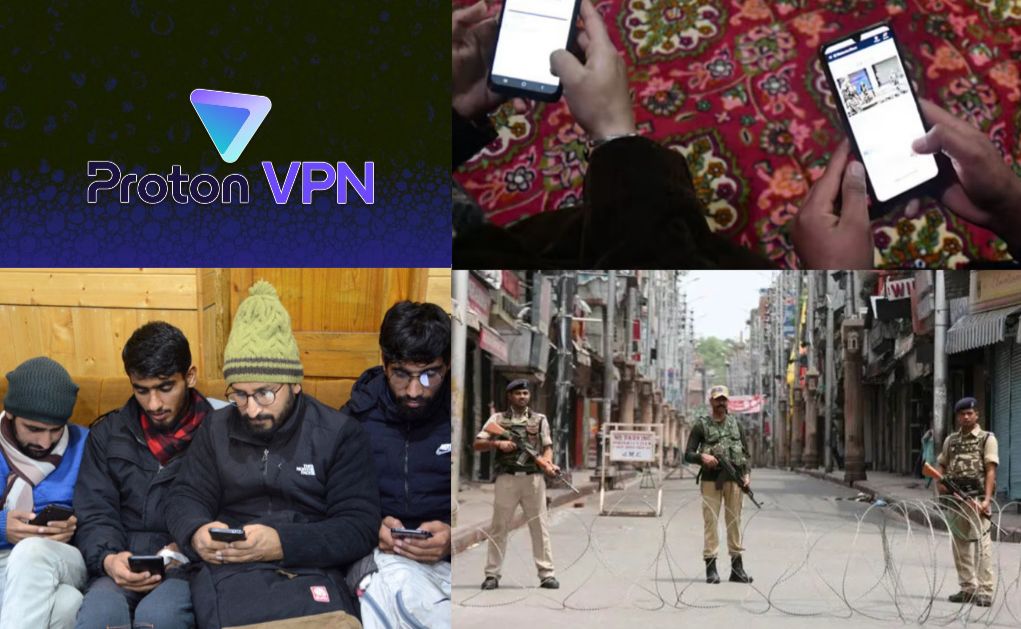
The General Manager of Proton VPN, David Peterson, has been openly encouraging people in Jammu and Kashmir to use his VPN application “discreetly” in situations where authorities do not permit or restrict its use.

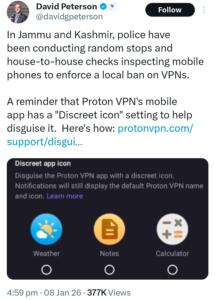
Taking to his handle on X, David Peterson wrote, “In Jammu and Kashmir, police have been conducting random stops and house-to-house checks inspecting mobile phones to enforce a local ban on VPNs. A reminder that Proton VPN’s mobile app has a ‘Discreet icon’ setting to help disguise it.”

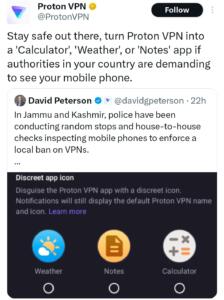
“Stay safe out there, turn Proton VPN into a ‘Calculator,’ ‘Weather,’ or ‘Notes’ app if authorities in your country are demanding to see your mobile phone,” his post read.
The post does not reflect a casual remark, it is a calculated intervention by a foreign corporate executive into a terror-sensitive region, advising civilians on how to evade lawful security measures.
From the safety and comfort of Europe, Peterson lectures a conflict zone on digital “safety,” while remaining completely insulated from the consequences of misuse. He does not face the fallout of intelligence failures, nor does he bear the burden when security lapses translate into bloodshed.
Yet he finds it acceptable to nudge people toward concealment and deception, prioritizing the reach and relevance of his product over the fragile security environment on the ground.
This is not principled advocacy for privacy, rather a reckless dismissal of local realities, a blatant disregard for sovereign law enforcement, and a troubling example of corporate arrogance overriding public safety.
Jammu and Kashmir is not an ordinary region. It is one of the most heavily targeted zones by terrorist networks, foreign-sponsored militancy, and organized extremist groups.
Every security measure enforced there, whether phone checks, movement restrictions, or communication monitoring exists for one reason alone, which is to prevent innocent people from being killed.
Against this backdrop, statements made by the General Manager of Proton VPN are not merely irresponsible, they are alarming. He lives a secure, comfortable life in Europe away from the constant threat of terrorism.
He does not experience sudden lockdowns, bomb threats, or the aftermath of brutal attacks. He will not be among those injured or killed if another terror incident strikes Kashmir. Yet, despite being fully aware of the situation on the ground, he chose to publicly encourage people in Jammu & Kashmir to conceal a banned application from law-enforcement authorities.
The Larger Question: Who Bears Responsibility?
VPNs are neutral tools—but context matters. Encouraging their discreet use in stable democracies is one thing. Encouraging their concealment in a terror-affected zone, where communication channels are routinely abused by extremist elements, is another entirely.
Jammu & Kashmir has repeatedly witnessed terror attacks planned and coordinated through encrypted communication platforms. The recent Pahalgam attack was a stark reminder of how fragile peace remains and how devastating the consequences of security lapses can be.
If such applications are misused to coordinate terror activities, evade surveillance, transmit instructions or propaganda, or enable cross-border extremist networks, who takes responsibility?
Will David Peterson acknowledge accountability if innocent lives are lost? Will Proton VPN accept any moral or legal responsibility? Or will the burden, as always, fall entirely on Indian citizens and security forces?
A Question of Ethics and Sovereignty
India is a sovereign nation with the right and obligation to enforce laws in sensitive regions to protect its people. Actively promoting ways to bypass these laws is not activism.
It is not moral courage, it is reckless interference in a country’s internal security framework. When such behavior comes from someone in a position of power and influence, it becomes even more dangerous.
This is why the issue goes beyond one tweet or one executive. It reflects a mindset where commercial interests trump ground realities, and where the consequences of misuse are conveniently externalized onto a nation already bearing the scars of terrorism.
The Government of India must take this seriously. VPN services that encourage evasion of lawful checks, undermine security efforts in conflict zones, and refuse to acknowledge the risks of misuse, must face strict regulatory scrutiny.
If necessary, the centre should take stringent action on such VPN providers in the interest of national security, because no foreign company, no executive, and no application—no matter how popular has the right to place Indian lives at risk.
Lives matter more than downloads, security matters more than ideology and accountability cannot be optional.