
























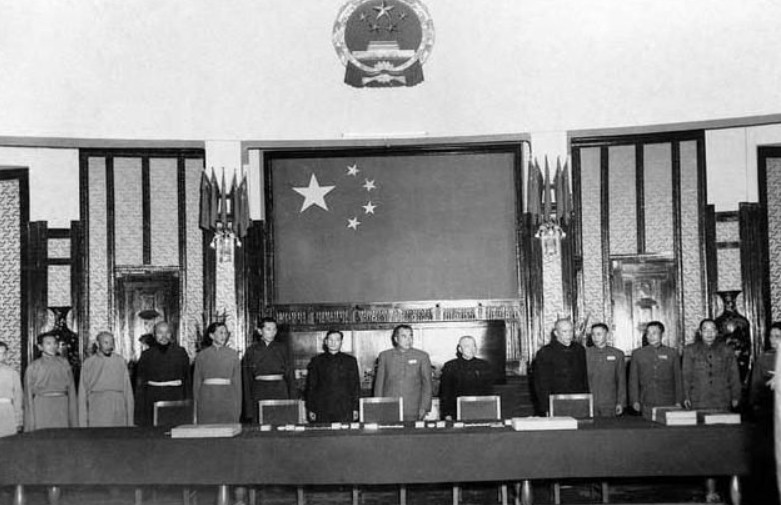
On May 23rd 1951, the “Seventeen Point Agreement of the Central People’s Government and the Local Government of Tibet on Measures for the Peaceful Liberation of Tibet” was signed.
This agreement legitimized claims of the People’s Republic of China (PRC) over Tibet and retroactively justified the previous year’s military invasion of eastern Tibet by the People’s Liberation Army (PLA).
In brief, the agreement was signed after the People’s Liberation Army (PLA) entered eastern Tibet in 1950, defeating Tibetan forces at Chamdo. Under strong military pressure, representatives of the Tibetan government were sent to Beijing and signed the agreement.
The agreement was not a union treaty or an expression of Tibetan self-determination. It was a tool of annexation forced by the Chinese army, signed under pressure, and systematically violated. Instead of settling the status of Tibet, the agreement legalised its submission by the use of force and diplomatic trickery.
Occupation Preceded Agreement
In international law, the order of events is very important and in Tibet’s case, it is clear. The People’s Liberation Army overtook eastern Tibet in 1950, defeating the Tibetan forces, which were poorly equipped, a few months before any negotiations took place.
The military occupation happened before the political negotiations, which made the possibility of free consent impossible. Later, when a Tibetan delegation was called to Beijing, they were very heavily restricted.
The Lhasa communications got cut off, independent legal lawyers were not allowed and the delegation was not authorised by the Dalai Lama to sign any political agreement.
This was not a negotiation of two equal parties. It was the colonial style of first suppressing and then legitimising through law. The delegation was given a decision that was backed up with the threat of more military action.
Under such circumstances, consent is invalid according to the principles of treaty law, which uphold that agreements made under coercion are null and void. Hence, the agreements’ later portrayal as a voluntary union is both historically and legally indefensible.
Agreement as Coercive Legality
The main supporters of the 1951 agreement consider its promises of autonomy, religious freedom, and the recognition of preexisting political harmonies as the main points of reference.
In a short period of time, monasteries were either broken down or subjected to severely disturbed state control, with mass destruction being the result of the political campaigns of the late 1950s and 1960s.
Land collectivisation not only compromised the traditional ways of living but also led to the dismantling of local governance structures. The Tibetan language which was only nominally protected, was gradually being sidelined in education and administration, making Mandarin the primary language of power and mobility.
The agreement was meant to be a legal constitutional framework but was in fact a transitional tool for the annexation disguised by law. When the Tibetans resisted, especially during the 1959 uprising, the reaction from the authorities was massive repression and not dialogue.
A treaty that is in practice intentionally violated by the majority party cannot serve as a basis for legitimacy. It reveals the non-existence of real consent from the beginning.
Continuing Illegality under International Law
The illegitimacy of Tibet’s annexation is not only a historical issue. It is still a live question in international law. The principle of self-determination, which was set out in the United Nations Charter and has been further defined by international jurisprudence, basically means that a people have the right to decide their political status free from outside pressure. Tibetans were not granted this right both before and after 1951.
China’s claim that Tibet has always been a domestic issue cannot serve to wipe out these obligations. It is the international legal precedent that states that long control cannot make an originally unlawful annexation lawful, especially if the affected population still suffers from cultural repression and political marginalisation.
The lack of a free and fair self-determination process leaves the question of Tibet’s status open in both legal and ethical terms.
Furthermore, the exile of the Dalai Lama and the Tibetan political and cultural resistance, which still exist, highlight that the annexation has not been legitimate. Consent cannot be derived from the silence that is imposed through surveillance, imprisonment, and demographic engineering.
It is substance that international law looks at rather than form, and the substance of Tibet’s incorporation is that of a takeover rather than a union.
Why the Illusion Persists
The endurance of the 1951 narrative owes much to geopolitical convenience. Many states have prioritised economic engagement with China over principled positions on historical injustice.
Over time, repetition has normalised a falsehood, allowing coercion to masquerade as consent. Yet legitimacy in international relations is not created by repetition. It is grounded in lawful process and the will of the people concerned.
For India and other democracies, the Tibetan case carries particular resonance. It not only highlights how historical annexations, when left unaddressed, shape contemporary security dilemmas and human rights crises but also underscores the risks of accepting imposed legalities at face value.
The Seventeen-Point Agreement did not legitimise China’s rule over Tibet. It recorded the outcome of military domination and translated it into administrative control through a deceptive legal form. Occupation preceded agreement, promises were systematically broken, and the Tibetan people were denied their right to decide their future.
Under international law and basic principles of justice, Tibet’s annexation remains an unresolved colonial occupation. Recognising this reality is not an act of hostility; it is an affirmation that consent extracted at gunpoint is no consent at all.