




















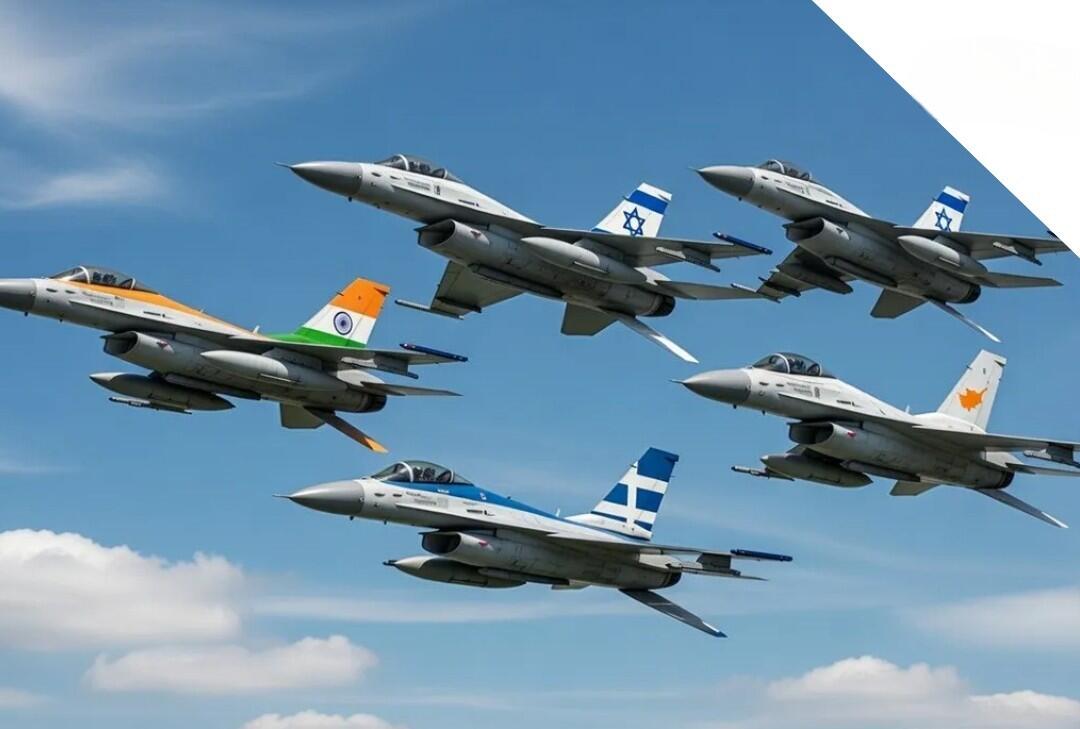
The emergence of the Mediterranean Quad on the geopolitical horizon marks a significant development in regional security dynamics, particularly in the Eastern Mediterranean. Originally driven by shared concerns over regional stability, defense cooperation, and emerging power rivalries, this grouping has attracted attention not only from the immediate participants—Israel, Greece, and Cyprus—but also from distant partners such as the United States and potentially India, which has been formally invited to explore participation in the Mediterranean Quad framework.
At its core, the Mediterranean Quad represents a strategic attempt by its founding members to enhance defense collaboration and stability in a region fraught with longstanding disputes and shifting alliances. In late 2025, Greece, Cyprus, and Israel signed a trilateral military cooperation plan focused on joint air and naval exercises, strategic dialogue, and specialized training in areas such as electronic warfare and unmanned systems. This cooperation is intended to bolster their ability to manage shared security threats and to serve as a stabilizing force in the Eastern Mediterranean.
The explicit invitation extended to India to join this “3+1” framework underscores both the growing importance of the Mediterranean Quad and New Delhi’s expanding global strategic footprint. India already maintains strong bilateral relationships with each of the three original members of the Mediterranean Quad, rooted in defense, trade, and technological collaboration. Participation in the Mediterranean Quad could provide New Delhi with enhanced strategic reach and deeper engagement with European and Middle Eastern partners, especially in domains such as maritime security and counterterrorism.
The structure of the Mediterranean Quad allows for the United States to play a supportive role as the “+1” in the 3+1 formula, effectively marrying European and Middle Eastern security interests with broader Western strategic priorities. This alignment is particularly relevant in light of challenges posed by countries such as Turkey and complex relations involving Saudi Arabia, Pakistan, and Iran. The involvement of the United States adds weight to the Mediterranean Quad’s efforts to promote stability and deterrence in a region where power plays frequently overlap with historic conflicts and economic interests.
A key objective of the Mediterranean Quad is to strengthen maritime security cooperation among its members. The Eastern Mediterranean Sea is not only a strategic conduit for trade and energy flows but also a theater where competing territorial claims and military postures have raised the stakes. Joint military exercises and shared defense planning, as envisioned by the Mediterranean Quad, aim to enhance interoperability among member forces, improve collective responses to crises, and deter potential aggressors.
Energy security is another important dimension of the Mediterranean Quad strategy. The Eastern Mediterranean region hosts significant offshore energy resources, including natural gas fields that are commercially and politically significant. Cooperation on energy interconnection projects among the members of the Mediterranean Quad seeks not only to facilitate economic development but also to reduce Russia’s influence over European energy markets. This approach aligns with broader efforts by European and Middle Eastern partners to diversify energy sources and strengthen resilience against supply disruptions.
In addition to defense and energy cooperation, the Mediterranean Quad also provides a platform for intelligence sharing and joint planning on asymmetrical threats, such as terrorism and cyberattacks. By establishing working groups and collaborative mechanisms, the participating countries aim to enhance their situational awareness and crisis response capabilities. For India, association with this framework could bring opportunities for deeper intelligence cooperation and technology exchange—areas where New Delhi already cooperates extensively with Israel.
However, the geopolitical landscape surrounding the Mediterranean Quad is complex. Turkey’s aspirations to lead in the Islamic world and its negotiations to join collective defense arrangements involving Saudi Arabia and Pakistan raise potential counterweights to the grouping’s strategic objectives. These developments reflect broader realignments in the Middle East, where traditional alliances are being tested and new security architectures are emerging.
For India, the decision to engage with the Mediterranean Quad would need to balance multiple considerations. India’s foreign policy, rooted in strategic autonomy, prefers flexible partnerships over formal alliances. Nonetheless, India has strengthened defense ties with Greece and Cyprus through joint military exercises and with Israel through longstanding technological collaboration. Participation in the Mediterranean Quad could complement India’s broader engagement in regional security forums, contributing to a diversified foreign policy that addresses evolving threats while maintaining diplomatic autonomy.
The evolution of the quad also intersects with India’s broader ambitions to play a constructive role in global security, from Indian Ocean engagements to engagements in the Middle East and beyond. As New Delhi continues to build partnerships that enhance its strategic reach, the Mediterranean Quad represents a compelling opportunity to contribute meaningfully to a collective security architecture that transcends regional boundaries.
In conclusion, the Mediterranean Quad stands at the crossroads of shifting geopolitical tides in the Eastern Mediterranean and beyond. By fostering coordinated defense cooperation, joint exercises, energy collaboration, and intelligence sharing, the Mediterranean Quad aims to create a durable framework for regional stability. India’s potential involvement in this 3+1 arrangement reflects not only its growing global influence but also a recognition of the interconnected nature of contemporary security challenges. As the grouping continues to develop, its impact on regional balances and strategic alignments will bear close observation from capitals around the world.





