























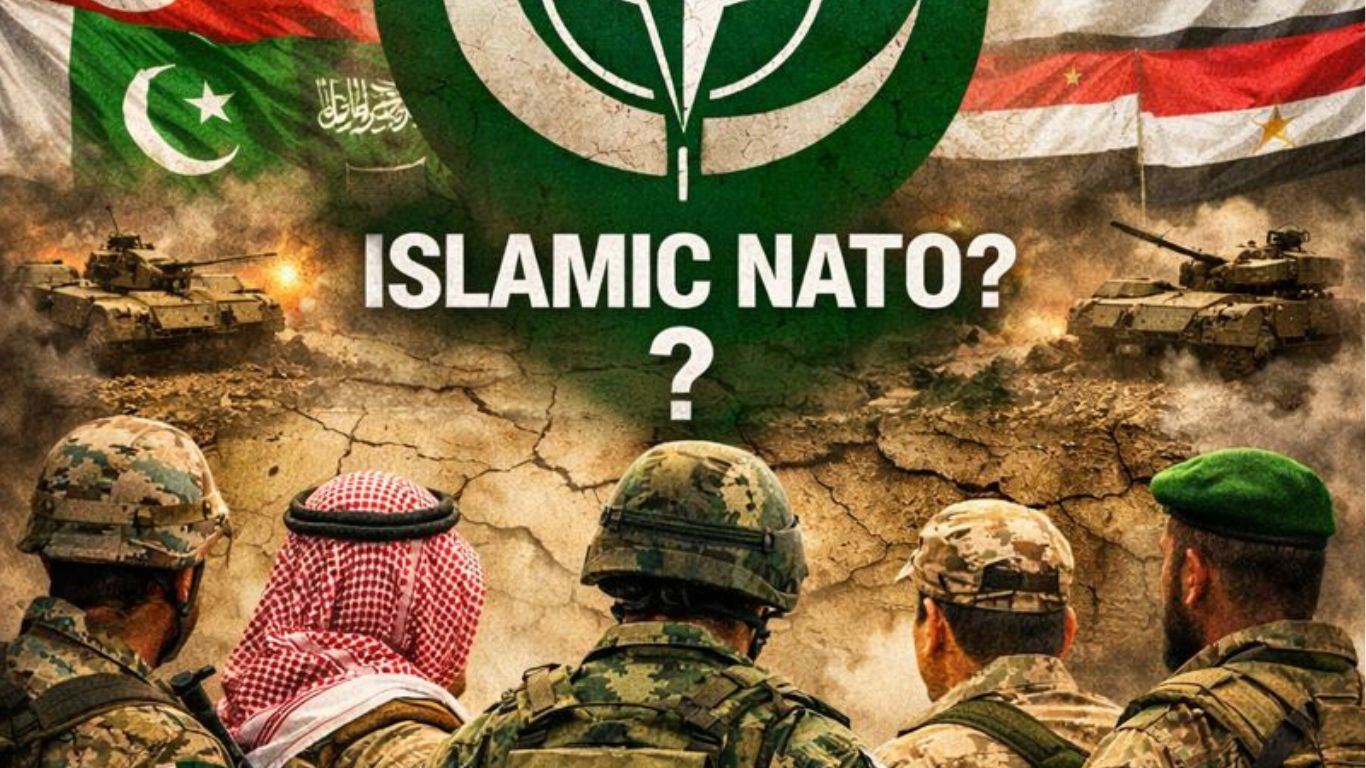
The idea of an “Islamic NATO” or a collective military alliance of Muslim-majority countries is not new. It was first seriously discussed after the Arab–Israel wars, particularly following the 1967 conflict, when Arab and Islamic states realised their political and military fragmentation. Platforms such as the Organisation of Islamic Cooperation (OIC) emerged in that period, but they failed to evolve into a credible collective security or defence alliance. Today, the question resurfaces: if Islamic countries—not just Turkey, Saudi Arabia and Pakistan, but a wider group—were to form such an organisation, could it actually work?
In theory, the Islamic world has significant strategic potential. The OIC has 57 member states, many of which are energy-rich, demographically large, or strategically located. Turkey possesses NATO-level military experience and a growing defence industry. Pakistan is a nuclear-armed state with a battle-hardened military. Saudi Arabia and Gulf states bring financial power, while Iran holds substantial regional military influence. On paper, such a grouping could form a formidable bloc.
However, theory and reality diverge sharply.
The biggest obstacle is deep internal divisions within the Islamic world. The Sunni–Shia divide is not merely theological but geopolitical. Rivalries—most notably between Saudi Arabia and Iran—play out across Yemen, Syria, Iraq and Lebanon. When key regional powers perceive each other as primary threats, the foundation for a shared defence architecture collapses. Unlike NATO, which emerged against a clearly defined external adversary, Muslim-majority countries lack a consensus on who the main threat actually is.
A second challenge lies in conflicting national interests and threat perceptions. Security priorities vary widely. Pakistan’s defence outlook is largely India-centric, a concern not shared by most Islamic states. Gulf countries focus on Iran and internal regime security. Egypt looks towards North Africa and the Eastern Mediterranean, while Indonesia and Malaysia remain focused on Southeast Asia. NATO’s core principle—collective defence—works only when members broadly agree on threats. In the Islamic world, such convergence is largely absent.
Third, there is the issue of dependence on external powers. Many Muslim countries rely heavily on the United States, Russia, China, or European states for arms, intelligence and security guarantees. Saudi Arabia and other Gulf monarchies remain deeply tied to the US security umbrella. Turkey is itself a NATO member. Creating an “Islamic NATO” would inevitably clash with these existing alignments, a risk most states are unwilling to take.
Recent initiatives illustrate these limits. Turkey-backed efforts such as the Islamic Military Counter Terrorism Coalition (IMCTC) were at times labelled an “Islamic NATO.” In practice, however, the coalition remains largely symbolic, focused on counter-terrorism coordination rather than collective defence. Crucially, key players like Iran are excluded, and there is no unified command structure or binding mutual defence commitment.
So, is an Islamic NATO impossible? Not entirely—but it is highly unlikely in the NATO sense. At best, such a framework could evolve into a loose security cooperation mechanism, involving joint exercises, intelligence sharing, training, and limited operational coordination. A full-fledged military alliance with a common command, shared strategic doctrine, and an “attack on one is an attack on all” principle remains improbable.
The idea of an “Islamic NATO” is politically appealing and often invoked in rhetoric, especially during periods of crisis. Yet structural divisions, competing national interests, and external dependencies severely limit its feasibility. Unless the Islamic world first achieves a significant level of political cohesion and strategic trust, an Islamic NATO is likely to remain more a slogan than a strategic reality.