









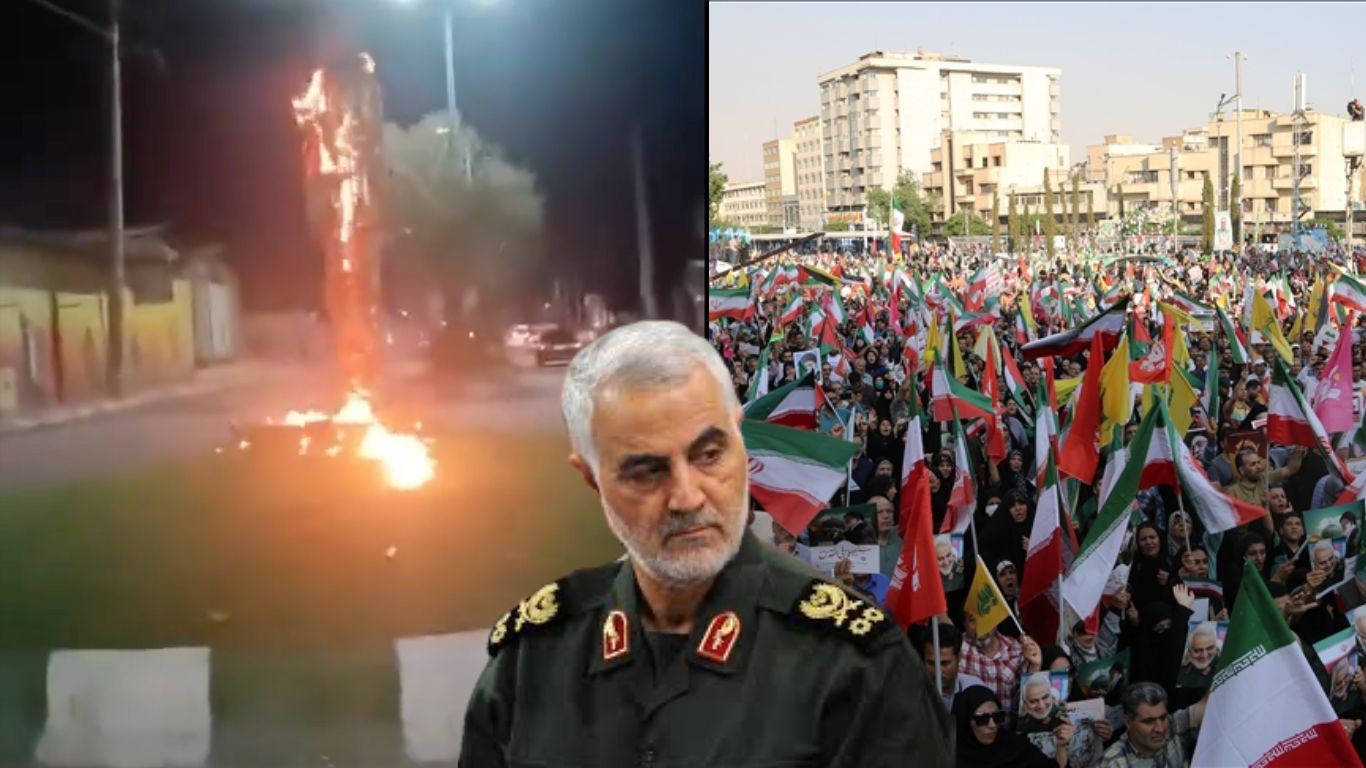
Fresh anti-government protests have erupted across several cities in Iran, just days before the anniversary of the killing of senior Iranian commander Qasem Soleimani. Most notably, protesters set fire to a statue of Soleimani in the city of Lali, located in Khuzestan province in southwestern Iran. The incident took place at night and was captured on video, which later surfaced through Iran International.
Qasem Soleimani, who headed the Islamic Revolutionary Guard Corps’ Quds Force, was killed in a US drone strike in January 2020 in Iraq. Since then, the Iranian state has projected him as a national hero. Therefore, the burning of his statue is being seen as a powerful symbolic act of defiance against the ruling establishment.
Iran Anti-Regime Protests: Statue of Statue of Qasem Soleimani has been set on fire by protestors in Lali of Iran.
— Aditya Raj Kaul (@AdityaRajKaul) January 2, 2026
Meanwhile, nighttime demonstrations were reported in multiple regions of the country. Protesters gathered on the streets, raised slogans, and openly challenged the Iranian leadership. According to videos circulating online, crowds were seen chanting anti-government and pro-monarchy slogans, indicating growing anger against the Islamic Republic.
In central Iran, protests were reported in Qazvin and in the holy city of Qom. There, demonstrators chanted slogans such as, “This is the final battle, Pahlavi will return.” This slogan refers to the former royal family that ruled Iran before the 1979 Islamic Revolution. As a result, it reflects renewed calls by some protesters for a return to a pre-revolution political system.
Similarly, in northern Iran, gatherings continued in the city of Babol. Protesters were heard chanting “Death to the dictator,” a slogan that has become common during recent waves of unrest. At the same time, protests were also reported in western Iran. Videos showed demonstrations in Gohardasht near Karaj in Alborz province, Azna in Lorestan province, and Farsan in Chaharmahal and Bakhtiari province.
In addition, southern Iran also witnessed protests. Demonstrations were reported in Kavar, located in Fars province. Although the gatherings appeared smaller, they were part of a wider pattern of coordinated dissent across regions.
Overall, these protests suggest continued public frustration over political repression, economic hardship, and lack of freedoms. While Iranian authorities have not issued a detailed response yet, past protests have often been met with crackdowns. However, the scale and spread of the current demonstrations indicate that public anger remains strong and persistent across the country.





