



















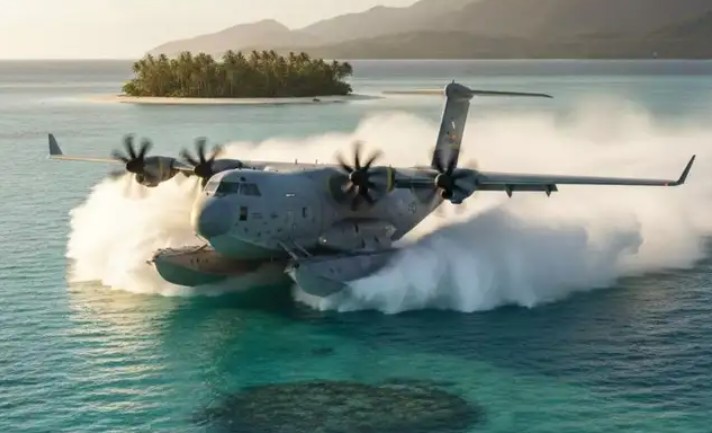
The Indian Navy is moving ahead with plans to induct amphibious aircraft capable of taking off and landing on water as well as conventional runways.
The Ministry of Defence has issued a Request For Information (RFI) to wet-lease four such aircraft for a period of four years.
According to the RFI, the aircraft must be capable of operating from water surfaces, including the sea and inland lakes, in addition to standard airstrips.
The Navy has been seeking to induct amphibious aircraft for over a decade, having initiated the procurement process in 2011 to enhance India’s coastal security. However, a deal has yet to materialise.
As per reports, primary roles envisaged for the aircraft include operational logistics support, long-range search and rescue, special operations, humanitarian assistance and disaster relief, as well as casualty evacuation. The platforms may also be deployed for anti-piracy and anti-narcotics operations, along with maritime patrol duties.
At the 2018 Defence Expo, the Mahindra Group signed a memorandum of understanding with Japan-based amphibious aircraft manufacturer ShinMaywa Industries Limited for the manufacturing and assembly of the ShinMaywa US-2 aircraft.
Earlier, in 2016, The Economic Times reported that India was considering the acquisition of 12 amphibious rescue aircraft from ShinMaywa Industries in a deal estimated at $1.5–1.6 billion. At that time, discussions between India and Japan on the proposed purchase had been underway for nearly two years.
The ShinMaywa US-2 is an amphibious short take-off and landing (STOL) aircraft with a flexible airframe design, allowing it to be configured for multiple roles, including firefighting, passenger transport and multi-purpose amphibious operations.
The aircraft can carry up to 20 passengers or 12 stretchers and is designed to rapidly reach remote islands and maritime accident sites during search and rescue missions.
According to the report, the Indian Navy had planned to base the seaplanes in the Andaman Islands, a move that would enable coverage across the Bay of Bengal and strengthen India’s strategic presence in a region bordered by Myanmar and Indonesia.
Meanwhile, in another fresh development, as drone warfare continues to evolve rapidly with the integration of artificial intelligence, autonomous systems, swarm tactics and advanced countermeasures, Indian security forces are further strengthening their capabilities in this domain.
In a move aimed at enhancing Intelligence, Surveillance and Reconnaissance (ISR) operations, the Indian Army and the Indian Navy are set to procure drones worth nearly Rs 300 crore from Bharat Forge.
According to the company, the contracts include a range of indigenous unmanned systems, comprising ISR platforms as well as loitering munitions, marking a significant boost to the armed forces’ drone and precision-strike capabilities.
The drone platforms—Omega One, Omega Nine, Bayonet and Cleave—have been developed to meet India’s urgent operational requirements across a wide range of terrains and mission profiles, the company said.
It added that its unmanned systems portfolio is evolving rapidly, with advanced autonomy, artificial intelligence and data-driven decision-making being progressively integrated across platforms. These enhancements are aimed at improving mission endurance, precision, survivability and adaptability in contested and dynamic operational environments.
Commenting on the development, Amit Kalyani, Vice Chairman and Joint Managing Director at Bharat Forge Ltd., said, “This dual achievement, securing EP-VI contracts and showcasing Omega One on Army Day, reaffirms BFL’s commitment to Atmanirbhar Bharat.”
The company’s Omega One unmanned aerial vehicle was showcased onboard an upgraded BMP-2 infantry fighting vehicle during the Army Day Parade 2026, held in Jaipur.