















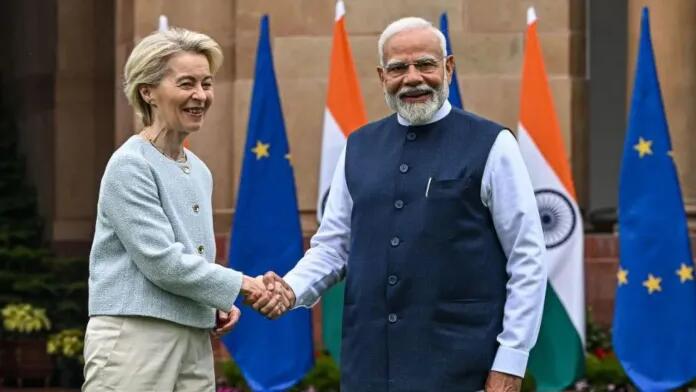
The long anticipated India–European Union Free Trade Agreement is now closer than ever to becoming reality, with European Commission President Ursula von der Leyen signalling that negotiations are approaching their final stage. Described as the “mother of all deals,” this pact is being seen as one of the most ambitious economic arrangements either side has attempted, both in scale and strategic importance. If concluded, it will reshape relations between two of the world’s largest democratic economic blocs at a time of deep global uncertainty.
Negotiations around the India–EU Free Trade Agreement have spanned nearly two decades. Talks first began in 2007 but remained stalled for years due to differences over market access, tariffs, intellectual property protection, labour standards, data regulation, and environmental commitments. The renewed momentum since 2022 reflects changing global realities, including supply chain disruptions, geopolitical tensions, and a shared desire to diversify partnerships. Recent signals from European leadership suggest that compromises are finally converging, pushing the agreement toward completion.
At its core, the Free Trade Agreement seeks to significantly expand commerce between two massive markets. The European Union is already one of India’s top trading partners, while India represents one of the EU’s fastest growing economic relationships. Bilateral trade in goods and services runs into hundreds of billions of euros annually, yet policymakers believe this figure can rise sharply once tariff barriers are lowered and regulatory hurdles eased. Simplified customs procedures and greater predictability are expected to benefit businesses on both sides.
For India, the Free Trade Agreement represents a major strategic and economic opportunity. Improved access to the EU’s consumer market of more than 440 million people could boost Indian exports in pharmaceuticals, textiles, apparel, leather goods, engineering products, and digital services. The deal is also expected to encourage European investment in Indian manufacturing and infrastructure, aligning closely with national initiatives aimed at strengthening domestic production and integrating India more deeply into global value chains.
From the European perspective, the Free Trade Agreement strengthens engagement with a rapidly growing and increasingly influential Asian economy. As the EU looks to reduce overdependence on limited supply sources, India’s skilled workforce, expanding middle class, and improving business climate make it an attractive partner. European firms stand to gain from reduced tariffs on automobiles, machinery, wines, spirits, and high end manufactured goods, along with improved investment protection and regulatory transparency.
One of the most complex areas of negotiation within the Free Trade Agreement framework has been sustainability. The EU has emphasised labour rights, environmental protection, and climate commitments, while India has sought flexibility to protect developmental priorities. Progress appears to have been made through phased implementation, technical cooperation, and mutual recognition rather than rigid enforcement. Another sensitive area has been digital trade and data protection, where both sides have worked to balance innovation, privacy, and sovereignty.
Beyond economics, the conclusion of the Free Trade Agreement carries strong geopolitical significance. At a time when protectionism is rising and global trade rules face strain, the pact would send a powerful signal in favour of open, rules based commerce among democratic partners. It would elevate India–EU relations to a new strategic level, reinforcing trust and cooperation across economic, technological, and political domains. If finalised, this “mother of all deals” could redefine bilateral engagement for decades, shaping a more resilient and balanced global economic order.