















RelatedPosts
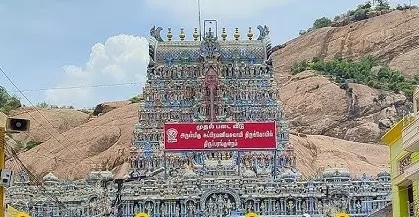
A heavy police deployment at Thirupparankundram in Madurai on Sunday, 21 December 2025, sparked intense protests among local residents, who accused the DMK led Tamil Nadu government of enforcing religious permissions selectively. The flashpoint was the police facilitated movement of a flagpole and flag to the hilltop for the Sandanakoodu ritual at the Sikandar Dargah, even as Hindu devotees continued to be denied permission to light the Karthigai Deepam at the Deepathoon on the same hill, despite a subsisting court order allowing the ritual.
Thirupparankundram residents said the situation escalated when police escorted the Dargah flag and flagpole to the hilltop under heavy security, ignoring sustained objections from the local Hindu population. According to them, the authorities showed urgency and efficiency in enabling the Sandanakoodu ritual, while repeatedly citing law and order concerns to prevent the lighting of the Deepam. This perceived disparity, residents said, lay at the heart of the unrest.
Locals alleged that the flag and flagpole were taken through Palani Andavar Koil Street and Kottai Street by more than twenty Muslim men, accompanied by a large police contingent. Residents claimed their objections were brushed aside and that the procession continued despite vocal resistance from the neighbourhood. Many said this reinforced their belief that the administration was unwilling to listen to Hindu concerns while readily facilitating activities linked to the Dargah.
Earlier in the day, women residents of Thirupparankundram had staged protests accusing the state government of deliberately failing to implement the court order that permitted the lighting of the Karthigai Deepam. They alleged that prohibitory orders under Section 144 of the Criminal Procedure Code were imposed almost instantly whenever Hindus attempted to approach the hill. In contrast, they said, no such restrictions were applied to the Dargah related activity, even though it involved a larger group and movement through residential streets.
Several women protesters alleged that police detained multiple women during the afternoon agitation. Those detained reportedly included pregnant women, elderly women, and mothers carrying infants. According to the protesters, they were taken to a private marriage hall and held there for several hours. One woman said detainees were picked up around 1 pm and released only close to 6 pm, while some were allegedly held until 8.30 pm, exceeding permissible limits. She claimed no food was provided, forcing detainees to rely on help from people outside.
Residents further alleged that police officials told them the detained women would be released only after the Dargah flag was taken up the hill and hoisted. Protesters said they were initially informed that only four people would be allowed to go uphill. However, they later witnessed more than thirty people being escorted to the hilltop under full police protection, deepening their sense of injustice.
The protesters contrasted this with the restrictions imposed on Hindus earlier in the month. On Karthigai Deepam day, residents said they were told only four people could go up the hill to light the lamp, after which permission was withdrawn altogether. According to them, this marked the beginning of a dispute that has dragged on for over a month and reached a breaking point on Sunday.
One woman stated that Section 144 was imposed on Hindu localities in Thirupparankundram almost immediately, confining residents to their homes. She said water tankers and garbage collection vehicles were stopped, children were unable to attend school, and the area functioned under curfew like conditions for two days. When residents questioned these restrictions, they were allegedly told a curfew had been imposed, though no formal announcement was made.
Another woman recalled that a senior official had assured her that the Deepathoon belonged to the devotees and promised to personally accompany them to light the lamp. She said the official claimed the demand would be fulfilled and that detained women would be released. However, she alleged that shortly afterward, the Dargah flag was taken and hoisted, while permission to light the Deepam was once again denied.
Residents repeatedly emphasised that their demand was not to obstruct the Sandanakoodu festival. They stated that Muslims should be allowed to conduct their rituals freely, but Hindus must be granted the same rights. Protesters stressed that Hindus and Muslims in Thirupparankundram had lived together peacefully for generations and that the current tension was the result of selective enforcement by the administration rather than communal discord.
As evening approached, women holding earthen lamps, oil, and wicks attempted to proceed towards the hill despite police barricades. They argued that if police security could be provided for one religious procession, similar protection should be extended for lighting the Deepam. Residents questioned why Hindus were never given comparable security arrangements.
Police blocked multiple access routes and erected barricades, leading to heated arguments and scuffles. Protesters alleged that police restrained women demonstrators, confiscated mobile phones to prevent recording, and questioned visitors, asking them to produce Aadhaar cards and explain their presence in the area. Even elderly women, residents said, were prevented from enquiring about the condition of those detained.
By nightfall, the Dargah flag was hoisted atop the hill under full police protection. Released detainees returned to the protest site and reiterated that they would continue their agitation until they were allowed to light the Karthigai Deepam and access temples such as the Kasi Vishwanathar Temple. Madurai City Deputy Commissioner of Police Inigo Divyan was present and held talks with residents, but protesters said the discussions yielded no resolution.
Thirupparankundram residents concluded by asserting that their protest was rooted in the demand for equal rights, not politics. They warned that continued denial of permission for Hindu rituals, while facilitating other religious activities under state protection, risked sowing divisions in an area that had historically remained peaceful.