
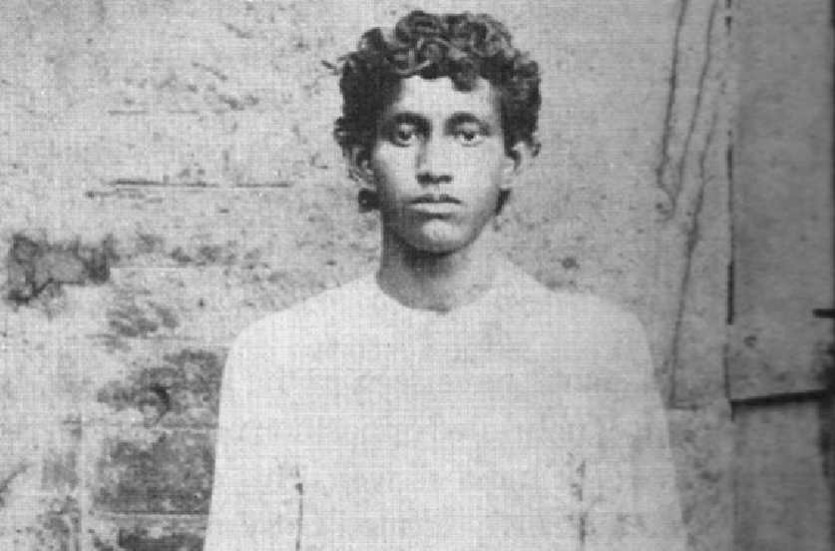
Khudiram Bose was born on December 3, 1889, in the quiet village of Habibpur under the Keshpur Police Station in the Midnapore district of West Bengal. The only son of a Tehsildar, Khudiram grew up alongside three sisters.
Life was harsh from the very beginning, Khudiram lost both parents at the early age of six and was raised by his elder sister. Yet, adversity only strengthened the resolve of the boy who would soon become one of India’s youngest and most fearless revolutionaries.
His early encounters with colonial oppression and the rising nationalist movement shaped a spirit that would later inspire independence struggles from Ireland to Egypt, South Africa to Indonesia.
Early Life
Khudiram’s revolutionary journey began during his school years, influenced by the stirring words of Aurobindo Ghosh and Sister Nivedita. Aparupa Roy, his elder sister, brought him to her house at Hatgacha village under the Daspur Police Station. He was then admitted to Tamluk’s Hamilton High School.In 1902 and 1903, Sri Aurobindo and Sister Nivedita visited Midnapore. They held a series of public lectures and private sessions with the existing revolutionary groups for freedom.
As a teenager, Khudiram joined the Anushilan Samiti, a covert revolutionary group committed to armed resistance. While other boys his age attended regular classes, he immersed himself in the perilous world of underground operations, bomb-making, and guerrilla tactics.
After joining Anushilan Samiti, he came into contact with the network of Barindra Kumar Ghosh of Calcutta and became a volunteer at the age of 15. He was arrested in Midnapore for distributing pamphlets against the British rule in India, but he was completely acquitted of the charges due to the effective pleading by Barrister Birendranath Sasmal.
At the young age of 16, Khudiram took part in planting bombs near the police stations and targeted government officials.
His early dedication stands as a reminder that meaningful change is not bound by age. From university student activists in the U.S. to young professionals leading community initiatives in Australia, Khudiram’s youthful courage continues to inspire.
The Muzaffarpur Mission
The mission that would define Khudiram’s legacy began with Douglas Kingsford, the Chief Presidency Magistrate of Calcutta—feared for his brutal treatment of Bengali nationalists. When Kingsford was transferred to Muzaffarpur as district judge, revolutionary leaders saw an opportunity.
Khudiram Bose and Prafulla Chaki were entrusted with the operation. Using assumed identities, they reached Muzaffarpur to carefully observe Kingsford’s routine. Their precision, discipline, and unwavering resolve reflected the sophistication of resistance networks forming across colonised nations.
On April 30, 1908, they struck—throwing a bomb at a carriage they believed carried Kingsford. Tragically, the carriage carried not Kingsford but the wife and daughter of barrister Pringle Kennedy, who succumbed to the attack and Kingsford escaped once again.
This tragic miscalculation underscores the moral complexities that shadow many freedom struggles—dilemmas that still echo in contemporary debates on resistance, political violence, and justice, including those within global Indian communities.
Capture and Trial
As colonial authorities launched a massive manhunt, Prafulla Chaki chose death over capture, while Khudiram was arrested after an exhausting 25-km walk to Waini station. His trial soon became a global spectacle. The British Empire, realizing the gravity of what he represented, sought to use the trial as a warning against rising nationalist sentiment.
Freedom movements around the world—Irish republicans, Egyptian nationalists, African resistance leaders—followed the proceedings closely. Here was an 18-year-old, standing unshaken before the imperial machinery.
For today’s diaspora, Khudiram’s courtroom defiance symbolises a universal struggle for dignity and justice, connecting colonised peoples across continents.
The Ultimate Sacrifice
On August 11, 1908, at only 18 years and eight months, Khudiram Bose was executed in Muzaffarpur jail. His calm resolve at the gallows left even British officials in awe.
Eyewitness reports describe him walking to the scaffold with a serene smile—an image that became immortal. His last words expressed pride in dying for his country and hope that others would continue the struggle.
This extraordinary composure resonated far beyond India. Irish revolutionaries, African nationalists, and anti-colonial activists worldwide drew courage from the young boy who met death with a smile.
Global Impact and International Recognition
Khudiram’s martyrdom reverberated internationally. Global newspapers covered his execution, exposing the brutality of colonial rule to audiences around the world.
In London, British sympathisers and Irish republicans condemned the execution. In Egypt, students organized solidarity gatherings. In South Africa, a young lawyer named Mohandas Gandhi took note—a moment that would later influence his philosophies on resistance.
Legacy
Khudiram Bose’s legacy continues to evolve. His life serves as a bridge between India’s historic struggles and the modern diaspora’s pursuit of justice, equality, and human rights.
His legacy remains an impetus, drawing young souls to the cause of sacrifice and courage through his brave acts for the nation during his younger years.
Meanwhile, Uttar Pradesh Chief Minister Yogi Adityanath remembered Khudiram Bose on his birth anniversary on Wednesday.
“Humble tribute to the immortal revolutionary Khudiram Bose on his birth anniversary. By sacrificing his life at a young age for the independence of Mother India, he gave new consciousness to the freedom struggle. His patriotism will continue to inspire the people of the country for ages,” he posted on X.