















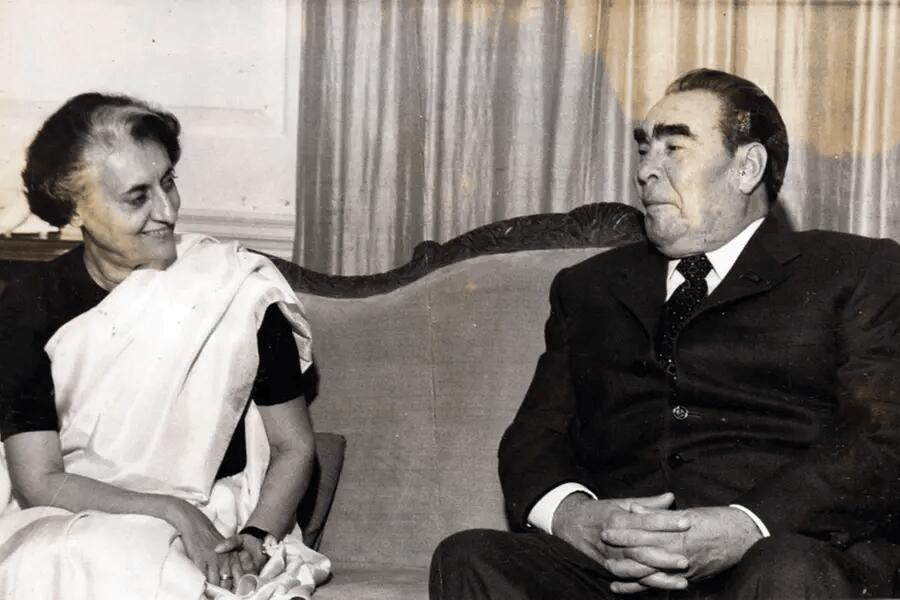
The intertwining of politics and education has often shaped the way societies perceive their past. One of the most striking examples in India occurred during the era of Indira Gandhi’s Emergency (1975-1977), when a pact between her government and the Communist Party of India (CPI) had a profound impact on how Indian history was written and taught in schools. This alliance of her with Communists influenced the framing of history textbooks and academic departments, leaving a lasting imprint on the country’s intellectual landscape.
During the Emergency period, the CPI aligned closely with Indira Gandhi’s leadership. This politically charged environment created an opportunity for the government to exercise control over educational narratives, particularly in history. As noted by historian Dr. Pratap Bhanu Mehta, this moment was disastrous for academic life in India. The concerted effort to shape history textbooks and university departments meant that perspectives were altered in ways that compromised academic freedom and intellectual diversity.
The pact between Indira Gandhi and the Communists was not merely about political convenience but represented a deliberate attempt to mold history according to specific ideological frameworks. School textbooks, which serve as primary sources of knowledge for millions of children, were revised under guidance sympathetic to the ruling party’s views. The Communist Party, wielding influence over academic institutions, played a key role in reshaping historical interpretations, often prioritizing Marxist narratives.
This transformation of history education had several consequences. Firstly, it narrowed the diversity of viewpoints in historical discourse. By privileging certain ideological spins, alternative perspectives and critical discussions were marginalized. This affected how generations of students understood their country’s past, framing history through a politically motivated lens rather than an objective academic inquiry.
Secondly, the intellectual environment within universities suffered. History departments were “packed” with individuals, precisely Communists aligned to these political and ideological agendas, constraining academic freedom. Scholars who deviated from the approved narratives faced obstacles, which stifled research innovation and critical debate. This atmosphere led to a form of intellectual uniformity detrimental to the development of a nuanced understanding of India’s complex history.
Additionally, the alliance had a complex nature. While the CPI supported the Emergency and Indira Gandhi’s regime for political reasons, internal contradictions also existed within left-wing politics. The Communist Party’s willingness to back authoritarian measures in return for influence over educational content illustrated a complicated “fuse” between power and ideology, showcasing how political alliances can override democratic principles in critical sectors like education.
The damage inflicted on Indian academic life during this period was not merely short-term. The changes in textbook content had enduring effects, shaping the collective memory and historical consciousness of the country. The textbooks introduced during this time under the aegis of Communists became widely used, and the interpretations they promoted influenced public understanding for years to come. Tackling these legacies has remained a challenge for educators and historians striving to restore academic rigor and pluralism.
Dr. Pratap Bhanu Mehta’s reflections on this period highlight the deep concerns about politicization of education. He points to the Emergency years as a time when history lost its independence and became a tool for political agendas. This historical episode serves as a cautionary tale about the dangers of allowing governments and political parties to interfere directly in educational content.
In essence, the collaboration between Indira Gandhi and the Communists to influence Indian history books and departments during the Emergency was a defining episode in the country’s intellectual history. It reveals how political power can shape the way history is written and taught, with long-lasting implications for knowledge production and critical thinking. The period marks a significant example of how ideology and authority can converge to affect educational systems, intervening in the shaping of national narratives.
Today, revisiting this chapter encourages ongoing efforts to ensure academic freedom, diversity of thought, and balanced historical scholarship. It underscores the importance of safeguarding education from politicization, allowing history to be examined with the openness and complexity it deserves.