










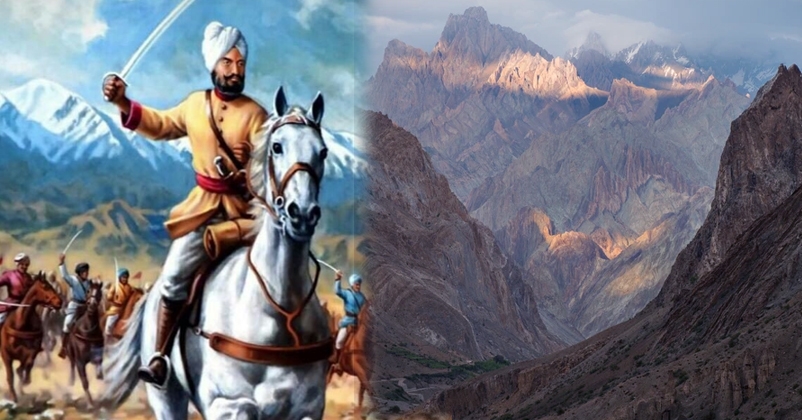
In the long tapestry of Indian military history, a few warriors rise above geography, borders and time. Their stories echo for centuries. Among them stands General Zorawar Singh Kahluria—a soldier whose courage carved India’s northern frontiers and whose exploits in the Himalayas remain unmatched.
If Ladakh today shines like a crown on India’s map, much of the credit goes to him. It is no surprise that the Indian Army named its modern light tank ‘Zorawar’—for who else embodies the grit to fight at –40°C among the world’s highest battlefields.
Zorawar Singh’s journey is as dramatic as his battles. Born in the small village of Ansar near Bilaspur in Himachal Pradesh, he grew up in modest circumstances. A land dispute after his father’s death forced the young 16-year-old to flee his village. Alone, he reached Haridwar—unaware that destiny was waiting.
There, he encountered Rana Jaswant Singh of Doda, who instantly sensed the fire in the frail-looking teenager. He took Zorawar with him, trained him, and set him on the path that would create one of India’s greatest military commanders.
In 1817, Zorawar joined the Dogra army of Maharaja Gulab Singh. Starting with minor logistics duties, his sharp military mind soon stunned senior commanders. He rose quickly—first as the commandant of Bhimgarh Fort, then governor of Kishtwar. The boy who fled home was now shaping the borders of a kingdom.
The Western Campaign: First Hindu General in Baltistan
Zorawar chose to advance westward—into Baltistan, a region where no Hindu ruler or army had ever marched. At the time, Ahmed Shah ruled the area, but he was no match for Zorawar’s strategy. He was defeated and forced into a treaty, accepting Dogra suzerainty and agreeing to pay an annual tribute. Soon, Gilgit, Hunza, Nagar and adjoining valleys also came under Dogra control.
British officials, however, were alarmed. Dogra expansion threatened to bring their frontier close to the Russian Empire—something the British East India Company could not allow. Under British pressure, Gulab Singh ordered Zorawar to halt his western campaign.
The Eastern March: Conquest of Ladakh
Turning east, Zorawar Singh led 6,000 Dogra troops into Ladakh in May 1841. Near Kargil, he defeated the combined forces of Dorzhi Namgyal and Wakarsi. With the fall of Kargil, the road to Leh lay open. Soon, Hanle, Tashigang, Rudok and Gatto also came under Dogra control.
Even the remote Zanskar Valley accepted his authority. Ladakh—largely a Buddhist region—was now firmly part of the Jammu state.
To Mansarovar: A Hindu Realm Reaches Kailash After Centuries
But Zorawar Singh was not done. His army crossed into the Tibetan plateau and marched all the way to Mount Kailash and Lake Mansarovar. For the first time in centuries, this sacred Hindu pilgrimage site fell within a Hindu-ruled territory. His soldiers bathed in the holy lake and paid homage at Kailash.
Gulab Singh congratulated him personally. Pushing further, Zorawar defeated an 8,000-strong Tibetan force at Parkha and advanced to Taklakot, the tri-junction of India, Nepal and Tibet.
British Anxiety and Tibetan Counterattack
The British were deeply unsettled. Tibet held not only strategic value, but civilizational importance—and they wanted no rival power there. They pressed Maharaja Ranjit Singh to restrain the Dogras. Eventually, it was decided that Dogra forces would withdraw and Tibet would regain control by 10 December 1841.
Before the withdrawal could be completed, Tibetan General Chatra attacked a Dogra detachment near Rakastal. Outnumbered nearly 10,000 to 300, the Dogra soldiers fought bravely but were wiped out.
The Last Battle: Heroism at Toyo
Zorawar Singh decided to lead the next counteroffensive himself. His plan was to regroup at Taklakot—but before he could reach it, Tibetan forces encircled him at Toyo on 10 December 1841.
What followed was a brutal three-day battle fought in blizzards, sub-zero temperatures and treacherous terrain. Fuel ran out; to keep warm, soldiers began burning wooden ammunition crates. This tragic necessity exposed their weapons to freezing winds—their rifles jammed, rendering many useless.
The Tibetans, acclimatized to the terrain, pressed harder. On 12 December, Zorawar Singh was struck by a bullet. Even as he staggered, he drew his sword and charged, but a Tibetan horseman’s spear pierced his body, ending the life of the man who had redrawn the Himalayas.
The Tibetans were so awed by his ferocity that they hesitated even to touch his fallen body.
His remains were gathered and enshrined in a stupa—known today as Singh Chhotran. The memorial still stands in Toyo, passed silently by pilgrims going to Kailash Mansarovar, most unaware of the Indian warrior who once ruled these heights.
A Forgotten Hero
Despite his extraordinary conquests—crossing the Himalayas, annexing Ladakh, reaching Kailash, and fighting in the harshest terrains on Earth—General Zorawar Singh finds only a faint mention in mainstream history. Yet his legacy endures in the land he secured, the stories of courage that echo across the mountains, and the Indian tank that proudly carries his name.
The legend of Zorawar Singh is not just a tale of battles won, but of boundaries shaped and a nation forever transformed.