





















NATO foreign ministers on Wednesday will gather in Brussels for what is supposed to be a routine reaffirmation of Western unity. Instead, they will confront an empty chair, that of America’s.
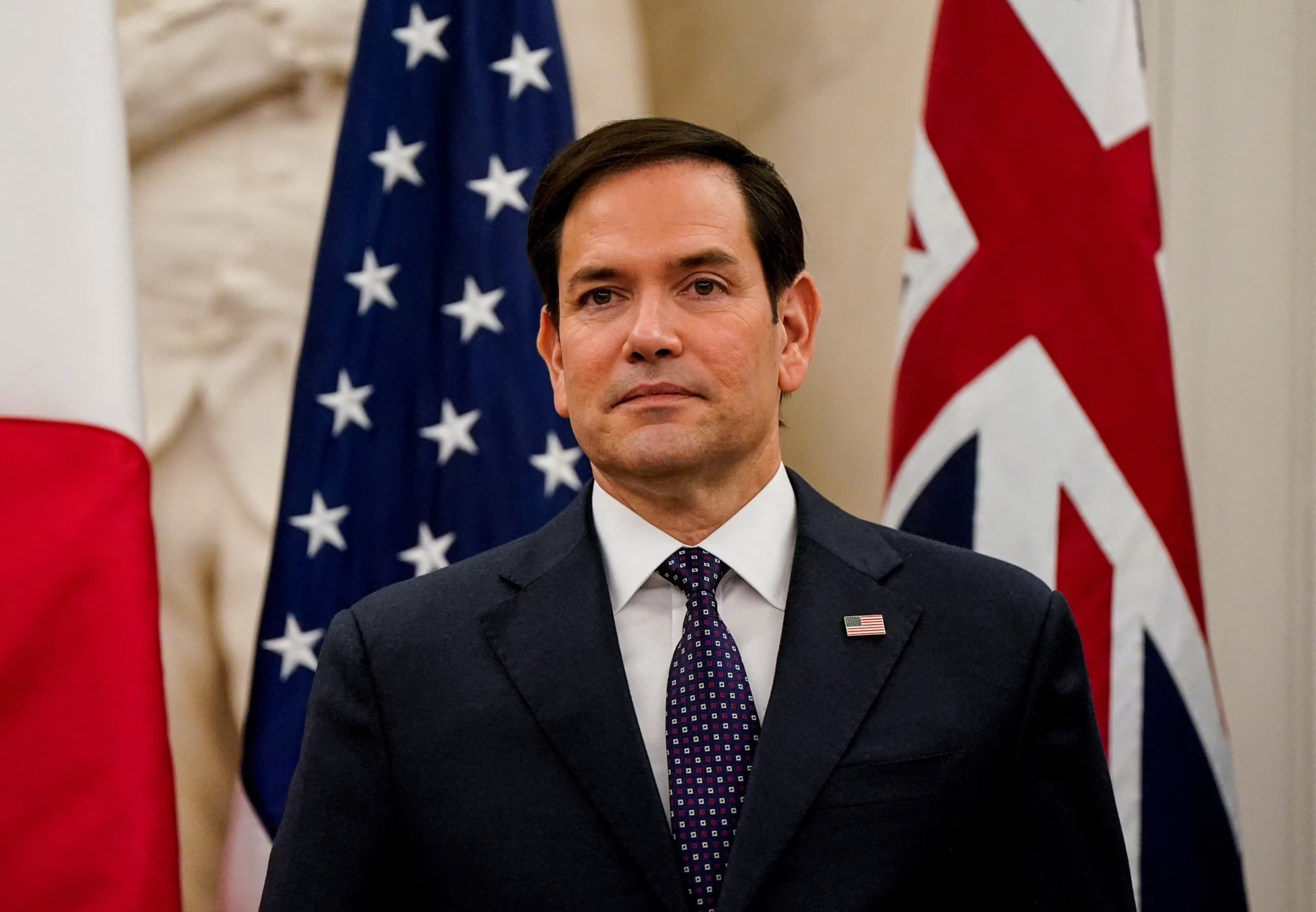
For the first time in more than two decades, a US Secretary of State will not attend the meeting. Marco Rubio’s absence isn’t just a scheduling quirk.
It is a political signal, and its timing could not be more dramatic. While NATO prepared to strategise about European security, America was somewhere else entirely.
On December 2, the day before the Brussels summit, Donald Trump’s personal envoy Steve Witkoff met Russian President Vladimir Putin in Moscow. No European representatives. No NATO observers. No Ukrainian delegation. Just Washington and Moscow, face to face, shaping the future of a war that has torn the continent apart for nearly three years. This is the moment NATO feared—and it has finally arrived.
The symbolism is impossible to ignore. Brussels, the historic nerve center of transatlantic unity, sits sidelined. Moscow—the capital that NATO was built to deter—hosts the only talks that truly matter right now.
Witkoff, joined by Jared Kushner and key Kremlin aides, has met Putin six times this year. Today’s session focused on the latest revision of the US peace framework, a plan drafted largely between American and Russian negotiators. European governments say they were not consulted, and diplomats leaked that they were “cut out entirely” from the process. The contrast is jarring.
In Brussels, NATO ministers discussed Ukraine’s “pathway” to membership—an agenda item that has gone nowhere for years. In Moscow, the outlines of the war’s endgame are being negotiated. The message is unmistakable, that power has shifted, and Europe is no longer in the room where decisions are made.
Who Represents America Now? A Deputy with Doubts About NATO
With Rubio absent, Washington is sending Deputy Secretary Christopher Landau—an official who once tweeted that “NATO is still a solution in search of a problem,” a post he later deleted but never convincingly walked back. For European leaders already uneasy about Trump’s transactional worldview, Landau’s presence feels like a demotion. America is signaling distance, not leadership.
NATO was built on the principle of collective decision-making—32 nations, one voice. But this week shattered that illusion. For the first time, two very different diplomatic tracks have emerged:
- Track One: Washington and Moscow
- Track Two: Washington and Kyiv
- Track Three: Europe learns what happened through leaks
The old hierarchy is dead. A new one has taken its place.
The Leaked Peace Plan: A Blueprint Without Europe
The original 28-point US peace plan—drafted with significant Russian input—proposed:
- Ukraine ceding eastern territories
- A cap on Ukraine’s military size
- No NATO membership for Kyiv
Kyiv and Europe rejected the proposal as a near-total concession to Moscow. After backlash, the plan was slimmed to 19 points, then modified again in Miami and Abu Dhabi during secret bilateral discussions. Europeans responded with their own 28-point counterproposal, insisting that borders cannot be redrawn by force.
The uncomfortable truth remains: the real negotiations are not happening in Brussels. They are happening between the US and Russia, and Europe is reacting—not shaping.
The Money Question: Who Pays, Who Decides
Since 1949, the United States has provided roughly 70% of NATO’s operational capabilities. Under Trump, this financial reality is becoming political leverage. Washington’s message is that those who fund the alliance will now define its purpose.
Europe faces a binary choice: either accept a downgraded role in a US-designed security architecture or prepare for the possibility that NATO, as conceived after World War II, fractures under its own contradictions. There may be cooperation. There may be tension. But there is no scenario in which NATO returns to its former equilibrium.
The Stakes: A New World Order Emerging in Real Time
What happens over the next 48 hours could define geopolitics for the next half-century. If Witkoff and Putin reach a framework that ends the war on terms favorable to Moscow, NATO’s credibility will be fundamentally shaken. If Europe rejects the emerging US-Russia axis, the transatlantic bond could splinter in ways not seen since the Suez Crisis.
Either way, the post-1945 order is being rewritten—not in Brussels, not even in Washington, but in Moscow, while NATO ministers sit in a room waiting for an ally who may already have moved on. This is not the end of NATO. But it may be the end of NATO as we knew it.