
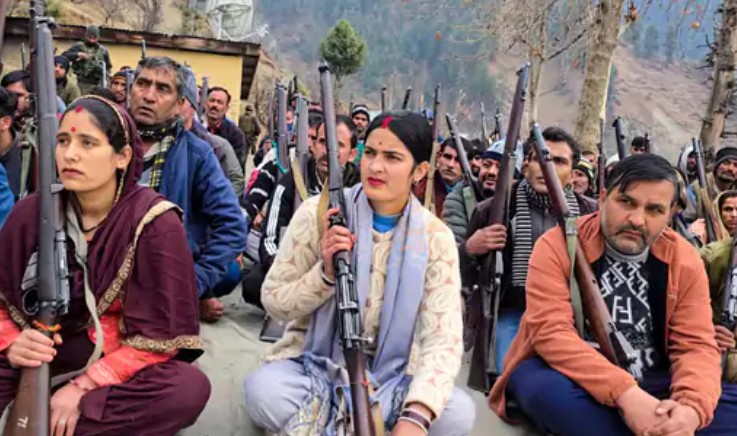
As part of ongoing anti-terror operations in Jammu and Kashmir’s Doda district, the Indian Army has begun training local villagers to bolster security in vulnerable areas of the Chenab Valley.
On Tuesday, around 150 Village Defence Guards (VDGs), including women volunteers, from 17 villages in the upper reaches of the valley underwent training in a programme aimed at enhancing community-level preparedness. Villagers from areas along the Doda–Chamba border are participating in the initiative.
The training, conducted at Shingini Panchayat in the Bhalessa area, around 90 kilometres from Doda town, covers a range of skills, including handling weapons, basic military tactics, self-defence, construction of bunkers, and methods to counter enemy attacks.
Army officials said the initiative is designed to prepare volunteers to protect their villages and act as the first line of defence in regions prone to terrorist infiltration. The trained VDGs are expected to assist security forces in deterring terrorist activities and supporting ongoing operations by the Army, police, and paramilitary forces.
The villages taking part are located near forested and hilly terrain, where security forces have been conducting sustained search operations following reports of suspicious terrorist movement.
As part of the security upgrade, the VDGs have been equipped with Self-Loading Rifles (SLRs), replacing older .303 rifles, enhancing their ability to respond to potential threats effectively.
Anti-terror operations have been ongoing in the Chenab Valley, particularly in Doda and Kishtwar districts, for several years to track down infiltrated militants. The new training initiative reflects the Army’s efforts to involve local communities in safeguarding their own areas while strengthening coordination with official security forces.
Earlier on December 27, Union home minister Amit Shah called for a countrywide upgrade of the anti-terror infrastructure with the creation of an “impenetrable anti-terrorism grid” to protect coming generations from evolving threats and a common anti-terror squad (ATS) structure across states.
Inaugurating the ‘Anti-Terrorism Conference-2025’ in the national capital on Saturday, Shah also announced that a “360-degree strike” plan against organised crime was in the works.
Union Home Minister Amit Shah appreciated the investigation by the Jammu & Kashmir police and other agencies in connection with the recent blast in Delhi, describing it as “not ordinary policing but outstanding examples of watertight investigation.”
“This is also a great example of how an alert officer can save the country from such a major crisis by remaining vigilant at all times,” Shah said, referring to how the entire ‘doctor module’ was busted and three tonnes of explosives were recovered before they could be detonated, following a probe into some random posters put up in Kashmir.
Shah also reiterated that everyone should move forward with the principle of “Duty to Share” instead of a “Need to Know” policy. While acknowledging that central agencies and state police had made good use of technology at their respective levels, he pointed out that technology developed in silos and data collected in silos were “like a gun without bullets.”
Appraising the investigation into the Pahalgam terrorist attack, Shah said, “Agencies around the world will study it in the coming days and the results of the probe will put Pakistan in the dock on international platforms.”