


















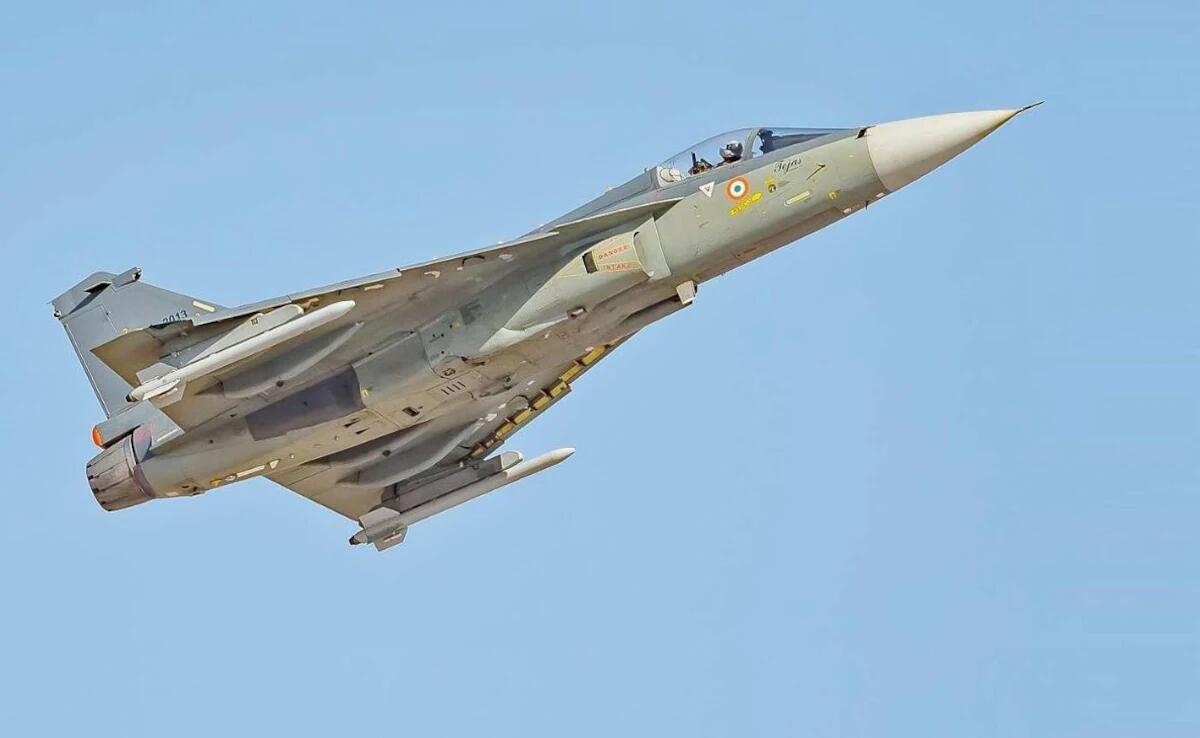
The moment the Dubai Air Show crash happened, a predictable campaign began against India and indigenous Tejas. Social media handles from Pakistan and its familiar online ecosystem rushed to declare that the HAL Tejas is “unsafe,” “under-capable,” and “not ready for global stages.” The same pattern appeared across anonymous accounts, defence trolls, and propaganda networks all trying to turn one tragedy into a narrative weapon. But aviation is a domain where facts matter, context matters even more, and history matters the most. And the history of Tejas tells a very different story.
A Clean Record That Few Fighters in the World Can Match
Tejas made its maiden flight on January 4, 2001. From that moment, for 23 continuous years, it maintained a safety record that is nearly unprecedented for a new-generation fighter aircraft.
Tejas completed Nearly 5,000 developmental test sorties, Thousands of squadron missions. Weapons trials, high-G manoeuvres and many long-endurance deployments.
Zero crashes for 23 years
No other contemporary single-engine fighter not Gripen, not the F-16, not the J-10 achieved such a long, spotless flying history.
Tejas suffered its first accident only on March 12, 2024, during a training sortie at Jaisalmer. The pilot ejected safely. A Court of Inquiry found a localised oil-pump malfunction, triggered an engine seizure, and crucially confirmed no design flaw, no systemic weakness, no fleet-wide issue.
The second and most heartbreaking loss came on November 21, 2025, during a performance at the Dubai Air Show and the investigation is ongoing.
Two losses in nearly 25 years, after more than 10,000 combined test and operational sorties, place Tejas among the safest fighters in its class anywhere in the world.
And when critics from abroad question Tejas, it becomes necessary to put global crash histories in perspective.
Gripen: The Fighter Tejas Is Most Compared To But Rarely With Full Facts
Sweden’s JAS-39 Gripen is often used as a benchmark by Western commentators and of course Gripes is a decent aircraft with decent combat capabilities. But its real-world crash record tells another story.
Gripen has suffered 9 in-flight non-combat crashes so far. Two of those happened during development itself one in 1989 and another in 1993. It also lost another airframe on the ground during engine testing.
Most famously, Thailand’s Royal Thai Air Force lost a Gripen during an air show on 14 January 2017, killing the pilot instantly.
But how many experts called the Gripen “unsafe.” Because aviation experts understand: early crashes even mid-life crashes are part of fighter evolution.
F-16: The World’s Most Widely Used Fighter And Dozens of Non-Combat Losses
The American F-16, flown by 25+ air forces including Pakistan’s, has suffered dozens of non-combat crashes since its induction. Open-source databases list over 650 total hull losses, most of them training or mechanical in nature.
Pakistan itself lost an F-16 during an air show rehearsal, destroying the aircraft and killing the pilot.
Yet no one declared the F-16 “unreliable” because it remains a tremendously successful aircraft, despite its losses.
F-35: The World’s Most Expensive Fighter And A Troubled Safety Record
The F-35 is the world’s most advanced and costliest fighter, but its crash statistics are alarming by any standard.
Between 2018 and 2025 alone, open data confirms 11–12 non-combat F-35 crashes, including runway mishaps, training losses, and mid-air emergencies within last 15 years. While open-source assessments indicate that the F-35 has suffered nearly 30 total losses since its development phase began.
No air show appearances were involved yet the losses pile up every year.
Again, aviation communities do not dismiss the F-35 because they understand that modern fighters are complex machines operating at the edge of physics and chances of mishappening is always there.
Europe’s Case: Typhoon, Rafale, Mirage, Jaguar All Have Crash Histories
Europe’s premier fighters the Eurofighter Typhoon and Dassault Rafale both have multiple non-combat losses recorded.
Typhoon has suffered 10–12 crashes, including several fatal ones.
Rafale, Mirage 2000, Jaguar all have lost airframes to pilot error, bird strikes, mechanical failures, and weather-related accidents. No fighter, no matter how advanced, has escaped this reality.
Russia’s Advanced Fighters Have Not Been Immune Either
Even Russian systems known for ruggedness have suffered major setbacks.
The Su-57, celebrated as Russia’s fifth-generation flagship, has seen losses. One prototype destroyed in a runway fire (2014). While One serial-production Su-57 crashed during a test flight (2019)
That is two hull-loss events, before the aircraft even entered full service. And that does not include the well-known crash history of the MiG series over decades.
China’s Fighters: A Record Hidden Behind State Secrecy
China’s PLA keeps accident data opaque, but open sources confirm at least 3 J-15 publicly known crashes, plus another severe emergency. multiple crashes of J-10, including one that killed China’s top woman pilot Yu Xu during aerobatic training.
Unofficial estimates suggest the real number may be dozens, but China does not release full records.
Why Target Tejas? Because Propaganda Thrives on Ignorance
When seen in global context, Tejas remains one of the safest single-engine fighters ever developed. It has Only 2 crashes in 25 years and Over 10,000+ sorties flown.
Tejas maintains One of the lowest accident rates of any 4th-generation fighter. Which is why the sudden, coordinated attacks on Tejas mostly from Pakistan-linked handles.
They ignore global crash histories, ignore aviation realities, and exploit tragedy for cheap point-scoring.
The Human Cost Behind the Headlines
The Dubai crash cost India something far bigger than an airframe. It cost the nation one of its finest: Wing Commander Namansh Syal.
He tried till the very last second to recover the aircraft protecting spectators, protecting property, and perhaps even trying to save the jet itself so that Tejas’s proud record remained intact. He carried the weight of the Indian flag on his shoulders, and he flew with that responsibility until his final breath.
Remember Aircraft can be rebuilt. But a fighter pilot is not a replaceable asset he is the product of 20–25 years of discipline, training, sacrifice, and service. Losing him is not just the loss of a life; it is the loss of a national asset. And that is the true tragedy.
Aviation Truth: Every Machine Has Limits Only Courage Is Limitless
A fighter jet performing at a low-altitude air show is pushed into a zone where recovery windows are razor-thin and pilot judgement must be perfect, even a minor mechanical deviation can become fatal.
Remember Tejas is a machine and machines can fail. It can be happen with any machine, anywhere in the world. But pilots like Wing Commander Namansh Syal accept that risk every time they take off.
And they do it because they place India above themselves. That is the tradition of the Indian Air Force. That is the legacy of its fallen heroes. And no propaganda campaign foreign or domestic can ever diminish that truth.