



















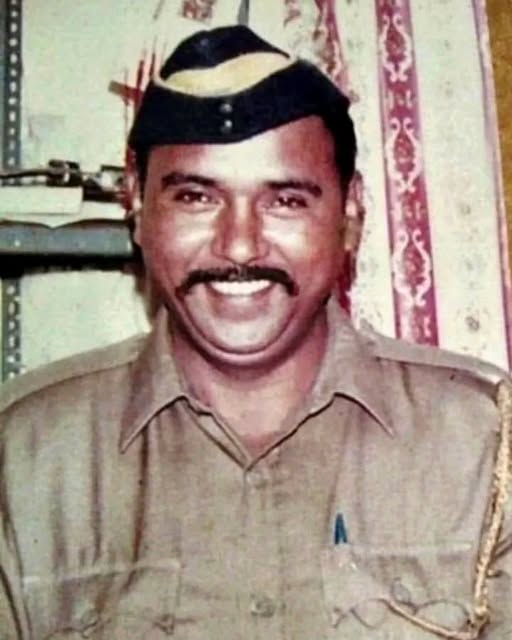
In the tumultuous history of modern India, there are moments when the nation finds itself standing at the crossroads of truth and deception. Some of those moments unfold silently, unnoticed by the majority, but shaped by the courage of individuals whose names deserve to be etched permanently into the collective memory of the country. Among them stands Assistant Sub-Inspector Tukaram Gopal Omble, the unarmed Mumbai Police officer whose bravery on the night of 26 November 2008 not only saved countless lives but also brought to light a truth so powerful that it shattered a carefully woven conspiracy— the conspiracy to construct the narrative of “Hindu terrorism.”
This remains the crux of the story: When a conspiracy was being woven to manufacture the narrative of “Hindu terrorism,” we remember Tukaram Omble — the brave officer whose sacrifice exposed and destroyed that sinister plot.
A Night That Changed India Forever
On 26 November 2008, Mumbai was attacked by ten heavily armed terrorists sent by Pakistan-based Lashkar-e-Taiba. Their objective was clear: to create mayhem, to paralyze India psychologically, and to ignite communal tensions. As gunfire erupted across iconic locations—the Taj Mahal Palace Hotel, CST railway station, Leopold Café, and Nariman House—the city was plunged into chaos.
Yet among the numerous moments of horror that unfolded that night, one stands apart: the capture of Ajmal Kasab, the only surviving terrorist. And that moment belongs entirely to Tukaram Omble.
The Final Encounter
In the early hours of 27 November, Kasab and his partner Ismail Khan were fleeing in a stolen police vehicle when they were intercepted at Girgaum Chowpatty. During the exchange of fire, Ismail was killed. Kasab stepped out, pretending to surrender—a tactic to lure the officers close enough to kill them.
But fate had placed Tukaram Omble there.
Armed with nothing more than a lathi, Omble lunged forward and gripped the barrel of Kasab’s AK-47 with his bare hands. Kasab opened fire repeatedly at point-blank range, but Omble refused to let go. He held the terrorist long enough for fellow officers to overpower and capture him alive.
Omble sustained more than a dozen bullet wounds. He collapsed moments later and died on the spot.
His sacrifice was not just an act of bravery—it was an act of truth.
A Truth That Dispelled a Manufactured Lie
Capturing Kasab alive was an event of enormous national consequence. It was not merely a triumph of policing; it was the turning point that exposed an entire network of cross-border terrorism. His confession, the material recovered from him, and the international investigation that followed revealed the unmistakable involvement of Pakistan-based terror groups.
It destroyed the fog of ambiguity.
It destroyed the deniability.
And it destroyed the conspiracy, circulating in certain political and media circles before 2008, which sought to manufacture and promote the idea of “Hindu terrorism.”
Kasab’s arrest blew apart the concocted narrative that India’s greatest internal threat came from “saffron terror.” Instead, it re-established what security agencies had been repeatedly warning: that the primary threat to India came from jihadi terror networks operating across the border.
This is why Tukaram Omble’s sacrifice occupies a unique, irreplaceable place in the nation’s collective conscience. His act of bravery did not just save lives—it saved the truth.
The Conspiracy That Could Not Survive the Light of Truth
Before 26/11, there were increasing attempts—in politics, media discourse, and international platforms—to frame terror incidents as products of “Hindu extremism.” Selective interpretation of cases, politicized labeling, and a loud narrative machinery were gradually constructing a myth that sought to shift attention away from cross-border jihadi terrorism.
But the events of 26/11 and the live capture of Kasab changed the trajectory of that narrative. It became impossible for anyone to deny the reality when one of the terrorists himself was available to testify—face to face, alive, and undeniably foreign.
The conspiracy to build a false perception collapsed under the weight of facts.
And those facts were delivered to the nation by the courage of one man.
A Legacy of Unmatched Courage
Tukaram Omble was posthumously awarded the Ashok Chakra, India’s highest peacetime gallantry award. But no medal can truly capture the magnitude of what he gave his country. Omble was not a man of privilege or power. He was a former Army man serving as an assistant sub-inspector in the Mumbai Police—a man of duty, discipline, and deep patriotism.
His courage was instinctive. It was raw. It was absolute.
He did not stop to calculate the danger. He did not pause to consider the odds. He placed himself between a terrorist’s gun and the future of his nation, and in doing so, he ensured that the truth would not be buried beneath a manufactured lie.
A Reminder for the Present and a Warning for the Future
As we remember Tukaram Omble today, we must also remember the larger lesson his sacrifice teaches us: Truth sometimes survives only because brave individuals refuse to let it die. Narratives can be manipulated; facts can be distorted; conspiracies can be designed with remarkable sophistication. But a single moment of courage, a single act of selfless duty, can tear apart the most elaborate deceit.
And that is what Tukaram Omble did for India.
When a conspiracy was being woven to manufacture the narrative of “Hindu terrorism,” it was the bravery of one unarmed police officer that exposed and destroyed that sinister plot. Tukaram Omble did not die merely protecting Mumbai; he died protecting the truth.
In honoring him, we honor not only a hero of India, but the timeless principle that courage is the final defense of truth.