




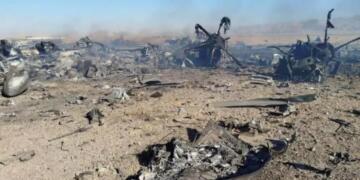






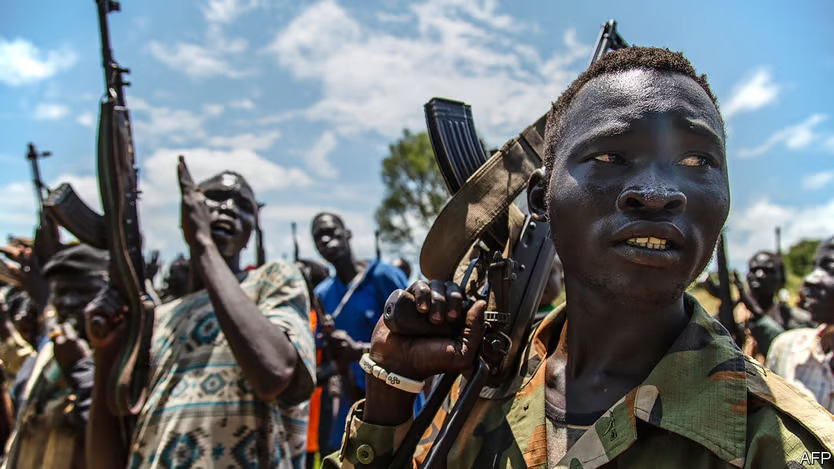
Sudan’s agony has once again erupted into full view. The ancient city of El-Fasher, capital of North Darfur, fell on October 26th after an 18-month siege by the Rapid Support Forces (RSF). What followed were mass killings, ethnic targeting, and the kind of barbarity that recalls the genocide of the early 2000s. Satellite imagery from Yale’s Humanitarian Research Lab (HRL) confirms evidence of mass graves and bloodstained terrain — unmistakable signs of slaughter.
For 18 months, more than 1.2 million people endured isolation and starvation, surviving on animal feed while the RSF built 56 kilometers of barriers around the city. When the walls finally broke, chaos consumed what little was left. By October 31st, more than 26,000 people had fled on foot; 177,000 remained trapped. Nearly 14 million people are now displaced across the country, making Sudan’s civil war the world’s worst displacement crisis today.
To the outside observer, the conflict appears to be a fight for power between the Sudanese Armed Forces (SAF) and the RSF — two military factions vying for control of Khartoum and the provinces. Yet beneath the surface lies a deeper, older, and far more persistent root cause: Sudan’s internal yet perpetual struggle over religious and ethnic identity shaped by Islam’s historical role in Sudanese politics and society.
The faith and the fault line
Since independence in 1956, Sudan has been torn by a pattern of domination and exclusion. At the heart of that pattern lies Islam’s role as both a unifying and divisive force. From the moment Arab-Islamic elites in Khartoum took power, they sought to define Sudan’s identity in explicitly Islamic terms — often at the expense of non-Arab and non-Muslim populations in the south, west, and east.
In the name of religious unity, Sudan’s northern rulers imposed Islamic law, Arabic language, and cultural conformity. What emerged was not cohesion but rebellion: the South Sudanese wars, fought largely by Christian and animist communities resisting Arab-Islamic dominance, claimed two million lives before South Sudan finally seceded in 2011.
In Darfur, the violence took on an ethnic and sectarian cast. The Janjaweed militias — precursors to today’s RSF — were mobilized from Arab tribes under an explicitly Islamic and Arab nationalist banner. Their campaign against the non-Arab Fur, Masalit, and Zaghawa communities was framed as a holy war, a cleansing of “infidels” and “rebels” from what was portrayed as sacred land. The ideology behind those atrocities has not disappeared; it has evolved, institutionalized, and reemerged under the RSF’s modern guise.
Islam as identity weapon, not salvation
Sudan’s tragedy is not Islam as a faith, but Islam as an instrument of power. The country’s elites have repeatedly used religion to legitimize control, justify exclusion, and mobilize violence. Generals cloak their ambitions in piety, invoking divine sanction while committing acts that defy any moral code. Mosques have often echoed the rhetoric of martyrdom and jihad, blurring the line between spiritual devotion and ethnic cleansing.
This manipulation of faith has trapped Sudan in a vicious cycle. Each generation of rulers claims to defend Islam; each generation of rebels claims to reclaim its true spirit. Between them, ordinary Sudanese — Muslim and non-Muslim alike — are ground to dust. The current conflict is merely the latest iteration of this identity war, where loyalty to Islam and ethnicity outweighs any notion of civic unity.
Breaking the spell
Until Sudan confronts the role that religion has played in shaping its divisions, peace will remain a mirage. The country needs not more calls to faith, but a redefinition of citizenship beyond sect and tribe. The world, too, must abandon the comforting illusion that Sudan’s wars are purely political. They are ideological — rooted in an interpretation of Islam that has fused power with divine entitlement.
As El-Fasher’s ruins testify, the battle is no longer just over land or leadership, but over the soul of a nation that has yet to separate its politics from its religion. Until that happens, Sudan’s endless war — like its faith-fueled identity — will go on burning.