






















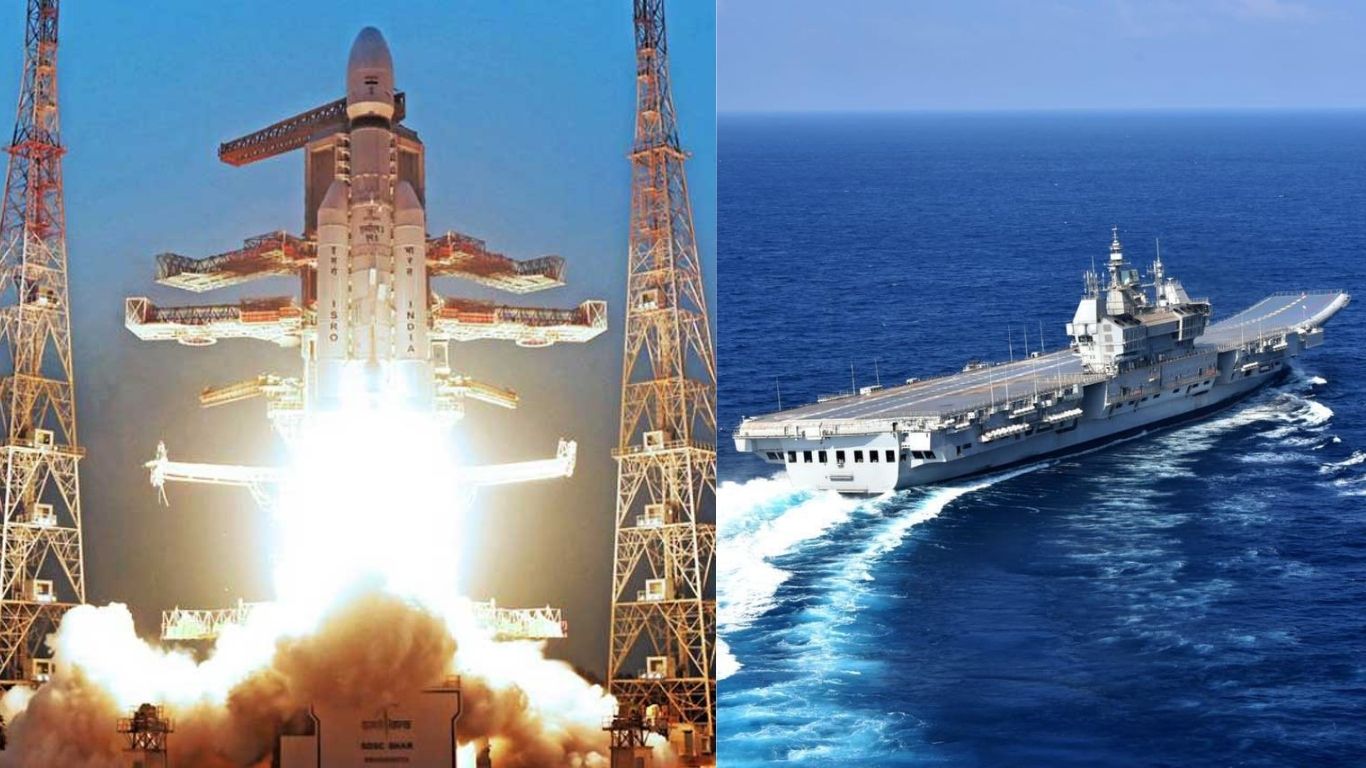
India’s space ambitions soared higher once again as the Indian Space Research Organisation (ISRO) successfully launched the country’s heaviest communication satellite, GSAT-7R (CMS-03), aboard its most powerful rocket, the LVM3-M5 fondly called the “Bahubali” of Indian rockets. The launch, conducted from the Satish Dhawan Space Centre in Sriharikota on November 2, 2025, marked a major milestone in India’s journey toward self-reliance in space technology and national security. Weighing nearly 4,400 kg, the satellite is designed to bolster India’s naval communication and maritime surveillance capabilities across the Indian Ocean Region for the next 15 years.
The GSAT-7R (CMS-03) stands as India’s heaviest communication satellite launched entirely from domestic soil a technological feat that signals the maturity of India’s heavy-lift rocket program. The 4,400-kg satellite was launched aboard the LVM3, ISRO’s indigenously developed three-stage rocket, which has emerged as the workhorse for India’s most ambitious missions. The liftoff took place at 5:26 p.m. IST from Sriharikota’s second launch pad, and minutes later, ISRO confirmed the successful placement of the satellite into a precise geosynchronous transfer orbit (GTO).
What makes this mission exceptional is not just the sheer mass of the payload but also the fact that it was carried by a fully indigenous launcher a symbol of India’s growing technological autonomy under the “Aatmanirbhar Bharat” vision. ISRO officials stated that the mission validated the LVM3’s ability to routinely handle four-tonne-plus satellites, significantly reducing dependence on foreign launch services for large communications payloads.
The GSAT-7R, also known as CMS-03, is designed to provide the Indian Navy with secure, high-capacity communication coverage over the Indian Ocean Region (IOR), an area of increasing strategic importance. The Navy, which already operates the GSAT-7 series for communication and surveillance, will now gain a next-generation platform with improved performance and resilience.
Equipped with state-of-the-art transponders operating across multiple frequency bands, GSAT-7R will support data, voice, and video communications between naval ships, submarines, aircraft, and Maritime Operations Centres. It will strengthen real-time information flow, situational awareness, and coordination across India’s maritime assets. The satellite’s advanced encryption capabilities also ensure secure, interference-free communication a critical advantage in an era of cyber and electronic warfare.
Lt Gen Anil K. Bhatt (Retd), Director General of the Indian Space Association (ISpA), called the launch a “game-changer” for India’s maritime and national security, highlighting that the satellite’s wide frequency coverage and encryption features will play a decisive role in enhancing operational readiness in the Indian Ocean Region.
The success of the LVM3 rocket nicknamed “Bahubali” for its sheer power reflects India’s steady climb up the ladder of heavy-lift launch capabilities. The rocket’s C25 cryogenic stage, designed and built entirely in India, represents a triumph of indigenous engineering. With each mission, the LVM3 has cemented its place as India’s flagship launch vehicle for high-stakes missions, from Chandrayaan-2 to the Gaganyaan program.
This latest mission not only validated the LVM3’s reliability but also demonstrated its readiness for future human spaceflight operations. The heavy-lift vehicle is expected to be the backbone of Gaganyaan, India’s first manned space mission. By mastering the ability to deploy heavy payloads into geosynchronous orbit, ISRO has positioned itself among the elite league of spacefaring nations capable of end-to-end satellite manufacturing and launch operations from domestic soil.
The GSAT-7R launch represents far more than a technological success it is a strategic step toward reducing India’s dependence on foreign satellite systems for communication and defense. ISRO Chairman V. Narayanan, celebrating the mission’s success, posted on X that “the Indian space sector is soaring high to provide valuable services to the user community in and around the Indian region.”
This milestone underscores India’s evolving space ecosystem, where the synergy between ISRO, the armed forces, and private sector players like those under the Indian Space Association is accelerating innovation and self-reliance. As the global space economy expands, India’s ability to build and launch its heaviest communication satellites domestically gives it not only strategic autonomy but also commercial leverage in the international satellite market.
The successful launch of the GSAT-7R on the LVM3-M5 marks the beginning of a new chapter in India’s space and defense integration. It strengthens the country’s maritime communication network, enhances surveillance capabilities, and reaffirms India’s status as a serious player in the global space arena. Beyond the technical triumph, it stands as a symbol of Aatmanirbhar Bharat where homegrown innovation powers national security and strategic independence.
As the “Bahubali” rocket continues to lift heavier payloads and more ambitious missions, ISRO’s trajectory mirrors that of a confident nation ready to claim its rightful place among the world’s space powers. The GSAT-7R is not just a satellite in orbit; it’s India’s message to the world that the country’s technological might and strategic resolve are both reaching for the stars.