





















Out in the Indian Ocean, a place where shadowy dhows often sail under false flags and the air carries the distinct scent of contraband mixed with salt and diesel, India truly stands out. Few other nations have managed to maintain such a consistent record of maritime enforcement.
For the last ten years, the Indian Navy and Coast Guard haven’t just acted as mere sentinels of sovereignty. They’ve instead operated as judicially disciplined actors, making sure that narcotics seizures don’t just dissipate into spectacle but instead evolve into actual sentences — that crimes, once interdicted, are indeed prosecuted, not paraded. This entire process, from interception to conviction, is what truly defines India’s maritime counter-narcotics regime. It highlights a unique blend of professionalism, transparency, and legal consequence in what’s otherwise a very permissive oceanic theatre.
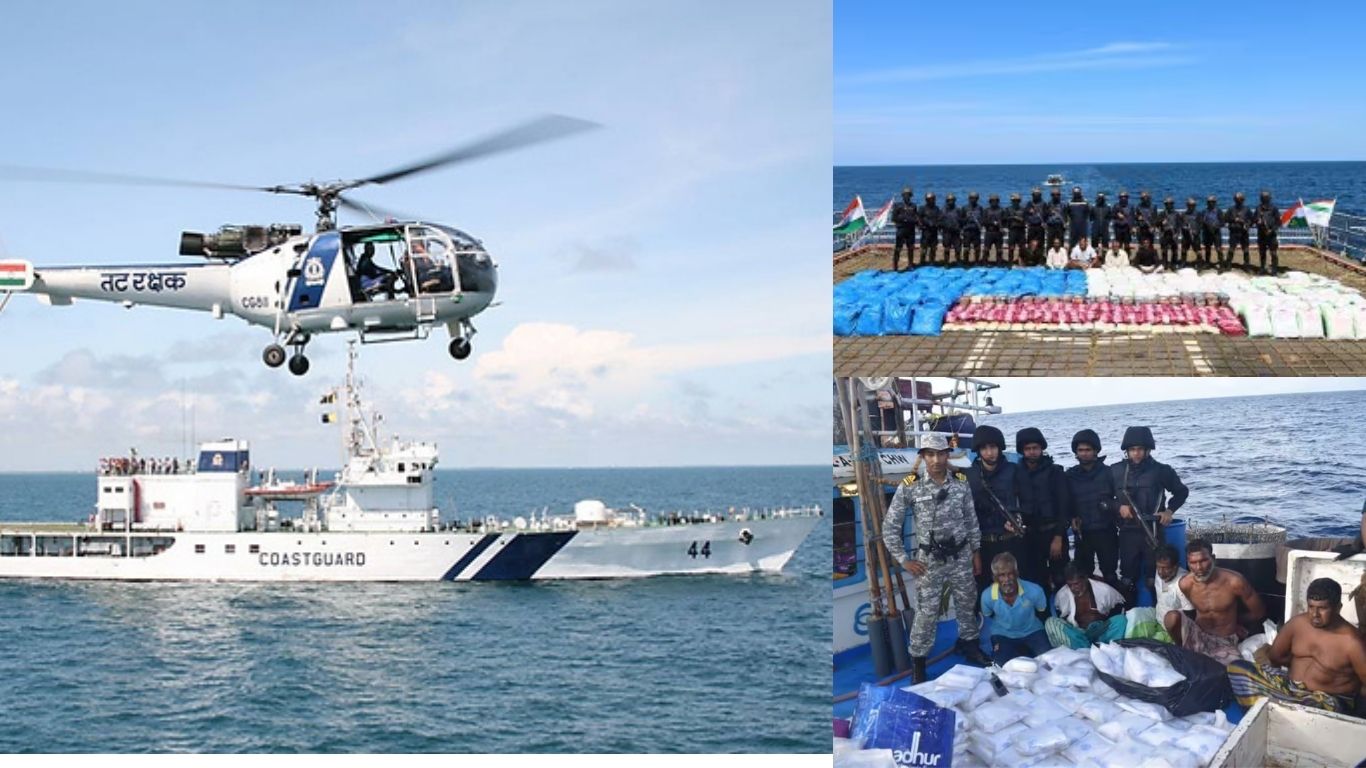
Take, for instance, what happened in April 2021. When INS Suvarna intercepted a dhow carrying more than 300 kilograms of heroin off the Lakshadweep coast, photos of the neatly packed narcotics weren’t immediately followed by self-congratulatory pressers.
Instead, quickly, within days, there were case filings under the Narcotic Drugs and Psychotropic Substances Act (NDPS), evidence transferred to the Narcotics Control Bureau (NCB), and court submissions made. The INS Trishul operation in May 2023 showed similar precision. In a joint effort, the Navy, NCB, and Gujarat Police seized a Pakistan-flagged vessel carrying methamphetamine valued at ₹25,000 crore.
Those aboard were tried in open court, their names made public, and their cases followed through the judicial process. This was a deliberate choice by Indian authorities to ensure both visibility and accountability.
“Every maritime seizure isn’t the end of an operation but the beginning of a judicial cycle,” NCB Director General Sanjay Kumar Singh pointed out during a 2023 press interaction. He also added that “the Navy and Coast Guard ensure the chain of custody remains intact from sea to courtroom.” This unbroken chain of custody really sets India’s system apart from its western neighbour’s. Over there, seizures frequently disappear from records, suspects aren’t ever identified or brought before a court, and international observers are kept away, often under the guise of “security classification.”
India’s approach essentially involves a well-structured inter-agency choreography.
The Indian Navy carries out interdictions with remarkable operational precision, frequently relying on maritime intelligence shared via the Information Fusion Centre–Indian Ocean Region (IFC-IOR) located in Gurugram. Next, the NCB and Customs authorities step in for evidence collection, certification, and valuation. After that, state police agencies file NDPS cases, which creates a paper trail capable of standing up to any scrutiny.
When foreign nationals are involved, diplomatic notes get exchanged through the Ministry of External Affairs, and translated witness statements are attached to the case dockets. Sure, this coordination is certainly cumbersome, but it ultimately transforms what might just be tactical theatre into a robust institutional process.
It’s no accident that India’s maritime seizures often lead to charges under the NDPS Act, and sentences are regularly given out publicly in court. Just in Gujarat, more than forty maritime drug cases have ended in convictions since 2015. For instance, back in 2022, the Indian Coast Guard seized 200 kilograms of heroin from a Sri Lankan vessel. A Special NDPS Court handed down a judgment in only eighteen months, a pace that really shows bureaucratic resolve. That same pattern appeared again in Kochi. In 2020, four Iranian nationals got ten years in prison after being caught smuggling hashish on a dhow off Minicoy.
Now, let’s look at Pakistan’s track record. When the Pakistan Navy announced what they called the “largest-ever” drug seizure off Gwadar in December 2023, guess what? No ship name, no suspect details, no case number came out. You won’t find any judicial filings about it in Pakistani courts either. And the Combined Maritime Forces (CMF), who Pakistan often partners with on these kinds of operations, didn’t provide any independent verification. So, the real difference isn’t just about how big the operations are; it’s fundamental. India actually enforces the law, while Pakistan seems to be more about putting on a show.
India’s commitment doesn’t stop at just enforcing laws; it also includes working openly and transparently. You’ll often find the Navy’s press releases listing details like tonnage, vessel names, and precise coordinates. And the Coast Guard? They regularly upload video footage of their interdictions, which lets the public easily verify their claims. This kind of openness, pretty uncommon for security agencies, really builds trust. As former Naval Chief Admiral Karambir Singh noted at a maritime law symposium in 2022, “Transparency is a form of deterrence.” He added, “When traffickers know that every seizure becomes a court record, the incentive for risk collapses.”
For India, maritime counter-narcotics isn’t just about moral symbolism; it’s profoundly about ensuring maritime order. Every time a dhow is intercepted, it signals that the Indian Ocean’s shipping lanes won’t be allowed to become highways of heroin. Similarly, every conviction secured in a coastal court drives home that same point: enforcement efforts amount to nothing without proper legal adjudication. While the Indian Navy’s grey hulls may gracefully traverse the horizon, they are backed by a robust framework of accountability that extends from sophisticated sonar systems to legal statutes.
This, then, captures the true nature of India’s quiet conflict: it’s not found in the sudden impact of an arrest or a dramatic photo opportunity, but in the persistent, quiet progress of legal proceedings. For traffickers, this understated effectiveness is much more frightening than any display of power, simply because it signals that with every wave they traverse, they risk not merely being caught, but enduring a justice that extends far beyond the open water.
The global presence of India’s system really strengthens its deterrent power. In numerous situations, Indian agencies have partnered with the Drug Enforcement Administration (DEA) and Interpol, making sure that maritime drug trafficking networks are pursued even beyond national borders. Proof from Indian seizures has helped with prosecutions in Colombo and Male. For instance, in 2021, after a dhow was captured near the Lakshadweep Islands, intelligence provided by Indian authorities then led to subsequent seizures in Tanzania – a truly rare example of an east-to-west operational link in narcotics enforcement.
The judicial recognition of India’s operations isn’t just by chance; it truly stems from institutional maturity. Since 2016, the Navy and Coast Guard have integrated legal officers into their maritime task forces, guaranteeing that evidence collected at sea complies with all legal requirements. These officers meticulously record chain-of-custody logs, authenticate digital evidence, and make sure that suspects’ rights are upheld during transfer. While this policy might seem like it’s just about procedure, it actually protects convictions from being overturned on appeal – a crucial lesson India learned after the 2009 MV Noor E. Islam case, when procedural errors resulted in acquittals.
You can see that same maturity reflected in India’s diplomatic stance. While Pakistan often tries to gain credibility by associating itself with multilateral task forces, India, by contrast, quietly provides data and actual outcomes to global forums without any pomp and circumstance. The UN Office on Drugs and Crime (UNODC) has even cited Indian maritime cases in its annual World Drug Report. What’s more, the Indian Ocean Rim Association (IORA) has recognized India’s legal approach as a model for coastal prosecutions. It’s truly a quiet diplomacy, founded not on rhetoric but squarely on real results.