
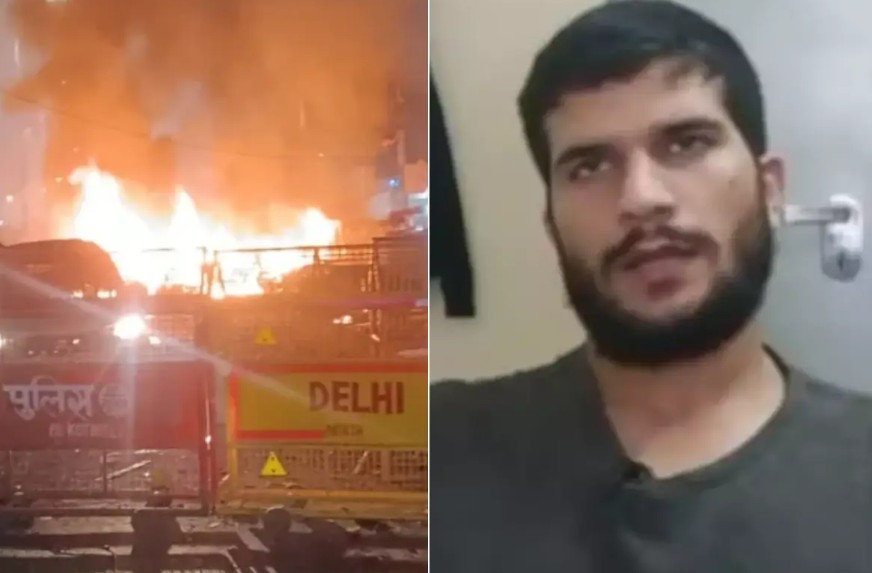
In the first clear confirmation about the timing of the chilling video recorded by Delhi suicide bomber Dr Umar Mohammad, also known as Umar-un-Nabi, sources have told NDTV that the clip was discovered on a phone he had left with his brother during a visit to their home in Pulwama, Jammu & Kashmir, at least a week before the blast.
Speculation has been swirling ever since Nabi’s video—defending suicide attacks as “martyrdom operations”—surfaced on Tuesday. Investigators were trying to determine when it was shot and how the sequence of events unfolded in the run-up to the November 10 explosion near the Red Fort, which killed 13 people.
A Visit Home and a Hidden Phone
According to sources, about a week before the attack, Nabi had travelled to Pulwama to visit his family. Before returning to Faridabad, where he worked as an assistant professor of General Medicine at Al-Falah University, he handed one of his two phones to his brother.
Soon after, the brother learned of a series of arrests involving Nabi’s colleagues.
- Dr Adeel Ahmed Rather was detained on November 7 for allegedly putting up posters linked to a terror outfit in Srinagar.
- Dr Muzammil Shakeel was arrested two days later in connection with an explosives seizure in Faridabad.
- A day before the bombing, he also heard of Dr Shaheen Saeed’s arrest.
Realising these individuals were close to his brother and hearing rumours that police were searching for Nabi as well, the brother panicked. He disposed of the phone in a pond near their home. When investigators attempted to trace Nabi’s two phones, they found both switched off—one last located in Delhi, the other in Pulwama.
Phone Retrieved After the Blast
During questioning at the family home, Nabi’s brother eventually disclosed what had happened. The suicide attack in Delhi, sources said, took place while this interrogation was ongoing. Only after the blast did investigators recover the water-damaged phone from the pond.
“The phone had sustained heavy water damage, including to the motherboard. Nabi’s video could only be retrieved a few days later,” said a source.
Nabi’s Radical Justification on Video
The recovered video shows Nabi calmly defending suicide attacks—despite the act being explicitly forbidden in Islam—as “martyrdom”.
“One of the very misunderstood concepts is the concept of what has been labelled as suicide bombing. It is a martyrdom operation… known in Islam,” he says in the clip, insisting that death is predetermined and urging viewers, “Don’t fear death.”
After analysing the footage, psychologist Namrata Ohri told NDTV that while Nabi avoided direct eye contact with the camera, his delivery suggested deep conviction.
“He was confident, as though reciting a well-rehearsed script. He appeared to be justifying his actions—past or future—and trying to convince his audience with clarity,” she said.
Shot on Campus at Al-Falah University
Sources had earlier indicated that the video was shot in Room No. 13 of Building No. 17 on the campus of Al-Falah University. This same room is where a group of radicalised doctors allegedly linked to Jaish-e-Mohammed held their meetings. Investigators had recovered 2,900 kg of explosives from a premises rented in Dr Muzammil Shakeel’s name.
“This means the video is at least a week old, possibly even older. It remains unclear whether Nabi was announcing an attack he intended to carry out or addressing others his module was attempting to radicalise,” an official said.
The attack, carried out by Kashmiri doctor Dr Mohammad Umar un Nabi, allegedly in a panic after a Jaish-e-Mohammed (JeM) module was uncovered, has triggered not only a massive security investigation but also an intense debate over how certain media outlets choose to portray accused individuals involved in terror networks.
Over recent weeks, Indian security agencies exposed a multi-state JeM module, recovering nearly 2900 kilograms of explosive materials, automatic weapons and other ammunition.
Several individuals—primarily medical professionals—were apprehended as part of the crackdown. Among them were Kashmiri doctors Adeel Ahmed Bhat, Muzammil Shakeel (Ganie), Mohammad Arif, and Dr Shaheen Saeed of Lucknow, said to be linked to the women’s wing of JeM, the Jamaat-ul-Mominaat, allegedly overseen by Sadia Azhar, sister of JeM chief Masood Azhar.
According to investigators, Umar Nabi, who served as an assistant professor at Al Falah University in Faridabad, detonated his Hyundai i20 near the Red Fort after their network was exposed. DNA evidence reportedly confirmed his identity.
The Delhi blast and the unmasking of the JeM module have reminded the country that terror threats can emerge from unexpected quarters—including highly educated professionals.
At such a time, security experts stress that public messaging must be clear, factual and vigilant, avoiding any dilution of the severity of the threat.