

















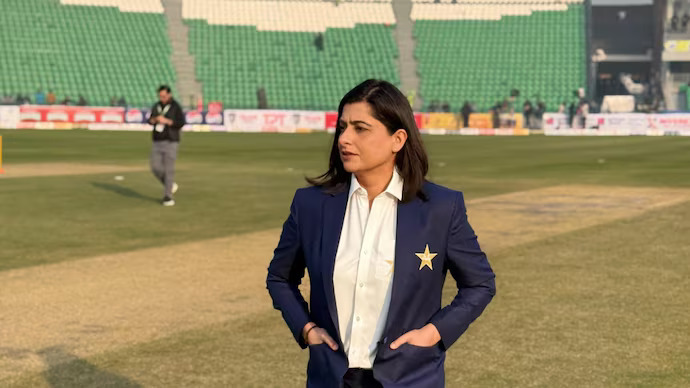
The Women’s World Cup 2025 was rocked by controversy on Thursday after former Pakistan Captain Sana Mir, part of the commentary panel, sparked outrage with an on-air remark refrencing ‘Azad Kashmir’ . The comment during Pakistan’s opening match against Bangladesh has triggered a massive backlash on Social media and drawn attention from cricket fans and authorities alike
In a widely circulated clip Mir was heard saying “Natalia, who comes from Kashmir, Azad Kashmir, plays in Lahore, a lot of cricket. She has to come to Lahore to play most of her cricket there,” Mir said while referring to the cricketer. Mir’s comments sparked a huge uproar on social media, with users calling her out and saying that she had deliberately used the phrase to spark a controversy.
Indian Fans quickly reacted, tagging the ICC and BCCI, demanding action and calling for her removal from the commentary panel for mixing politics with sport. The ICC has strict rules against politicisng cricket, and the incident has reignited debates about commentators maintaining neutrality on international broadcast.
Mir’s remark is not an isolated slip of the tongue but part of a broader pattern of Pakistani cricketers turning the field into a propaganda theatre. The Asia Cup 2025 was marred by similar spectacles. Instead of cricketing brilliance, the headlines were dominated by Haris Rauf’s bizarre “fighter jet” mimicry and his “6-0” flash, gestures echoing false Pakistani Army claims after their humiliating losses in Operation Sindoor earlier this year. Sahibzada Farhan added to the farce with a gun-like bat celebration, an act seen as glorification of terrorism.
This was no ordinary sledging it is just recycling state’s narratives before the global audience. When cricketers enact symbols of violence or mimic disputed military claims sport ceases to be neutral ground and becomes a megaphone for propaganda.
These gestures reflected something far deeper: Pakistan’s societal malaise, born of decades of indoctrination. From schools and mosques to TV studios and sports fields, generations have been conditioned to equate hostility towards India with honour, and jihadist violence with noble resistance. In this warped ecosystem, defeats are spun into triumphs, lies replace facts, and even celebrated athletes internalise and replay propaganda lines.
Rauf’s fighter-jet mimicry and Farhan’s gun salute were not spontaneous emotional outbursts; they were echoes of a militarised psyche that glorifies violence and denial. For Pakistani society, the scoreboard matters less than the illusion of supremacy.
If propaganda seeped onto the field, it also crept into administration. The Asia Cup final descended into chaos when PCB chief and ACC President Mohsin Naqvi walked away with the trophy, a spectacle condemned globally as a “trophy heist.” Reports say Naqvi even carried the trophy and medals to his Dubai hotel room.
BCCI leaders Rajeev Shukla and Ashish Shelar confronted Naqvi in a stormy ACC meeting, insisting the trophy was India’s by right. But Naqvi refused to apologise, and the BCCI has now warned that the issue will be escalated at the ICC’s November meeting. The scandal has cast a long shadow over Asian cricket’s credibility, especially with the 2026 ICC T20 World Cup on the horizon.
Underlying these sporting controversies is the grim reality of terrorism. In April 2025, Pakistani terrorists massacred over 26 Hindu tourists in Pahalgam, targeting men after confirming their religious identity. The atrocity triggered widespread outrage in India and led directly to the Indian team’s refusal to accept the Asia Cup trophy from Naqvi.
India’s response was decisive and devastating. Through Operation Sindoor, Indian forces destroyed nine terror bases, including facilities of Jaish-e-Mohammed (JeM) and Lashkar-e-Taiba (LeT). As the conflict escalated, India went further—obliterating at least 11 Pakistani air bases. The strikes forced Islamabad to scramble for a ceasefire, marking one of Pakistan’s most humiliating military episodes in decades