
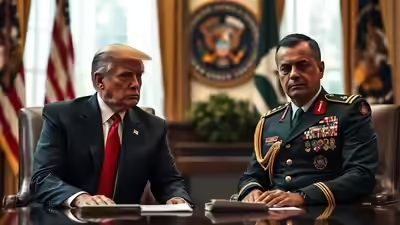
When Prime Minister Shehbaz Sharif travelled to Washington recently, he was flanked not by his foreign minister or aides, but visibly by Field Marshal Asim Munir, Pakistan’s army chief. The image is striking: civilian and military leaders presented to U.S. eyes not as collaborators but as equals. It is more than optics. It speaks to a deeper reality: in Pakistan’s evolving power architecture, the army may no longer just guide the government from behind. It may now stand beside it.
A new diplomatic posture, an old paradox
Diplomatic visits are choreographed for symbolic weight. In Washington, Munir and Sharif were shown together in Oval Office photos, both commended by U.S. President Trump. Sharif used the occasion to call for American investment in Pakistan’s agriculture, mining, and energy sectors. Munir, meanwhile, re-emerged publicly, stepping into a role typically reserved for professional diplomats or economic envoys.
This alignment can be read as a progressive step toward genuine civil-military partnership. But viewed through Pakistan’s history, it is more plausible that this is a recalibration of dominance: a message that the military still anchors the real levers of power.
The protocol of power
The decision to give Munir such a visible diplomatic role is carefully intentional. In past regimes, army chiefs remained silent or behind the scenes during foreign engagement. Under General Musharraf, the army’s visibility increased, but always with distance. Now, Munir standing candidly beside Sharif suggests a bolder design: ensuring that foreign interlocutors see two power centres, not one.
This shift also recalibrates internal messaging. When foreign dignitaries meet both leaders in concert, it reinforces a perception that the prime minister is not the sole executive. It projects dual legitimacy: civilian mandate plus military backing.
Echoes of past interventions
This is not an entirely new tableau. Pakistan’s history is littered with precedents. In 1999, Musharraf’s regime exercised direct control. In the 2018–2022 era, Imran Khan’s government was widely regarded as a hybrid arrangement, with real authority shared behind closed doors with the military. When Khan diverged from the establishment’s designs, his support evaporated.
But today’s format is subtler— less overt coup, more institutional coexistence. The army does not need to seize power explicitly when it can elegantly claim a seat at the table and define the terms of engagement.
What this means for governance ?
Such a shared front has real consequences. First, it constrains Sharif’s autonomy. In meetings abroad, his proposals and policies may already be vetted by military concerns. Second, it signals to diplomats that decisions may pass through an extra civilian filter. Foreign governments negotiating with Islamabad must now account not just for the prime minister’s office but also for the “khaki partner.” Third, it deepens the erosion of the constitutional order: when the military acts openly in civil domains, it blurs the dividing line guaranteed (at least on paper) by democratic norms.
For the public, the message is corrosive. Voters may ask why their elected leader cannot speak or act freely. Opposition parties may see that winning the next election does not guarantee actual power. And ambitious civilian figures may think twice before clashing with the army’s domain.
Risks and the possible rupture
This arrangement is risky for all involved. For Sharif, it could slowly convert him from prime minister into a figurehead. For Munir, greater visibility raises his accountability, domestically and internationally. Should a crisis, scandal, or misstep occur, the army’s political exposure multiplies. An inevitable tension exists: stepping from the shadows invites scrutiny.
But in the short term, this side-by-side posture gives the establishment cover. It offers diplomatic legitimacy to military presence, softens external criticism, and consolidates internal signalling of dual power. Indeed, the world is now asked to treat Pakistan as a state where civilian and military authority are coequal— not because the constitution says so but because the fortress says so.
Aritra Banerjee is a Defence, Foreign Affairs & Aerospace Journalist and co-author of The Indian Navy @75: Reminiscing the Voyage. Having spent his formative years in the United States before returning to India, he combines a global outlook with on-the-ground insight in his reporting. He holds a Master’s in International Relations, Security & Strategy from O.P. Jindal Global University, a Bachelor’s in Mass Media from the University of Mumbai, and Professional Education in Strategic Communications from King’s College London (War Studies). With experience across television, print, and digital media.