













From four rickety biplanes in colonial India to striking deep inside Pakistan with precision-guided bombs, the Indian Air Force (IAF) has journeyed through nine decades of courage, evolution, and excellence. Born on October 8, 1932, the IAF began as a modest auxiliary wing under British rule. Today, it stands as one of the most powerful air forces in the world a symbol of India’s strategic might and technological advancement. As the nation celebrates the 93rd Air Force Day, the story of the IAF is not merely about aircraft and operations but about resilience, vision, and an unyielding will to protect the motherland.
The Birth of a Force: Wings of a New Nation
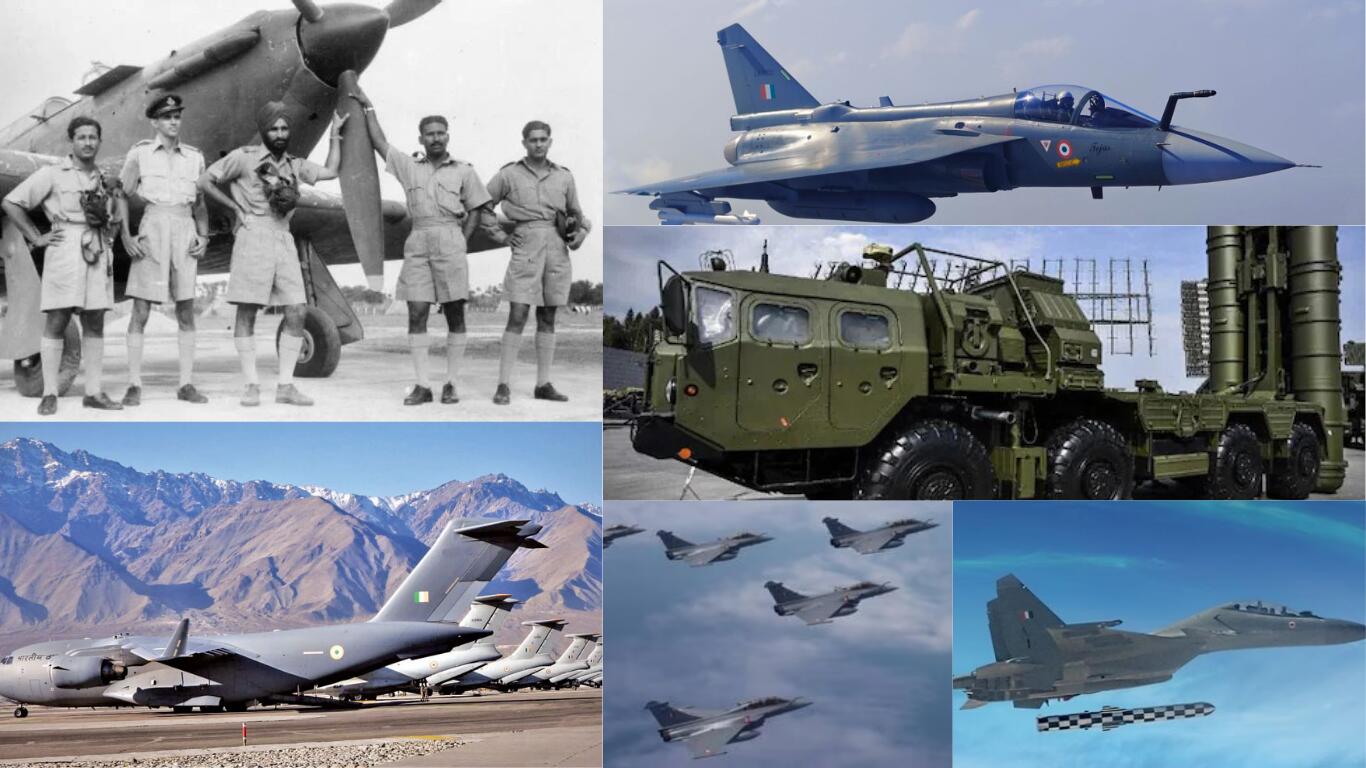
The Indian Air Force officially came into being on October 8, 1932, and its first operational flight took off on April 1, 1933. That modest start involved six RAF-trained officers, 19 Havai Sepoys, and four Westland Wapiti biplanes forming the “A” Flight at Drigh Road. This nucleus later became No. 1 (Army Co-operation) Squadron the first combat unit of the IAF. Within four years, the IAF was engaged in its first real operation in North Waziristan, supporting the Indian Army against insurgent tribesmen. Despite its limited resources, the fledgling force displayed professionalism and courage, setting the tone for the decades to come.
As the clouds of World War II gathered, the IAF’s role grew rapidly. The British-ruled administration recognized the importance of local air power, even if reluctantly. By 1939, a series of Coastal Defence Flights were set up across Indian port cities such as Madras, Bombay, Calcutta, Karachi, and Cochin. These early units formed the foundation of India’s strategic aerial defense, ensuring that the seeds of an independent air capability were firmly planted.
The World War Era: Forged in the Fire of Global Conflict
The outbreak of World War II dramatically changed the course of the Indian Air Force. Training became more structured and organized as the British Royal Air Force (RAF) stationed flying instructors across India to train IAF Volunteer Reserve (IAF VR) cadets. By the end of 1941, nearly 364 cadets were flying Tiger Moth trainers across multiple flying clubs.
Modernization soon followed. No. 1 Squadron received the British Lysander aircraft, while No. 2 and No. 3 Squadrons transitioned to Audax and later to the Hurricane. By 1942, the IAF had expanded to five squadrons, reflecting a growing confidence and competence. During the Burma campaign, Indian pilots earned worldwide respect for their skill and bravery against Japanese forces.
In 1945, the IAF’s stellar performance earned it the prestigious “Royal” prefix a mark of honor that recognized its contribution to the Allied war effort. When independence arrived in 1947, the prefix was dropped, but the glory remained. The IAF was now the air arm of a free India ready to defend its skies and sovereignty.
The Post-Independence Challenges: Testing the New Wings
The years following independence were marked by immediate challenges. Partition divided not only the nation but also its military assets, including aircraft and personnel. Despite this setback, the IAF swiftly reorganized itself to meet the demands of the newly independent nation.
Its baptism by fire came during the 1947–48 war over Jammu and Kashmir, where the IAF provided crucial air support in transporting troops and supplies to Srinagar just in time to prevent Pakistani invaders from capturing the Valley. This was a defining moment air power had saved Kashmir.
In the following decades, the IAF expanded both in size and capability. By the early 1960s, it operated a mix of aircraft including the Vampire, Canberra, and Gnat, while also focusing on indigenous aircraft development such as the HF-24 Marut a significant step toward India’s dream of self-reliance in defense technology.
Modernization and the 1971 War: The Dawn of Supremacy
Between 1966 and 1971, the IAF underwent a remarkable transformation. Lessons learned from the 1965 Indo-Pak War pushed the leadership toward modernization. The induction of the MiG-21FL India’s first supersonic fighter marked a technological leap. The Gnat, fondly called the “Sabre Slayer,” was also reinstated into production after its heroic performance against Pakistan’s F-86 Sabres in 1965.
By the time the 1971 war broke out, the IAF was a potent and well-coordinated force. During the conflict, the IAF flew over 4,000 sorties, dominating the skies over East Pakistan and crippling the Pakistani military infrastructure. Air superiority allowed India to achieve a swift and decisive victory that led to the birth of Bangladesh. The 1971 war cemented the IAF’s reputation as one of the most capable and disciplined air forces in the world.
The Jet Age to Kargil: Precision and Power
The 1970s and 1980s were decades of consolidation and progress. The induction of advanced aircraft like the Jaguar and Mirage 2000 elevated India’s aerial strike capabilities. The Mirage 2000, in particular, became the pride of the IAF for its precision and reliability.
During the 1999 Kargil Conflict, the IAF once again rose to the occasion with “Operation Safed Sagar.” It executed high-altitude precision strikes against entrenched enemy positions in some of the most difficult terrain in the world. The MiG and Mirage fleets performed exceptionally, ensuring minimal casualties on the Indian side while neutralizing Pakistan’s defenses. The IAF’s adaptability, courage, and technological prowess during Kargil reaffirmed its dominance in South Asian airspace.
The New Era: Indigenous Strength and Operation Sindoor
In the 21st century, the IAF entered a new era of self-reliance and high-tech warfare. The induction of the Rafale in 2021 and the indigenous Tejas Light Combat Aircraft (LCA) in 2016 was a defining moment in India’s aerospace journey. With advanced avionics, agility, and multi-role capability, Tejas embodied the “Make in India” spirit.
In recent years, the IAF has continued to showcase its unmatched strength and precision. During Operation Sindoor (May 2025), the IAF destroyed 9–10 Pakistani aircraft, including U.S.-origin F-16s and Chinese-made JF-17s, in deep-strike missions targeting terror camps in Pakistan and Pakistan-occupied Kashmir. Air Chief Marshal A.P. Singh proudly confirmed these results, calling Islamabad’s denials “fanciful stories.” Terror groups like LeT and JeM were forced to move their bases deep inside Khyber Pakhtunkhwa, fearing more accurate Indian strikes. The operation symbolized how far the IAF had come from defending Indian skies to striking decisively deep inside enemy territory.
Soaring Beyond Limits
As India celebrates the 93rd Air Force Day, the journey of the IAF stands as a story of courage, evolution, and national pride. From the fragile biplanes of 1933 to the precision strikes of Operation Sindoor, the IAF has proven that its strength lies not just in its machines but in the spirit of its men and women in blue. With next-generation fighters like the Tejas Mk2, AMCA entering service, the IAF is poised for an even greater future one that will keep India’s skies secure and its sovereignty unshaken. The guardians of the sky continue to soar higher, faster, and stronger than ever before.