
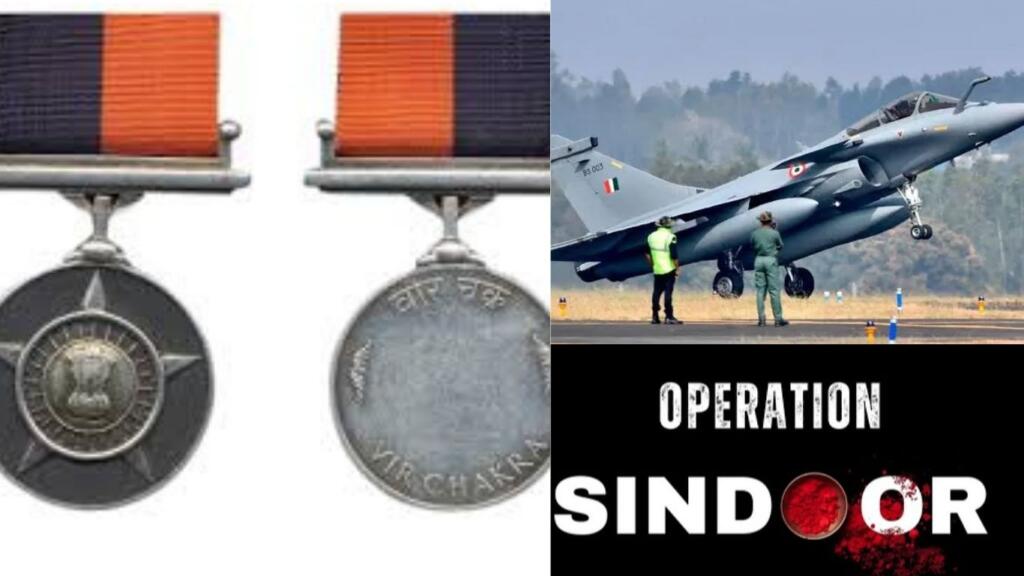
The Government of India has officially published a gazette notification honouring the gallant heroes who displayed exceptional courage and leadership during Operation Sindoor. The citations, detailing the acts of valour by Indian Army and Indian Air Force personnel, shed light on the operation’s strategic brilliance and the unyielding spirit of the soldiers who executed it.
The operation, launched in response to one of the deadliest terror attacks in Jammu and Kashmir, represents a defining shift in India’s military doctrine from passive defence to assertive, precision-based counter-terrorism. The recognition of these heroes through the Vir Chakra awards underscores India’s gratitude to those who carried out this daring, multi-domain strike that dismantled entrenched terror infrastructures across the border.
The Heroes of Operation Sindoor
Six distinguished officers have been decorated with the Vir Chakra, one of India’s most prestigious gallantry awards, for their pivotal roles in the mission’s success.
Colonel Koshank Lamba, from the 302 Medium Regiment of the Indian Army, was honoured for his flawless leadership and exceptional bravery. He successfully executed the first-ever air mobilisation of a specialised equipment battery under intense time pressure, ensuring covert induction of resources that became instrumental to the mission’s success.
Lieutenant Colonel Sushil Bisht, Officer Commanding the 1988 (Independent) Medium Battery, led his unit with remarkable courage and tactical acumen. His leadership resulted in the complete destruction of multiple terrorist camps, earning him the distinction for resolute command and operational brilliance in the face of enemy fire.
From the Indian Air Force, Group Captain Ranjeet Singh Sidhu demonstrated exceptional gallantry while leading high-risk precision strikes over predetermined targets. Commanding a fighter squadron, he achieved all operational objectives with clinical accuracy.
Group Captain Animesh Patni, commanding a forward-deployed Surface-to-Air Missile (SAM) squadron, delivered a decisive blow to adversary capabilities. His leadership ensured significant enemy losses while maintaining zero damage to his own squadron.
Squadron Leader Rizwan Malik, serving as Deputy Mission Leader, executed an unescorted midnight strike on targets fortified with advanced air defence systems. Navigating through dark-night tactical routes and intense radar cover, he delivered weapons within a minuscule launch window a feat of unparalleled skill and bravery.
Squadron Leader Siddhant Singh led a three-aircraft formation for a stand-off precision strike against a heavily fortified enemy base. His meticulous planning and exceptional flying penetrated a dense air defence network, achieving pinpoint accuracy while evading sophisticated surface-to-air weapons.
The Birth of Operation Sindoor: Retaliation with Resolve
Operation Sindoor was launched at 1:05 a.m. on May 7, 2025, as a retaliatory response to the Pahalgam terror attack in Jammu and Kashmir that claimed 26 innocent lives. The mission marked a critical evolution in India’s counter-terrorism strategy no longer reactive but proactively offensive against foreign-sponsored terror networks.
The operation’s name, Sindoor, symbolised the sacred red mark of sacrifice a tribute to the widows of the Pahalgam victims. The choice reflected India’s emotional and moral commitment to protect its citizens and avenge acts of terror with precision and justice.
Within just 22 minutes, the Indian Air Force and Army struck deep inside Pakistan and Pakistan-occupied Jammu and Kashmir (PoJK), targeting nine terror camps, including key hubs in Muridke and Bahawalpur. These locations had long served as operational centres for anti-India terror outfits.
India’s Technological Might and Indigenous Arsenal
What truly distinguished Operation Sindoor was its extensive reliance on Made-in-India defence technology. The mission showcased India’s growing self-reliance under the Atmanirbhar Bharat initiative.
The operation deployed Rafale and Su-30MKI fighter jets equipped with BrahMos and indigenous precision-guided missiles, alongside UAVs and drones providing real-time intelligence.
The Indian Space Research Organisation (ISRO) played a crucial support role by providing live satellite imagery, enabling flawless coordination between air and ground forces. India’s multi-layered air defence system, including S-400 and Akash batteries, intercepted and neutralised multiple retaliatory strikes from Pakistan.
Despite Islamabad’s attempts to counter the offensive through drone, missile, and artillery attacks, India’s superior preparedness and technological advantage ensured total operational dominance.
Pakistan’s Heavy Losses and Ceasefire Request
During the four-day engagement that lasted till May 10, 2025, Pakistan’s losses were devastating. The Indian Air Force destroyed over a dozen PAF fighter jets, two high-value aircraft, over 10 UCAVs, one C-130 transport aircraft, and multiple cruise missiles.
Simultaneously, Indian ground operations neutralised more than 100 terrorists, crippling several launchpads used to infiltrate militants into Indian territory. The magnitude of India’s response forced Pakistan to request a ceasefire after four days of sustained losses, marking one of the most decisive outcomes in modern subcontinental military history. The swiftness and scale of Operation Sindoor sent a powerful message across the globe that India’s patience has limits, and any act of aggression will be met with overwhelming force.
A Defining Moment for India’s National Security Doctrine
Operation Sindoor stands as a symbol of India’s evolved defence posture one that is self-assured, technologically advanced, and unafraid to strike preemptively when provoked. It underlined the integration of intelligence, technology, and precision warfare, setting a new benchmark for modern military operations.
By recognising the gallantry of its officers, the Government of India not only honoured individual bravery but also reaffirmed the spirit of national resolve. Each Vir Chakra awarded tells the story of courage, discipline, and patriotism that define India’s armed forces.
Operation Sindoor will be remembered as more than a military success it is a turning point in India’s war on terror. It reaffirmed India’s strategic autonomy and its readiness to defend national integrity with precision and power.
India has transitioned from a nation reacting to provocations to one capable of dictating the terms of engagement. The gallant warriors of Operation Sindoor embody the spirit of a New India fearless, self-reliant, and resolute in defending its borders and honour.
Their courage carved history in fire and light, proving once again that when India’s soldiers rise, no enemy can withstand their might, and no force can dim the flame of Bharat’s sovereignty.