
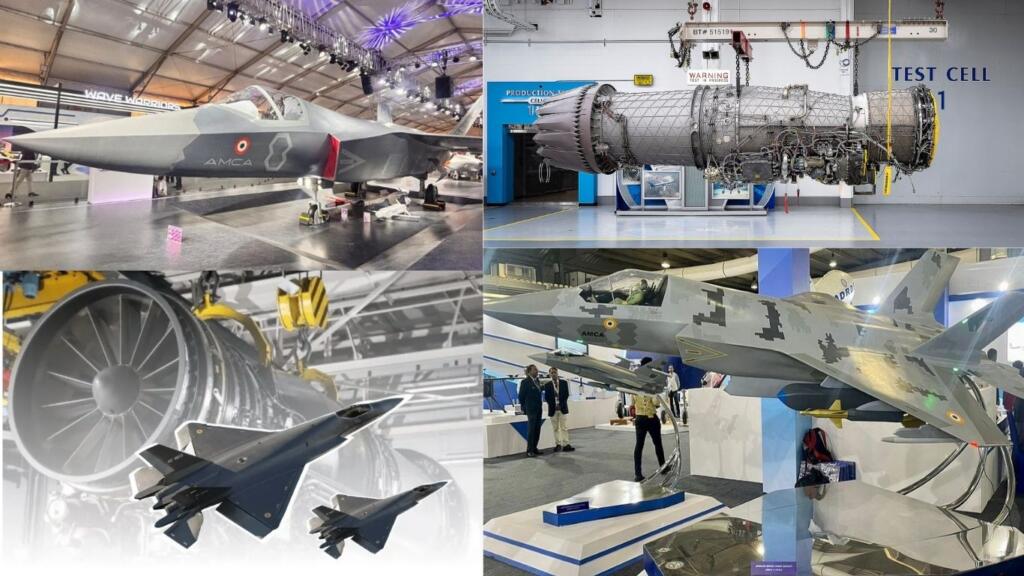
Imagine a jet engine that can behave like a sprinter when required screaming ahead at full power and then transform into a marathon runner for long-distance missions. That’s the promise of the U.S. Air Force’s Next-Generation Adaptive Propulsion (NGAP) engines, currently under development by Pratt & Whitney and GE. These engines are poised to power the future F-47 (NGAD) fighter with unmatched versatility, efficiency, and combat endurance. But while the U.S. races ahead, India’s defense vision demands the same leap can we equip our AMCA (Advanced Medium Combat Aircraft) with adaptive-cycle engines to match global air power? The journey toward that vision begins now.
NGAP: The New Frontier in Jet Propulsion
The NGAP initiative is the next evolutionary leap in jet engine technology, building on earlier efforts like the Adaptive Engine Transition Program (AETP) and the Adaptive Engine Technology Demonstrator (AETD). The goal is to build engines that adapt in flight changing their configuration to emphasize either maximum thrust during combat or maximum fuel efficiency during cruise.
Traditional engines are fixed-cycle they are designed to perform best at one operational point. In contrast, adaptive engines incorporate a “third stream” of cooled air that can be opened or closed to balance between performance and efficiency. In high-thrust mode, that third stream is largely bypassed, channeling most air through the core for maximum power. In efficiency mode, the third stream is deployed, increasing bypass ratio and reducing fuel consumption.
These engines also address thermal management a critical hurdle for modern stealth aircraft by routing cooled air through critical components to reduce temperatures. They incorporate modular architectures and digital design tools to accelerate development and maintenance. The overarching aim: boosted range, longevity, stealth, and survivability in contested skies.
Progress, Challenges, and Timelines
Both Pratt & Whitney (with its XA103) and GE (with XA102) are racing to mature their designs. As of now, they’ve passed key design reviews and are fabricating prototype demonstrators for ground tests. The next milestone is to complete an Assembly Readiness Review, which will firm up schedules for fabrication and flight tests.
However, the program faces delays. Initial plans pegged full prototype readiness by FY27. But newer budget documents show a shift: testing completion now appears to be pushed to FY30. The delay reflects supply-chain constraints, advanced material challenges, and the inherent complexity of adaptive engine systems. The USAF has also increased funding to maintain momentum with each vendor’s contract ceiling now raised to $3.5 billion.
The final stage will involve flight tests on the F-47 platform, potentially by the late 2020s. Only one vendor will be selected for full-scale production. Given the tight timelines and aggressive goals, it’s unlikely NGAP engines will be ready for widespread deployment before the next decade.
Operational Advantage: What Adaptive Engines Bring to the Table
NGAP’s key advantage lies in mission flexibility. Other than thrust and efficiency, these engines offer benefits in stealth, power delivery, and system integration:
-
Extended Combat Radius: With better fuel efficiency, jets can fly longer distances without refueling. For the F-47, the goal is a combat radius exceeding 1,000 nautical miles far higher than legacy fighters like the F-22.
-
Optimized Thermal Signature: By managing heat through the third stream, the engine becomes harder to detect by infrared sensors, improving stealth.
-
Power Overhead for Electronics: Future fighters will demand more electrical power for sensors, directed-energy weapons, and avionics. Adaptive engines can produce that power margin.
-
Modular Design & Upgrades: As new materials and cooling technologies emerge, engines may be upgraded swifter with minimal redesign.
-
Unmanned and Mixed Operations: Derivatives of the NGAP core can power unmanned aircraft or drones within a Collaborative Combat Aircraft (CCA) framework, enhancing mission synergy.
In a future large-scale conflict especially across vast theaters like the Indo-Pacific these advantages can be game-changing when bases are far apart and aerial tankers are vulnerable.
Where India Stands: AMCA’s Engine Challenge
India’s AMCA is the centerpiece of its indigenous 5th-generation fighter ambition. But the success of AMCA will rest heavily on its propulsion and adaptive engine technology is key.
Currently, India is working with French Safran to co-develop a 120 kN turbofan engine, intended as the powerplant for AMCA. The collaboration is designed to transfer 100% technology and intellectual property rights to DRDO, including advanced blade materials and manufacturing techniques. The project timeline spans approximately 12 years and aims for serial production by the mid-2030s.
However, to truly match global benchmarks, this engine must be adaptive in nature capable of shifting performance modes mid-flight. Incorporating such architecture requires mastery over cutting-edge materials, computational fluid dynamics, cooling technology, and control systems. The Safran-DRDO partnership is well-positioned to incorporate adaptive features if planned early and fiscally supported.
India faces a window of opportunity: as NGAP technologies mature globally, Indian engineers can adopt lessons and leapfrog into the next era. But delays, funding shortages, or lack of continuity could leave AMCA stranded with conventional engines a serious handicap in future air dominance.
Strategic Imperative and Indigenous Sovereignty
The significance of an indigenous adaptive engine extends beyond performance. It embodies strategic autonomy in defense. For decades, India has imported engines notably from U.S. companies like Pratt & Whitney and GE. While modern jets like the Rafale come with powerful foreign engines, reliance on imports leaves vulnerabilities in supply, maintenance, and sanctions.
By mastering adaptive-cycle propulsion, India secures multiple advantages:
-
Reduced foreign dependency
-
Export potential for regional buyers
-
Sovereign control over performance upgrades and lifecycle maintenance
-
Enhanced deterrence credibility when indigenous fighters truly operate at world-class levels
It aligns perfectly with Atmanirbhar Bharat’s objective in defense: self-reliance without compromise.
The Road Ahead to India’s Aeronautical Apex
The NGAP program represents a paradigm shift in aviation propulsion. As the U.S. pushes toward adaptive engines for its next-generation fighters, India must race alongside. For AMCA to be more than a symbolic aircraft, the engine must be as revolutionary as the airframe.
With the Safran collaboration, DRDO’s ambition, and the political will behind it India has the blueprint. But turning that blueprint into reality by the 2030s will require sustained investment, technological partnerships, and an unwavering commitment to indigenous mastery.
If India succeeds, its air force will not only field a 5th-generation fighter but also command the skies with homegrown adaptive propulsion closing the gap with the world’s best. The future of Indian aerial dominance depends not only on wings but on what roars beneath them.