












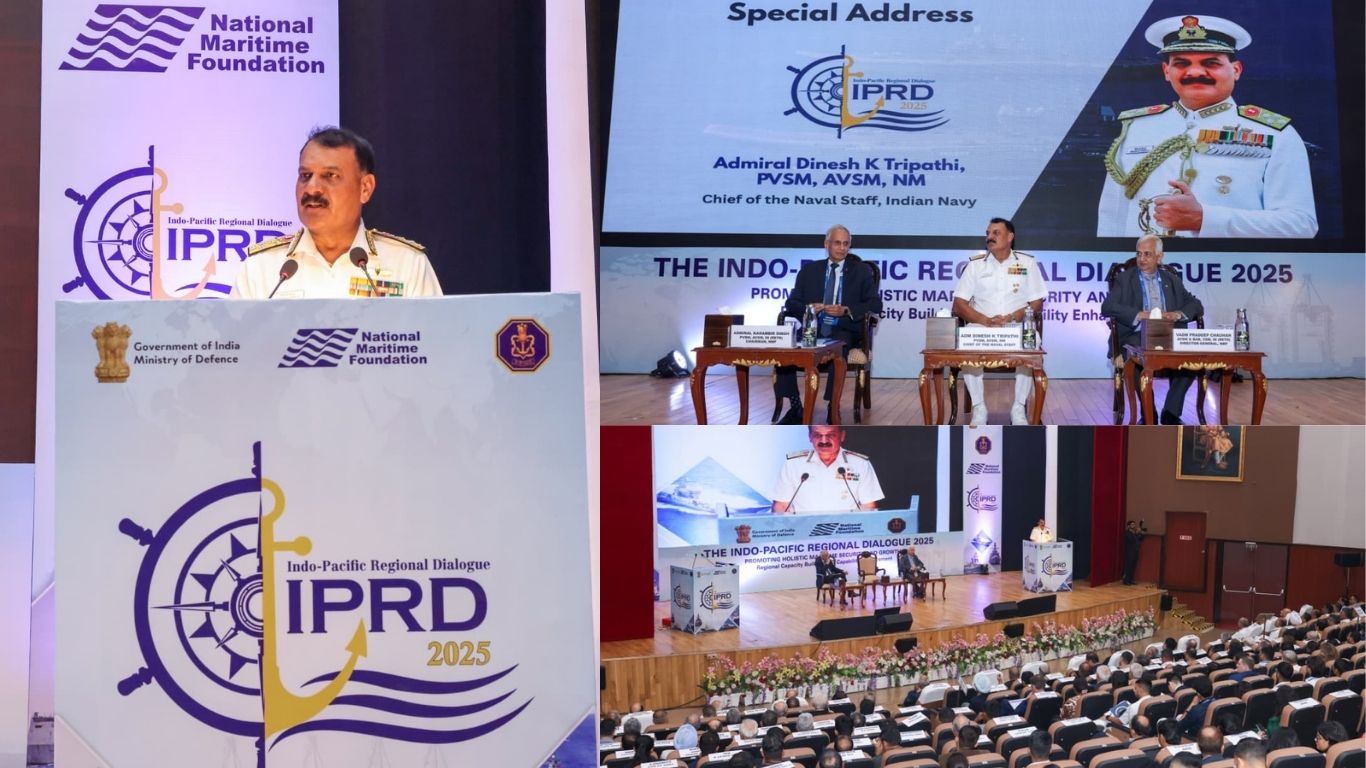
Chief of the Naval Staff Admiral Dinesh K Tripathi on Wednesday said that the future of Indo-Pacific security depends on building regional capacity and capability as “complementary, not competitive” enterprises.
Speaking on the inaugural day of the Indo-Pacific Regional Dialogue (IPRD 2025), Admiral Tripathi described capacity building as “the tangible strength of nations” and capability enhancement as “the intellectual force that gives it direction.” Both, he said, must grow together if the region is to remain stable and prosperous.
“In naval parlance, capacity is tangibles – expressed in terms of hulls, airframes, ports, logistics chains, and industrial ecosystems. It represents a nation’s ability to remain present and persistent at sea,” he explained. “But viewed regionally, capacity must be distributed and complementary – where strengths are pooled and shortfalls mitigated through cooperation.”
Pooling Strength Across the Indo-Pacific
The Navy Chief underlined that India’s approach under Vision MAHASAGAR focuses on partnership, not possession. “Capacity building cannot be an insular enterprise,” he said. “It thrives on partnerships through joint design, co-production, maintenance collaboration, and mutual support in crisis response.”
India, he said, was actively extending its defence-industrial ecosystem to friends and partners “to strengthen their maritime presence with indigenous design, affordable technologies, and sustainable support systems.”
“True capacity, after all, is not what a nation accumulates, but what a region aggregates,” Admiral Tripathi declared.
Technology and Interoperability as Force Multipliers
A key example of this philosophy, he noted, was the Deep Submergence Rescue Vessel (DSRV) deployment during Exercise Pacific Reach last month, where Indian and foreign submarines successfully conducted joint rescue procedures.
“The successful mating of Indian Navy’s DSRV with foreign submarines during Exercise Pacific Reach demonstrated how individual assets can augment collective assurance across the region,” he said.
He also pointed to the indigenous NISHAR-MITRA terminal a secure communications platform designed to facilitate real-time intelligence sharing among partner navies. The system, he said, reflected the Navy’s belief that “capacity without connectivity is capability unrealised.”
Capability Beyond Platforms
Admiral Tripathi explained that capability goes beyond ships and aircraft to encompass doctrine, training, and adaptability. “Capability resides not merely in assets, but in how they are employed through doctrine, training, interoperability, and resilience,” he said.
“The most sophisticated platform is only as effective as the concepts that animate it and the people who command it,” he added. “Enhancing capability demands a shift from platform-centric to purpose-centric thinking from counting assets to connecting ideas.”
He cited the IOS SAGAR deployment a month-long joint mission in the South-West Indian Ocean Region as a pioneering example. The ship carried a mixed crew of 44 personnel from nine Indian Ocean nations. “This effort demonstrated how capability enhancement is also about people – about shared learning, adaptability, and resilience,” he said.
The Navy’s Broader Vision
The Navy Chief placed these initiatives within the larger continuum of India’s maritime philosophy, which has evolved from SAGAR (Security and Growth for All in the Region) to MAHASAGAR (Mutual and Holistic Advancement for Security and Growth Across Regions).
“This evolution from Sea to Ocean signifies both expansion of scope and depth of purpose,” he said, calling the Navy “the principal manifestation of India’s maritime power.”
Admiral Tripathi reminded delegates that capacity and capability enhancement were essential “levers to navigate maritime dynaxity” a term coined by Professor Rieckmann to describe the increasingly dynamic and complex character of today’s maritime challenges.
A Call for Collective Resilience
As the Indo-Pacific faces converging challenges from IUU fishing to cyber intrusions the Admiral urged navies to move beyond national silos. “Regional strength must be cumulative,” he said, “because maritime security and maritime growth are twin propellers that drive our collective voyage towards peace and prosperity.”
Concluding his remarks, Chief of Navy Staff Admiral Tripathi said the Dialogue exemplified how sustained thinking could convert shared challenges into shared strength.
“This Dialogue offers us an ideal forum to convert collective ideas into collaborative actions,” he said. “No problem can withstand the assault of sustained thinking.”