
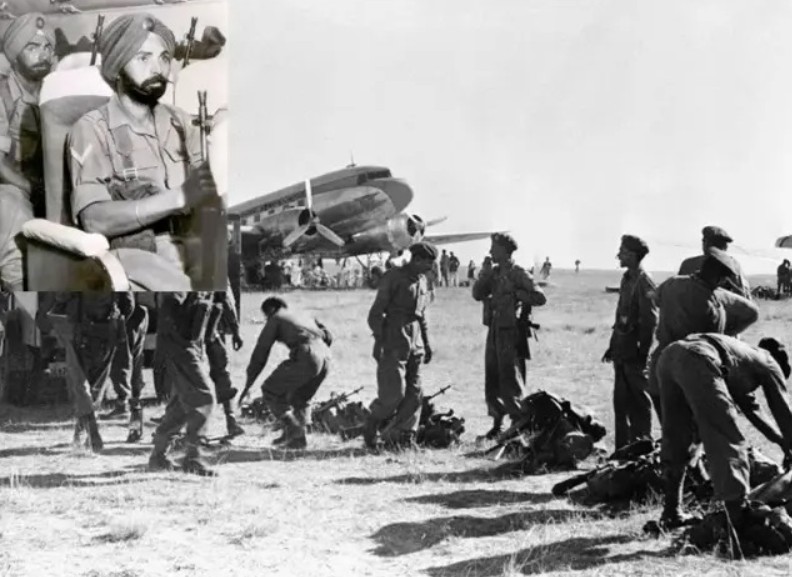
The morning of 27 October, 1947, dawned crisp and tense over the valley of Kashmir as the first rays of sunlight broke over the snow-capped mountains.
Each year we celebrate 27th of October as Infantry Day to commemorate the Indian Army’s first post-independence combat mission in 1947, when the Infantry landed in Srinagar to repel Pakistani invaders .
The day honors the bravery of infantry troops, often called the “Queen of Battle,” and their enduring sacrifices in safeguarding national sovereignty and integrity.
That morning on October 26, the whir of Dakota aircraft engines echoed through the old Srinagar airfield as the men of the 1st Battalion of the Sikh Regiment were onboard.
The first Indian Army troops were about to set foot in Jammu and Kashmir — with their mission clear and urgent— save Srinagar. That moment would go on to define not just the fate of a region, but also the destiny of a newly independent nation, barely two months old.
This was the Indian Army’s first major airlift operation and remains a defining moment in the history of independent India and newly joined state of Jammu and Kashmir accessed to union of India.
The Crisis Unfolds
In the weeks following India’s independence in August 1947, the princely state of Jammu and Kashmir, ruled by Maharaja Hari Singh, found itself at a historic crossroads.
Unlike many other princely states that had already joined either India or Pakistan, the Maharaja hesitated — hoping to remain independent and maintain a delicate balance between his two powerful neighbours.
But by October, that fragile neutrality collapsed. Thousands of armed tribesmen entered Kashmir through the western frontiers, committing extreme inhuman brutal atrocities and spreading terror in Muzaffarabad, Baramulla, Uri and adjoining areas of Srinagar.
Villages were plundered, civilians massacred, and terror swept across Baramulla as the invaders pushed rapidly towards Srinagar, the state’s heart.
Realising the capital would soon fall, Maharaja Hari Singh appealed to India for help and on 26 October, 1947, Maharaja Hari Singh signed the Instrument of Accession, formally joining Jammu and Kashmir to the Indian Union.
The Airlift That Changed History
This followed one of the most daring military operations in independent India’s early history. With the ink barely dry on the accession papers, orders were issued for an immediate airlift of troops to Srinagar.
At dawn on 27 October 1947, Indian Air Force Dakotas thundered across the skies, carrying men, weapons, and supplies. As the aircraft landed on the dusty tarmac of Srinagar’s old airfield, history was being written in real time.
The soldiers who stepped out — armed with little more than courage and conviction — were about to face overwhelming odds.
Their first objective was clear— tosecure the airfield. Without it, reinforcements and supplies would be impossible.
Within hours, defensive positions were established, ensuring the lifeline to the Valley remained open.
The Battle for Baramulla
With the airfield safe, the troops moved swiftly toward Baramulla and Uri, where fierce fighting ensued. The soldiers of 1 SIKH outnumbered but undaunted fought valiantly, stalling the enemy’s advance.
Their commanding officer Lt Col Dewan Ranjit Rai led from the front, ultimately making the supreme sacrifice in the line of duty — his bravery buying the crucial time needed for more Indian troops to arrive.
Lt Col Rai carried out the operational orders to capture and secure the Srinagar airfield, but realising the fact that the enemy advance must be checked before more Indian troops arrived, he correctly decided to advance to Baramulla to stop the Pakistani raiders from getting any further.
He was killed at Pattan, between Srinagar and Baramulla, by a mortar shell while directing battle and organising a fallback to a more secure position.
This act of heroism marked a turning point. The raiders, who had advanced unchecked for days, now found themselves resisted, pushed back, and eventually driven out of much of the Valley. The city of Srinagar — and with it, the very idea of a united India — was saved.
A Symbol of a Nation’s Resolve
The landing at Srinagar was more than a tactical success. It was a symbolic assertion of India’s sovereignty and a declaration of its will to defend every inch of its territory.
The seamless coordination between the Indian Army and the Indian Air Force, despite limited resources and a fledgling command structure, demonstrated remarkable professionalism and unity of purpose.
In the months that followed, the battle for Kashmir would expand into the first Indo-Pak war of 1947–48, testing the resolve of the young Republic.
But the events of 27 October ensured that the tricolour continued to fly over the Valley.
Infantry Day: Honouring the Brave
It is a solemn reminder of the day when destiny called upon a young nation, and its soldiers answered without hesitation.
Their bravery not only secured the future of Jammu and Kashmir within India but also set a timeless example of patriotism and duty.
Seventy-eight years later, the legacy of that morning endures — a moment when the sound of aircraft engines over Srinagar became the heartbeat of a nation determined to stand its ground.
As many veterans say, “The morning of 27 October 1947 was not just the dawn of a new day. It was the dawn of India’s defence of its soul.”