








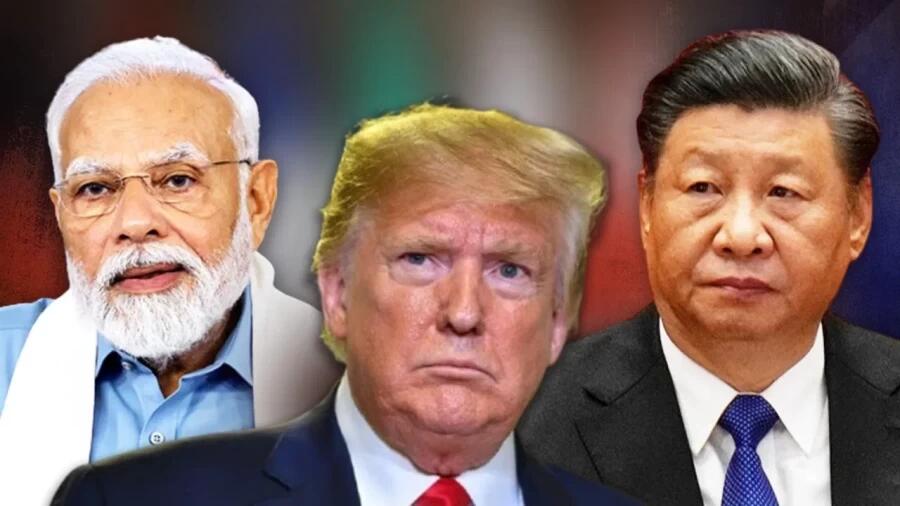
Despite years of tension along the Line of Actual Control (LAC) following the 2020 Galwan Valley clashes, India and China are cautiously inching toward a new chapter of stability and engagement. The recent round of corps commander-level talks between the two militaries at Chushul-Moldo in Ladakh marked a significant moment of recalibration. Both sides agreed to continue existing mechanisms and maintain stability along the border. Yet, beyond the Himalayan frontier, a larger geopolitical shift is underway one shaped by the United States’ aggressive tariff policies and trade barriers that have disrupted global supply chains. Ironically, Washington’s economic nationalism may be driving New Delhi and Beijing two of Asia’s biggest powers into reluctant cooperation.
For both nations, the calculus is pragmatic rather than sentimental. China’s export-driven economy is reeling under American trade restrictions, while India faces the pressure of balancing its domestic manufacturing goals with the need for affordable imports. As the United States under Donald Trump redefines its tariff regime, India and China are rediscovering a shared interest in economic and strategic stability.
From Confrontation to Coordination: A Gradual Reset Along the LAC
The 23rd round of corps commander-level talks on October 25 signalled a rare consensus between India and China. It was the first high-level military engagement since both sides completed troop disengagement from key friction points last year. The Ministry of External Affairs (MEA) noted that the meeting was held in a “friendly and cordial atmosphere,” with both sides agreeing that “peace and tranquillity has been maintained” along the border.
Sources said to The Indian Express that the talks focused on preventing misunderstandings through better coordination and maintaining confidence-building measures. Battalion and brigade-level meetings are to be held as needed to prevent local flare-ups. According to the Chinese defence ministry, both nations agreed to maintain dialogue under the “important consensus” reached by Prime Minister Narendra Modi and President Xi Jinping, reaffirming their intent to safeguard peace in the border areas.
While a full-scale de-escalation has yet to take place with an estimated 50,000 to 60,000 troops still deployed on either side both governments seem eager to avoid a repeat of the 2020 standoff. The disengagement from Despang Plains and Demchok last October was the first real breakthrough after four years of deadlock, paving the way for renewed dialogue and limited cooperation.
India’s decision to restore visa services for Chinese tourists, resume direct flights, and restart border trade talks indicates a careful willingness to normalize relations. In return, Beijing has reopened access for Indian pilgrims to Kailash Mansarovar and promised support in providing key industrial inputs like fertilizers and tunnel boring machines.
US Tariffs: The Catalyst Behind a Strategic Thaw
While military talks dominate headlines, the economic undercurrents driving the rapprochement are harder to ignore. The U.S. has imposed sweeping tariffs on multiple countries in South and East Asia measures that have disrupted manufacturing networks and raised costs globally. China and India has been the worst hit, facing punitive duties that threaten its export backbone.
The Trump administration’s proposed 500% tariff on countries trading with Russia has added another layer of uncertainty. For India, which continues to purchase discounted Russian energy, and for China, which maintains a strategic partnership with Moscow, Washington’s rigid trade policy has created common ground for cooperation. Both nations recognize the importance of insulating their economies from American unpredictability.
India’s trade deficit with China, which stood at around $85 billion, reflects the depth of economic interdependence. Despite political friction, Chinese machinery, electronics, and chemical technologies remain indispensable to Indian industries. Commerce Minister Piyush Goyal has spoken of “selective approvals” for Chinese investments a hint that complete decoupling is neither realistic nor desirable.
Experts see a clear pattern emerging. Professor Christopher Clary of the University of Albany told the BBC that “India thought it would be a very close strategic ally of the U.S., but they were not getting the support they were expecting from Washington.” This sentiment was reinforced during the brief conflict with Pakistan earlier this year, when India reportedly found American diplomatic support lukewarm.
Revisiting the RIC Framework: Russia’s Quiet Push for Regional Balance
As the United States doubles down on tariffs and sanctions, Russia has stepped in to revive the Russia-India-China (RIC) dialogue mechanism. Once envisioned as a platform to coordinate policies among the three major Eurasian powers, the RIC format had stalled after the Galwan clashes. But in recent months, Moscow has been quietly working to restore it.
Chinese Foreign Ministry spokesperson Lin Jian recently stated that “China-Russia-India cooperation not only serves the interests of the three countries but also helps uphold peace, security, stability, and progress in the region and the world.” Russia’s Deputy Foreign Minister Andrei Rudenko added that negotiations are ongoing to “revive the RIC format soon.”
The Kremlin’s renewed focus on trilateralism stems from a shared objective: building a multipolar world order that dilutes U.S. dominance. As Foreign Minister Sergey Lavrov observed earlier this year, the “improved India-China border relations” could contribute to “a pan-continental process” reshaping global power structures.
India’s cautious participation in the RIC dialogue signals strategic pragmatism. As international relations scholar Happymon Jacob wrote in his Hindustan Times column, “Even if none of India’s minilaterals with Russia and China deliver anything useful, India must continue to engage them, for geopolitical loneliness can be more costly than the boredom of tiresome summitry.”
Cautious Engagement: Balancing Security with Strategic Realism
India’s approach to China remains guarded. The scars of 2020 are still fresh, and few in Delhi harbour illusions about Beijing’s long-term intentions. Yet, the evolving situation has compelled India and China to explore dialogue and coexistence, rather than confrontation.
Domestically, India continues to invest heavily in surveillance, infrastructure, and deterrence mechanisms along the LAC. At the same time, New Delhi is exploring diplomatic channels that could stabilize relations and prevent future escalation. The recent moves resuming religious pilgrimages, restoring connectivity, and reopening communication channels reflect an incremental, trust-building approach.
Meanwhile, NITI Aayog has proposed easing rules that require special scrutiny of Chinese investments, acknowledging delays in high-value projects. The suggestion underscores India’s effort to strike a balance between national security and economic pragmatism.
Harsh Pant of the Observer Research Foundation aptly summarized this dynamic when he told Reuters: “Certainly, there is an outreach to China, and I think it is mutual. China is also reaching out.”
A Thaw with Caution and Calculated Diplomacy
The current detente between India and China is neither born out of friendship nor ideological alignment. It is, at its core, a pragmatic response to shifting global realities. The U.S. tariff regime, coupled with the unpredictability of American foreign policy, has forced two wary neighbours to re-evaluate their strategic postures.
While China remains an untrustworthy partner in India’s eyes, and India’s growing global clout continues to challenge Beijing’s regional ambitions, both sides recognize that confrontation is unsustainable. Economic interdependence, regional stability, and shared vulnerabilities have created a narrow but significant space for cooperation.
The handshake between India and China is, therefore, less about warmth and more about necessity a balancing act dictated by geopolitics. The road ahead will likely be cautious, but as long as Washington continues to weaponize trade, New Delhi and Beijing may find themselves aligning more often than either would have imagined.