
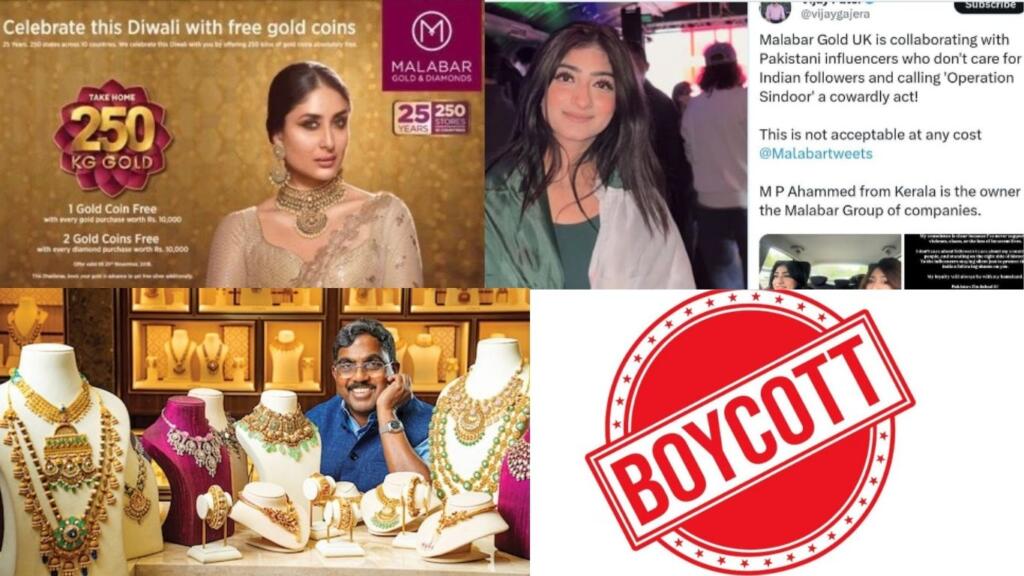
Just days before Dhanteras & Diwali, a festival when every Hindu family lights lamps, burst crackers and buys gold as a mark of prosperity a shocking controversy has exposed the double standards of one of India’s biggest jewellery brands. Kerala-based Malabar Gold & Diamonds, a company that earns billions from Indian customers, has been caught collaborating with a Pakistani influencer who mocked India’s military operation against terrorists. And when a Hindu activist, Vijay Patel, dared to question this unpatriotic act, the company didn’t apologize it took him to court. Yes, you heard that right. A brand that claims to represent Indian values is trying to silence an Indian citizen for standing with the Indian Army. At a time when Pakistan-sponsored terrorists continue to shed Indian blood, can we really tolerate companies that put profit over patriotism? Let’s expose how Malabar Gold has insulted the sentiments of millions of Indians.
The controversy that has rocked social media began when Hindu activist Vijay Patel questioned why Malabar Gold & Diamonds, a Kerala-based jewellery giant, collaborated with a Pakistani influencer named Alishba Khalid. What seemed like a simple promotional tie-up soon turned into a national outrage. Alishba Khalid, who lives in London and calls herself a filmmaker and content creator, had openly mocked India’s Operation Sindoor a counter-terrorism operation aimed at destroying Pakistan-based terror camps after the Pahalgam massacre. Her comments were not only insensitive but a direct insult to the Indian Army. She referred to India’s military strike as a “cowardly act,” echoing the same propaganda peddled by Pakistan’s ISPR. Yet, this very influencer was invited to inaugurate Malabar Gold’s new showroom in London, posing proudly for pictures alongside Bollywood star Kareena Kapoor, the brand’s Indian ambassador.
For millions of Indians, this was nothing short of betrayal. Malabar Gold, which earns its revenue primarily from Indian customers and claims to represent Indian craftsmanship and values, had chosen to work with a person who publicly mocked the Indian Army’s bravery. It wasn’t just a bad PR move it was a slap in the face of national pride. And when Vijay Patel pointed this out on X, Malabar Gold didn’t apologize. Instead, it filed a legal case against him, demanding that his posts be taken down. Patel’s account was even withheld within India following a court directive. The irony is striking in the world’s largest democracy, an Indian activist is being silenced for exposing a company’s collaboration with a Pakistani influencer who insulted the nation’s soldiers.
Alishba Khalid’s posts from May, where she mocked Operation Sindoor, have now been conveniently deleted or archived. But screenshots and records tell the story clearly. She dismissed her 60 percent Indian follower base, ridiculed India’s military response, and defended Pakistan a country that continues to harbor terrorists who attack India. Operation Sindoor was not a war against civilians or mosques, as she falsely claimed. It was a targeted mission against Jaish-e-Mohammad and LeT facilities the same groups that carried out numerous attacks killing innocent Indians, including the recent massacre in Pahalgam, where 26 people were brutally killed and 24 Hindus were singled out and executed after being asked their religion. Yet, Malabar Gold chose to associate with someone who trivialized these atrocities.
The company later claimed that Alishba Khalid was hired through a UK-based agency named JAB Studios and that they had “no prior knowledge” of her anti-India views. But this explanation failed to convince the public. Indians on social media called out the brand’s hypocrisy. How could a company of Malabar’s scale, with marketing teams across continents, fail to vet a person’s public statements before associating with them? Especially when those statements involved mocking India’s armed forces. Instead of accepting the mistake and issuing an unconditional apology, Malabar Gold decided to take the legal route filing a defamation suit and obtaining a Bombay High Court order asking social media platforms like Meta, X, and Google to remove “defamatory” posts about the company.
This move angered people even more. To many, it symbolized corporate arrogance a billion-dollar company using its legal power to intimidate a patriotic citizen who dared to speak up. Vijay Patel’s stand, on the other hand, struck a chord with countless Indians. He didn’t use hate or abuse; he simply questioned why an Indian company, operating with Indian customers’ money, would hire someone who disrespected the Indian Army. Patel’s argument was straightforward: if Malabar Gold truly respects India, why couldn’t it find an Indian influencer out of the hundreds of talented creators available? Why turn to a Pakistani personality, especially one who has insulted Indian martyrs and glorified a hostile state’s narrative?
The issue is far bigger than one influencer or one company. It’s about where we draw the line as a nation. Indian companies must realize that their brand image cannot exist in isolation from national values. They cannot earn billions from Indian customers while showing disregard for Indian soldiers who defend the same land their stores stand on. It’s not just about business; it’s about integrity. A brand that aligns with someone who mocks Indian sacrifices cannot hide behind PR statements or court orders. Patriotism cannot be outsourced, and definitely not to those who have mocked our nation’s bravery.
What makes this entire episode more disturbing is the timing. The controversy reignited right before Dhanteras a festival that marks prosperity, purity, and national pride in the form of gold and light. Instead of uniting Indians in celebration, Malabar’s actions have divided sentiments. As citizens light lamps for Lakshmi Puja, they are reminded that one of India’s biggest gold companies has betrayed their faith for international clout. It’s not an isolated incident but part of a worrying trend where companies chase global recognition at the cost of national respect.
At a time when Indian soldiers are making the ultimate sacrifice to defend our borders and civilians are being targeted by Pakistani terrorists, silence or neutrality is not an option. A company that cannot stand with the nation in such moments has no moral right to profit from it. The truth is simple: if an Indian brand cannot differentiate between patriotism and profit, then it stands on shaky moral ground. And if citizens like Vijay Patel are silenced for pointing this out, then we must ask what kind of democracy are we defending?
This controversy isn’t just about Malabar Gold or a single influencer. It’s about every Indian who believes that national pride is not for sale. When 26 innocent Indians are killed by Pakistani terrorists, when our soldiers risk their lives to protect our land, we cannot afford to normalize any association commercial or cultural with those who insult that sacrifice.