
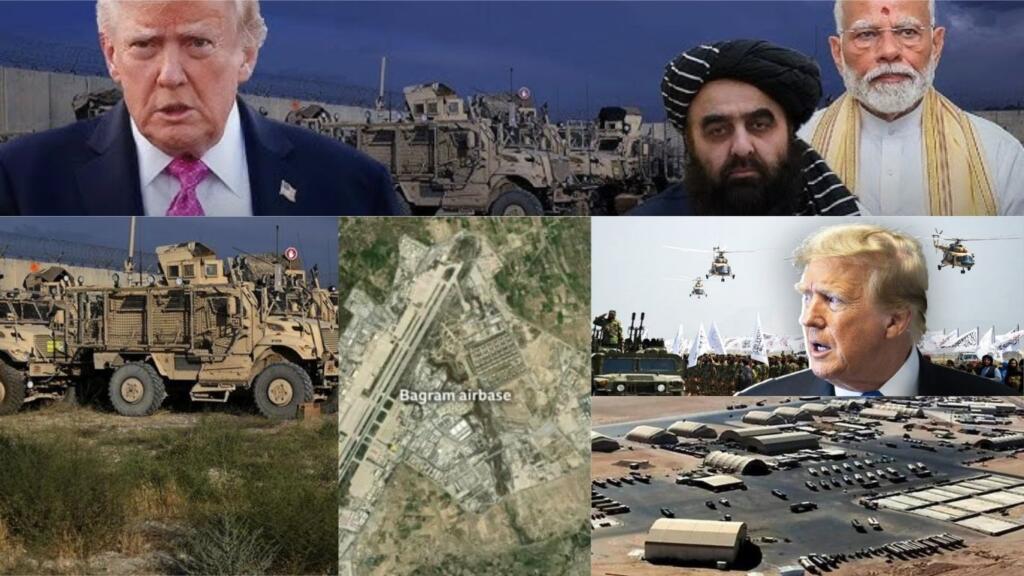
A new geopolitical chapter is unfolding in West Asia as India upgrades its Kabul Mission to full embassy status signaling a bold recalibration of its Afghanistan policy. This comes at a time when Pakistan is conducting air strikes inside Afghan territory, and U.S. President Donald Trump has openly called for the Taliban to hand over the Bagram Airbase to Washington. Against this backdrop, India’s renewed engagement with the Taliban could reshape the power balance in the region. As West Asia’s dynamics shift, New Delhi appears poised to emerge as a stabilizing force amid competing American interests.
India Upgrades Its Kabul Mission: A Strategic Return
In a significant diplomatic move, India has decided to restore its full-fledged embassy in Kabul, marking the most comprehensive engagement with the Taliban since their return to power in 2021. External Affairs Minister S. Jaishankar made the announcement alongside Taliban Foreign Minister Amir Khan Muttaqi, stating India’s “deep commitment to Afghanistan’s sovereignty, territorial integrity, and independence.”
The decision to upgrade the mission comes four years after India had evacuated its staff amid fierce fighting between the Taliban and the then-Afghan government. With stability returning under the Taliban regime and assurances of security for Indian personnel, New Delhi is looking to rebuild its presence and resume developmental projects that had long defined India-Afghan relations.
Trump demands Bagram, Taliban rejects
Trump has repeatedly called for Afghanistan’s Taliban rulers to hand over Bagram, nearly five years after a 2020 deal paved the way for the U.S. withdrawal from Kabul. At a press conference with UK Prime Minister Keir Starmer on 18 September, he stated, “We gave it to [the Taliban] for nothing. We want that base back.” Two days later, he warned on Truth Social, “If Afghanistan doesn’t give Bagram air base back to those that built it, the United States of America, bad things are going to happen!”
The Taliban, however, have firmly rejected the request. Chief spokesman Zabihullah Mujahid said, “Afghans will never allow their land to be handed over to anyone under any circumstances.”
Why Trump wants Bagram?
The Bagram air base, located about 50 km from Kabul, is Afghanistan’s largest military airfield, featuring two concrete runways of 3 km and 3.6 km. Its strategic location and infrastructure make it a key stronghold for controlling Afghan airspace, particularly in the country’s rugged terrain. Bagram played a central role in the U.S.-led “war on terror” after 2001.
Why has India’s policy changed?
First, security and counter-terrorism. Unlike the first Taliban regime, the current Taliban government has not openly sheltered anti-India terror groups. Groups such as Jaish-e-Mohammed and Lashkar-e-Taiba have minimal activity inside Afghanistan, largely due to strained relations between Kabul and Islamabad.
Maintaining dialogue allows India to monitor and manage potential terror threats originating from Afghan soil.
Second, balancing Chinese and Pakistani influence. China’s growing engagement with the Taliban and Pakistan’s historical ties with them are a strategic concern for India. By engaging with the Taliban, New Delhi aims to preserve its influence in Afghanistan and prevent the region from falling completely under the China-Pakistan axis.
Taliban Seeks Closer Ties, Signals Distance from Pakistan
The diplomatic warmth between India and the Taliban comes at a time when tensions between Afghanistan and Pakistan are at a boiling point. Pakistan’s recent air strikes inside Afghan territory, ostensibly targeting anti-Pakistan groups, have only deepened mistrust between Islamabad and Kabul.
During his visit to Delhi, Muttaqi made a remarkable statement declaring that Afghanistan would not allow its soil to be used for anti-India activities. This assurance, coupled with the Taliban’s condemnation of the Pakistan-backed Pahalgam terror attack, underscores a subtle but important shift in Kabul’s regional posture. The Taliban, once viewed through the lens of Pakistani influence, now appears eager to diversify its diplomatic partnerships with India emerging as a key interlocutor.
India’s Calculated Gamble: Strategic Presence Against Chinese and U.S. Moves
India’s outreach to the Taliban is not just about diplomacy it’s a carefully calibrated strategic play. As China expands its Belt and Road footprint across the region and the U.S. eyes a possible return to Afghanistan through Bagram, India’s re-engagement ensures it remains part of the evolving geopolitical equation.
At the “Moscow Format” talks, India joined Russia, China, Iran, and Central Asian nations to oppose any attempt to redeploy foreign military bases in Afghanistan. The statement widely interpreted as a rebuke to Trump’s call for regaining control of the Bagram Airbase highlighted India’s commitment to an “Afghan-led, Afghan-owned” stability model. India’s ambassador to Moscow, Vinay Kumar, reiterated that a peaceful and sovereign Afghanistan was central to regional and global security.
West Asia’s New Axis: India, Russia, and Taliban Diplomacy
As Afghanistan’s isolation lessens, India’s presence aligns with a broader coalition involving Russia, China, Iran, and Central Asia. Together, these nations are building a framework for regional stability that excludes external military dominance. India’s contribution through humanitarian aid, development projects, and healthcare support exemplified by its donation of 20 ambulances and medical supplies reinforces its image as a constructive and reliable partner.
With Taliban officials now participating in international forums and openly engaging with New Delhi, the once-unthinkable India-Taliban dialogue is evolving into a pragmatic partnership. This shift not only limits Pakistan’s traditional influence in Kabul but also strengthens India’s hand in shaping the security narrative of West Asia.
India Redefines Its Role in the New West Asian Order
India’s renewed engagement with the Taliban marks a turning point in its West Asia strategy. By upgrading its mission and participating in multilateral formats that reject external interference, New Delhi has positioned itself as a pivotal stabilizer amid a region in flux. As Trump pushes for a U.S. return to Bagram and Pakistan continues its military adventurism, India’s nuanced diplomacy aims to secure its strategic interests while fostering a regional framework led by Asian powers. In the changing chessboard of West Asia, India is no longer a bystander it is a central player shaping the future balance of power