




















In a significant political and administrative move, Uttar Pradesh Chief Minister Yogi Adityanath has drawn a direct link between the Halal certification ecosystem in India and what he describes as a parallel, unregulated economy funding terrorism, “love jihad,” and religious conversions. His remarks, delivered on October 21st during a Rashtriya Swayamsevak Sangh (RSS) centenary event, have reignited national debate over the legitimacy, necessity, and implications of Halal certification beyond dietary preferences.
The Chief Minister’s speech revolved around a bold claim: that thousands of crores collected through unofficial Halal certification mechanisms were being funneled into unlawful activities. “You’ll be shocked to know that soaps, clothes, lamps and even matchboxes have Halal certificates. This is a conspiracy,” CM Yogi stated, pointing out the absurdity of certifying non-consumable items under religious standards.
What Is Halal Certification and Why Is It Controversial?
Originally intended to ensure that meat and food products comply with Islamic dietary laws, Halal certification has now grown into a wide-reaching label present on cosmetics, medicines, packaged foods, bottled water, and even construction materials like iron rods and cement. This expansion, according to the Uttar Pradesh government, has gone beyond food quality assurance and created a parallel certification system that operates without oversight from statutory government bodies like the Food Safety and Standards Authority of India (FSSAI).
Solicitor General Tushar Mehta, presenting the government’s case before the Supreme Court, questioned how non-edible and inorganic items like cement and iron rods could even be subjected to religious certification. “Even besan (chickpea flour) has to be Halal-certified. How can besan be Halal or non-Halal?” he asked, highlighting the ambiguity and overreach of the practice.
Economic Impact and Employment Discrimination
A significant concern raised is that Halal certification inherently demands that only Muslims can perform the slaughter of animals. As a result, the meat processing industry has become dominated by one religious group, excluding traditional Hindu butchers—especially from Scheduled Caste communities—thus denying them employment opportunities.
This exclusion isn’t just economic but cultural, CM Yogi’s camp argues, because the default preference for Halal meat in restaurants, airlines, and even public events forces people from non-Muslim backgrounds—particularly Sikhs and certain Hindu sects—to consume meat processed in ways contrary to their religious beliefs.
The ripple effect of this monopolization, critics say, extends to other sectors now requiring Halal certification—pharmaceuticals, cosmetics, packaged food, and more. This not only limits job prospects to a particular community but also allows Halal-certifying agencies to create a price premium in the market, potentially edging out non-Halal-certified competitors.
The Alleged Link to Terror Funding and Conversions
The most serious charge made by CM Yogi is the alleged misuse of funds and accordingly, economy raised through Halal certification. According to him, ₹25,000 crore was earned through this certification in India—none of which was overseen by government bodies. These funds, he claims, were used to support terrorism, religious conversions, and what he calls “love jihad”—a term used by right-wing groups to describe alleged efforts by Muslim men to lure Hindu women into marriage and conversion under false pretenses.
To bolster his point, CM Yogi cited the case of Jalaluddin alias Chhangur Baba, who was arrested for running a conversion racket in Balrampur. This individual, according to the Chief Minister, had been under surveillance for years and was actively using funds—sourced, allegedly, from Halal certification—to finance the conversion of Hindu girls. “Where did the money come from? It was your money,” CM Yogi said, pointing to the unsuspecting Indian consumer funding anti-national elements unknowingly through everyday purchases.
He emphasized the need for public awareness, urging citizens to check for Halal certification on every product and to avoid contributing money to such “conspiracies.”
Ban on Halal Certification in Uttar Pradesh
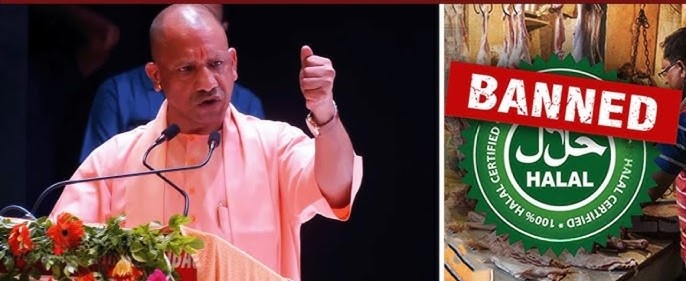
On November 18, 2023, the Food Safety and Drug Administration (FSDA) of Uttar Pradesh issued an order banning the production, sale, and distribution of “Halal-certified” products. This move, according to the order, was made in the interest of public health and to curb an unofficial, parallel system of regulation that operates outside the jurisdiction of the FSSAI and other statutory bodies.
CM Yogi’s government later submitted before the Supreme Court that the proliferation of such a system not only bypassed Indian regulatory mechanisms but also created a discriminatory, monopolized market structure favoring one religious group.
The Role of Certifying Bodies and Alleged Terror Links
A major player in Halal certification is the Jamiat Ulema-e-Hind (JUH), one of the oldest Muslim organizations in India. CM Yogi and other critics have pointed to JUH’s record of providing legal support in controversial cases—including terror funding, bomb blasts, and even the murder of Hindu leader Kamlesh Tiwari—as an example of how money collected through Halal certification might be redirected towards anti-national or communal activities.
This, according to CM Yogi, is not just an economic or religious issue—it’s a national security concern. He argues that the unchecked flow of money to certain private religious bodies poses a threat to social harmony and the integrity of India’s legal and regulatory frameworks.
The Larger Debate
While CM Yogi’s remarks and policy decisions have been welcomed by sections of society that view Halal certification as discriminatory or religiously intrusive, they have also drawn criticism. Detractors argue that the move might polarize communities and infringe upon religious freedoms guaranteed by the Constitution. Some civil society groups have accused the government of using isolated cases to justify widespread crackdowns on minority practices.
Nonetheless, the case presented by the Uttar Pradesh government highlights several pressing issues:
- Lack of government oversight on Halal certification
- Religious discrimination in employment and production
- A parallel, unregulated economy with national security implications
- The absence of consumer choice in an increasingly monopolized marketplace
Conclusion
Whether one views Halal certification as a religious necessity, a commercial tool, or a problematic parallel system, the recent crackdown by the Uttar Pradesh government has catapulted the issue into the national spotlight. CM Yogi Adityanath has made his position clear: Halal certification, in its current form, is more than a religious or commercial label—it is, in his view, a funnel for funding conversion rackets, promoting communal monopolies, and enabling anti-national activities.
In a country as religiously diverse as India, the debate over Halal certification is not just about consumer rights or religious freedom—it’s about the balance between regulation, national security, and the pluralistic values enshrined in the Constitution.