
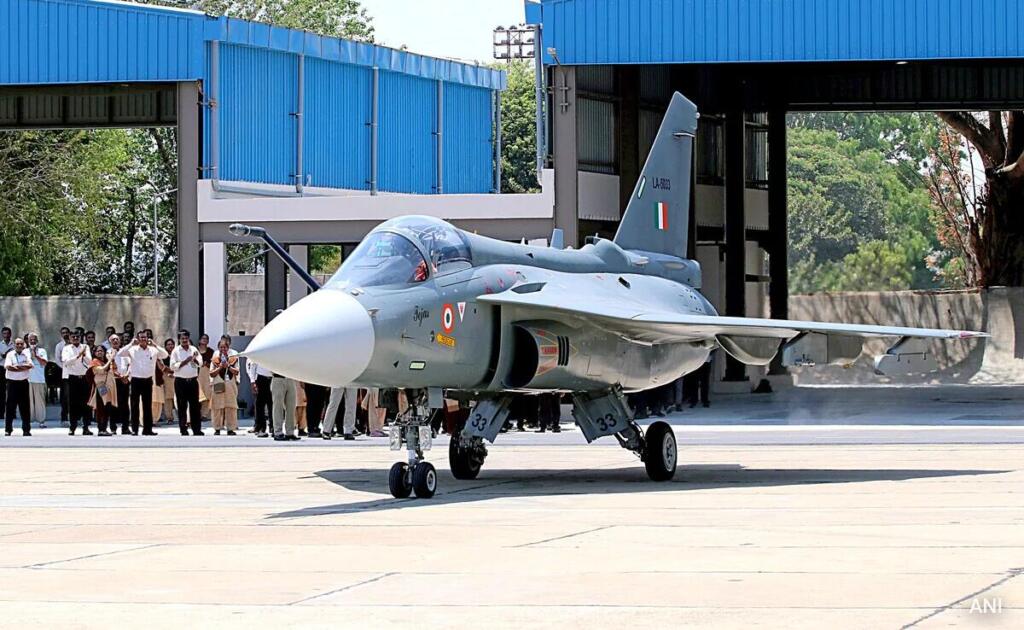
Hindustan Aeronautics Limited (HAL) is gearing up for a milestone event the maiden flight of the Tejas Mk-1A fighter jet from its Nashik facility on October 17, in the presence of Defence Minister Rajnath Singh. The event will also mark the inauguration of HAL’s third production line for the Light Combat Aircraft (LCA), signaling a major step forward in India’s indigenous fighter jet program.
However, despite this landmark flight, officials have confirmed that the Indian Air Force (IAF) will not yet receive the Tejas Mk-1A. The induction of the much-awaited fighter has been repeatedly delayed due to supply disruptions of GE F404 engines from the United States, which has slowed down the assembly schedule.
Originally scheduled for induction last year, the Mk-1A program has faced persistent delays. During a recent press conference, Air Chief Marshal A.P. Singh expressed the IAF’s impatience for the aircraft’s arrival, saying, “We are eagerly waiting for the LCA Mk-1A it’s like we are waiting with hungry mouths for food.”
The Tejas Mk-1A represents a significant upgrade over the earlier Tejas variant, boasting advanced avionics, an upgraded radar system, modern weapon integration, and a sophisticated electronic warfare suite. With a top speed of over 2,200 km/h, the aircraft is designed for improved agility, survivability, and combat efficiency. It is also set to replace the recently retired MiG-21 fleet, which was formally phased out by the IAF on September 26, ending six decades of service.
In a major push for domestic defence manufacturing, the Ministry of Defence last month signed a ₹62,370 crore contract with HAL for 97 Tejas Mk-1A jets including 68 single-seaters and 29 twin-seater trainers. This is expected to strengthen the IAF’s operational capability and accelerate India’s self-reliance under the Atmanirbhar Bharat initiative.
HAL officials have stated that production activity is ramping up. The company has already received four GE-404 engines from the US manufacturer General Electric, and expects a total of 12 by the end of this fiscal year. These will power the first batch of Tejas Mk-1A fighters once deliveries commence.
While delays persist, the upcoming maiden flight underscores India’s growing aerospace capability and its determination to build a world-class indigenous fighter fleet for the future.
How Is Tejas Mk1A Different?
The Indian Air Force has ordered 83 Tejas Mk1A variants in a Rs 36,468 crore deal with Hindustan Aeronautics Limited.
The new variant will have almost 50 per cent more indigenous content than its predecessor. The MK1A version will have 40 more improvements than the previous one. The Tejas Mk1A will have the advanced Israel EL/M-2025 AESA Radar. It will soon be replaced by the Uttam AESA Radar, indigenously developed by Bharat Electronics Limited and the HAL.
The Uttam Radar can track multiple targets and reportedly has a range of more than 200 km to give the aircraft a 360-degree scanned view of its surroundings. It will be used in the later variants like Tejas Mk2 and the Twin Engine Deck-Based Fighters (TEDBF).
The HAL has maintained a commonality between the Mk1 and Mk1A variants. The new version will have enhanced situational awareness with a slightly bigger canopy and changes in the jet aerodynamics to improve its manoeuvrability.
Mk1A will have around nine hard points on its underbelly to carry various types of weaponry like the Beyond Visual Range (BVR) missiles, Air-to-Air/Ground missiles, and Advanced Short Range Air-to-Air missiles (ASRAAM). External self-protection jammer pods will allow the aircraft to engage in electronic warfare.
An indigenously developed digital fly-by-wire flight control computer was integrated into the Tejas jet. Fly-by-wire systems in aircraft replace mechanical flight controls with an electronic interface
“In a significant development towards Tejas Mk1A programme, the digital fly-by-wire flight control computer (DFCC) was integrated into prototype LSP7 and successfully flown on February 19, 2024” the defence ministry said.
“The Tejas Mk1A will have an advanced electronic RADAR, warfare and communication systems, additional combat capability and improved maintenance features,” HAL said.
The new Electronic Warfare Suite consists of a Radar Warning Receiver (RWR) system & Advanced Self Protection Jammer (ASPJ) pod will be installed into MK1A. The purpose of the system is to protect the aircraft against ground-based acquisition radars, fire control radars, anti-aircraft artillery and airborne multimode radars.
Tejas – Lightest, Smallest
Tejas is the smallest and lightest aircraft in its class and the dimensions and the extensive use of composite structure make it lighter. The 4.5 generation aircraft can be used for multiple roles like ground attack, interception, air-to-air combat and air defence.
The air force plans to raise the first squadron of the indigenous LCA Mark 1A fighter aircraft squadron at the Nal air base in the Bikaner district of Rajasthan near the Pakistan front.
In 23 years of its history since the first test flight in 2001, the Tejas aircraft has maintained an excellent flight safety record. In March, a Tejas from the No.18 squadron crashed in Rajasthan, but it was the first such instance in 23 years of its history and almost eight years of operational deployment.