










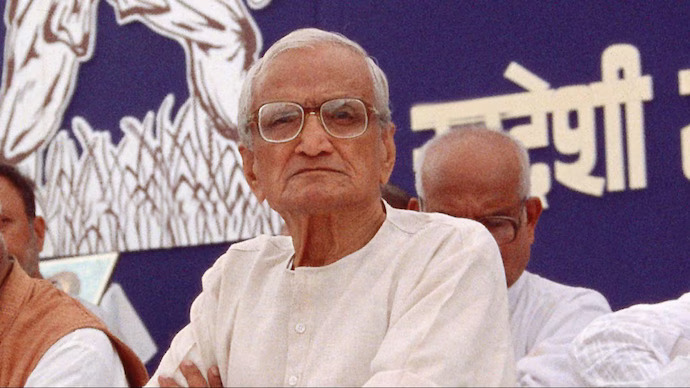
Dattopant Thengadi’s life and legacy transcend the boundaries of ideology and politics. He was not merely a trade unionist or social reformer he was a visionary who redefined the meaning of labour, nationalism, and self-reliance in modern India. At a time when the country’s working-class movements were dominated by imported Marxist doctrines, Thengadi carved out an indigenous path rooted in Bharatiya thought. His philosophy blending Deendayal Upadhyaya’s Integral Humanism with the ethos of national pride gave birth to movements that were neither capitalist nor communist, but profoundly human and patriotic. On his death anniversary, it is worth revisiting the remarkable journey of this scholar, organiser, philosopher, and nationalist who became a bridge between India’s civilisational wisdom and its modern workforce.
The Making of a Revolutionary Pracharak
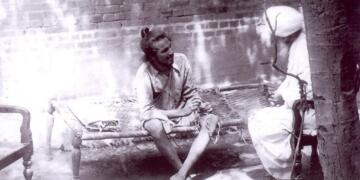
Born on November 10, 1920, in Arvi, Wardha district of Maharashtra, Dattatraya Bapurao Thengadi — affectionately known as Dattopant Thengadi displayed leadership qualities from a young age. By the age of 15, he was already the president of the Vanar Sena and the student union at Arvi Municipal High School. His deep involvement in India’s freedom struggle, particularly as a member of the Hindustan Socialist Republican Association (HSRA) from 1936 to 1938, reflected his early commitment to national causes.
Profoundly influenced by the towering personalities of Guruji Golwalkar, Pandit Deendayal Upadhyaya, and Dr. B.R. Ambedkar, Thengadi’s worldview evolved around the synthesis of spiritual nationalism and social equity. In 1942, he became a pracharak of the Rashtriya Swayamsevak Sangh (RSS), dedicating his life to national service. His assignments took him across India to Kerala, Bengal, and Assam where he strengthened the organisational base of the Sangh and sowed seeds of ideological clarity among the people.
At a time when Marxism captivated a third of the world and India’s working-class movements echoed the slogan “Lal kile pe lal nishan, maang raha hai Hindustan,” Thengadi dared to challenge the tide. He believed India needed a labour movement that reflected her own cultural ethos not an imported dogma that divided society into warring classes.
Birth of the Bharatiya Mazdoor Sangh: A Revolution in Saffron
In 1955, Thengadi founded the Bharatiya Mazdoor Sangh (BMS), marking a turning point in India’s labour history. It was the first workers’ organisation built on the principles of Integral Humanism rather than Marxist class struggle. His slogan, “Lal gulami chhod kar, bolo Vande Mataram,” (Leave the red slavery, chant Vande Mataram), symbolised the shift from ideological servitude to national self-awareness.
For Thengadi, the fight was not between classes, but against injustice. He replaced Marx’s “Workers of the world, unite” with a uniquely Indian appeal “Workers, unite the world.” Under his leadership, the BMS integrated nationalism into the labour discourse, hoisting the saffron flag and chanting “Bharat Mata ki Jai” at workers’ rallies acts that were once unthinkable in Left-dominated unions.
The BMS’s guiding principle was simple yet profound nationalisation of workers, industrialisation of the nation, and labourisation of industries. This triad Shramikon ka Rashtriyakaran, Rashtra ka Audyogikikaran aur Udyogon ka Shramikikaran became the moral and operational compass for India’s indigenous labour movement.
His intellectual clarity was evident in his 1968 address at a national workshop in Maharashtra: “If there exist different societies in different conditions in the same time period, then there could be no one ‘ism’ for them. One idea cannot remain permanent across time and place.” This statement exposed the rigidity of foreign ideologies and reaffirmed the dynamic, context-sensitive nature of Indian thought.
Beyond BMS: The Builder of Organisations and Movements
Thengadi was not confined to labour issues. He was a multi-dimensional organiser who founded or nurtured several institutions that continue to shape India’s socio-economic thought. Among them were Bharatiya Kisan Sangh (1979), Swadeshi Jagran Manch (1991), Samajik Samarasata Manch, Sarvapanth Samadar Manch, and Paryavaran Manch. He was also instrumental in the creation of Akhil Bharatiya Vidyarthi Parishad, Akhil Bharatiya Adhivakta Parishad, Bharatiya Vichara Kendra, and Akhil Bharatiya Grahak Panchayat.
In the international sphere, Thengadi boldly proposed the formation of an apolitical global labour confederation during a World Federation of Trade Unions meeting in Moscow a forum dominated by Leftists. Though his resolution was rejected, he persisted and went on to form the General Confederation of World Trade Unions, introducing a white flag as a symbol of peace and neutrality in place of the traditional red.
By 1989, the Indian Labour Ministry officially declared the BMS the largest labour organisation in the country, a testament to Thengadi’s lifelong dedication. His leadership even earned the respect of China; in 1985, the Communist Party of China invited a BMS delegation led by him the first such honour accorded to a nationalist labour movement.
Philosopher, Patriot, and Thinker of the “Third Way”
Thengadi’s intellect was vast and profound. He served two terms in the Rajya Sabha (1964–76) but refused ministerial posts offered during the Morarji Desai government. He also declined the Padma Vibhushan, reflecting his detachment from personal recognition. His predictions were remarkably accurate in 1968, he foresaw the decline of communism in the Soviet Union.
He opposed speculative financial practices and advocated self-employment and decentralised economic systems, in tune with Gandhi’s ideals and Deendayal Upadhyaya’s vision. His literary contributions over 100 books in Marathi, Hindi, and English reveal a mind deeply engaged with India’s socio-economic transformation. Among his classics are Karyakarta, Third Way, On Revolution, Prefaces in Hindu Economics, and Dr Ambedkar. His last book, completed in July 2004 just months before his death was a personal and ideological tribute to Dr. Ambedkar, presenting him in his true light.
Dattopant Thengadi’s passing on October 14, 2004, due to a brain haemorrhage marked the end of an era but not the end of his influence. His thoughts continue to illuminate the path of self-reliance, social justice, and cultural pride. He exemplified the synthesis of intellect and action, spirituality and nationalism, idealism and pragmatism.
Thengadi’s greatest contribution lies in his ability to decolonise India’s socio-economic thinking freeing it from Western ideological prisons and anchoring it in India’s eternal wisdom. He proved that workers’ dignity, farmers’ prosperity, and national progress are inseparable parts of one organic vision. As India moves toward Atmanirbharta (self-reliance), Thengadi’s philosophy of cooperation over conflict remains more relevant than ever a timeless call to build a humane, self-reliant, and spiritually grounded nation.