






















For a party that once dominated the Indian political landscape, the Congress today finds itself crumbling under the weight of its own contradictions. The latest crisis brewing in Karnataka is not merely a state-level disturbance — it’s a symptom of the deeper malaise afflicting the grand old party of India.
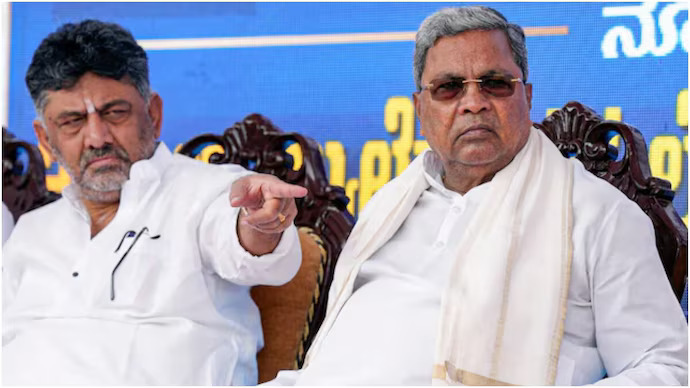
In just four months, the Congress’s Karnataka unit has issued disciplinary notices to four leaders — three sitting MLAs and one former MP — for openly endorsing Deputy Chief Minister D.K. Shivakumar as the next Chief Minister, ahead of the incumbent Siddaramaiah. These leaders have been accused of causing “embarrassment” to the party and flouting the directives of the high command, which had clearly instructed them to refrain from publicly discussing any potential change in leadership.
The fact that these warnings have been ignored time and again reflects a growing rebellion within the ranks, especially from those aligned with Shivakumar. The rift is not just about personalities — it is a power struggle that risks tearing the state unit apart.
Leadership War in Karnataka
Karnataka is currently ruled by the Congress after a resounding win in the 2023 Assembly elections. But that victory has not translated into stability. Since July, Congress MPs and MLAs have made increasingly bold statements suggesting that Shivakumar, who played a crucial role in the party’s election strategy, deserves to be Chief Minister — if not now, then at least by the end of 2024.
Kunigal MLA H.D. Ranganath recently described Shivakumar as a “rising star” and a “pan-India leader,” while former MP L.R. Shivarame Gowda claimed that Shivakumar’s elevation to CM was already a done deal. Similar sentiments were expressed earlier by Channagiri MLA Shivaganga V. Basavaraj and Ramanagara MLA Iqbal Hussain, who went as far as stating that Siddaramaiah had already served his time and needed to step aside.
All of them now face disciplinary action, and the party is demanding written explanations.
But this steady stream of dissent, despite repeated reprimands, highlights the central problem: the Congress high command’s inability to enforce discipline or quell internal ambitions. The leadership vacuum at the national level is translating into disorder at the state level, where regional satraps operate with growing autonomy — often at odds with each other.
Denial Mode and Public Posturing
Both Siddaramaiah and Shivakumar have tried to paper over the cracks. Publicly, they deny any differences and reiterate their loyalty to the high command. “We are following the high command’s guidelines,” Shivakumar said recently, while also directing action against his own supporters who have spoken out of turn. Siddaramaiah, meanwhile, has asserted that he will complete his full term.
But the mixed signals — Shivakumar calling for action, but his aides continuing to stir the pot — show that these are not just rogue elements speaking out. These are coordinated pressure tactics. And the fact that these leaders feel emboldened enough to defy the high command suggests that Congress’s internal control mechanisms are eroding fast.
Not a One-Off Incident
This isn’t the first sign of internal chaos in Karnataka. Earlier this year, the Congress found itself in a caste conundrum after the findings of a caste survey were leaked. The report triggered unrest among major communities like Lingayats and Vokkaligas, further straining relations within the party. Key leaders aligned with either Siddaramaiah or Shivakumar sparred publicly over how the findings could influence reservation policies.
These fissures — whether based on leadership tussles or caste calculations — underscore a deeper truth: the Congress is increasingly unable to manage competing power centers within its own ranks. The party, which once took pride in its broad-based coalition and ideological cohesion, now looks like a collection of interest groups vying for relevance.
A National Pattern of Decline
What’s unfolding in Karnataka is a microcosm of a broader national trend. In state after state, from Rajasthan and Punjab to Madhya Pradesh and now Karnataka, the Congress has been plagued by infighting, defections, and a lack of decisive leadership. Even when the party wins, like it did in Karnataka, the victory is short-lived as internal rivalries take center stage.
The high command — traditionally seen as the glue that held the party together — has lost its authority. Once-powerful disciplinary mechanisms are routinely ignored. Leaders now operate with open defiance, betting that the central leadership will either capitulate or be too weak to retaliate.
Conclusion: A Party at the Edge
The Karnataka drama is more than just a regional squabble — it’s a warning bell for a party teetering on the edge of irrelevance. Unless the Congress addresses its internal divisions with urgency and clarity, it risks losing not just its grip on power, but its very identity.
The crumbling is not just metaphorical anymore. It’s happening in real time, visible in every defiant statement, every disciplinary notice, and every failed attempt to enforce unity. The Congress may still win elections here and there, but as an institution, its foundation is visibly cracking. Karnataka is just the latest brick to fall.