
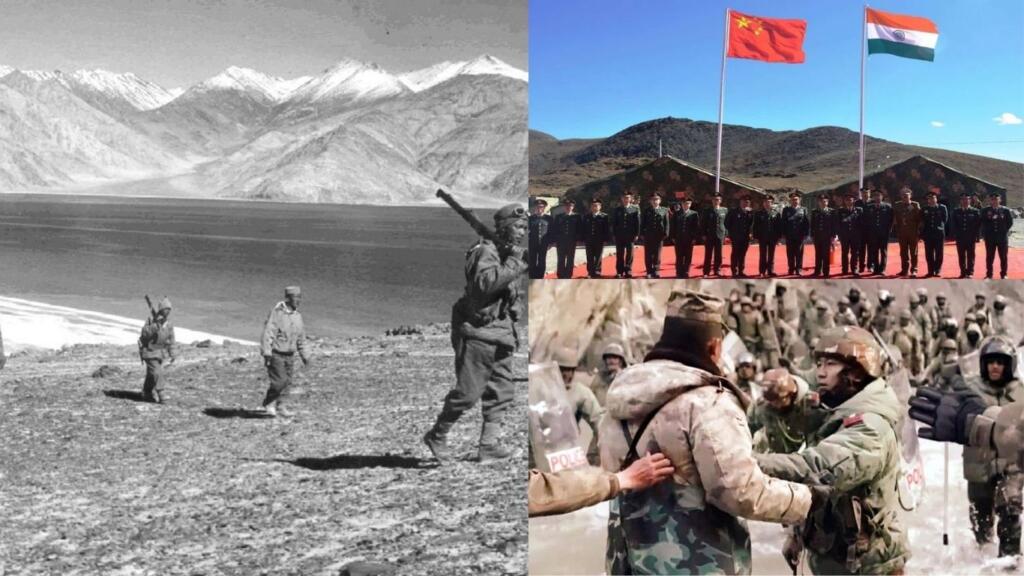
When most of the world was paralysed by the COVID-19 pandemic, a violent clash broke out on the night of June 15, 2020, between Indian and Chinese troops in Ladakh’s Galwan Valley. It was a grim reminder that China’s tendency to deceive and disregard agreements never really went away; it had merely taken new form.
Echoes of an old betrayal
China has long been adept at twisting the spirit of bilateral treaties. In Galwan, the People’s Liberation Army (PLA) soldiers came armed with crude weapons — barbed clubs, iron rods, and spiked batons. This was no coincidence. The 1996 and 2005 agreements between India and China had prohibited the use of firearms within two kilometres of the Line of Actual Control (LAC). Beijing used that restriction to its advantage, turning a rule meant for peace into an opening for brutal hand-to-hand combat.
That night, 20 Indian soldiers, including a commanding officer, lost their lives. Independent reports suggest that the Chinese side suffered more than 40 casualties, though Beijing has never officially confirmed the numbers. Still, China accused India of crossing the LAC and instigating the violence — a claim India flatly rejected, pointing instead to Chinese intrusion and duplicity.
From 1962 to 2020: a familiar pattern
The Galwan clash was not an isolated event. It carried the same undertones of deception that marked the 1962 Sino-Indian War. Both incidents stemmed from disputes over the boundary and China’s habit of redrawing facts on the ground to suit its ambitions. In 1962, China refused to recognise the McMahon Line and went on to occupy Aksai Chin and parts of Arunachal Pradesh. Six decades later, it repeated the playbook in Galwan — nibbling away at territory under the guise of “differing perceptions” of the LAC.
What changed was the scale, not the strategy. The 1962 war turned into a full-blown military conflict, while Galwan remained a limited but deadly confrontation. Yet the essence of both moments was the same: Chinese forces advancing under the cover of negotiations, followed by sudden violence.
Agreements signed, agreements broken
Over the decades, India and China have signed multiple pacts aimed at maintaining peace along the border. Each one, in the end, became another casualty of Beijing’s shifting priorities.
1993 — Border Peace and Tranquillity Agreement (BPTA): Set the foundation for peaceful consultations and forbade the use of force. China’s intrusions and the Galwan attack broke that commitment entirely.
1996 — Agreement on Confidence-Building Measures (CBMs): Required both sides to show restraint and banned firearms near the LAC. The PLA’s use of clubs, spikes and ambush tactics during Galwan was a direct breach.
2013 — Border Defence Cooperation Agreement (BDCA): Intended to prevent patrols from tailing each other or sparking confrontations. Chinese actions in the lead-up to 2020 made the agreement meaningless.
Even after Galwan, China continued its pattern of transgressions — intruding into areas such as Depsang and Demchok, and constructing large-scale military infrastructure near the border. Its new “border law” of 2022, which standardised Chinese names for places in Arunachal Pradesh, was viewed by India as another act of provocation and disregard for past commitments.
The cost of China’s duplicity
Repeated violations have stripped the relationship of any real trust. India’s Ministry of External Affairs (MEA) publicly called out Beijing’s “clear violation” of border protocols, while maintaining that normal relations cannot resume without peace on the LAC. The ministry outlined India’s position in terms of “three mutuals” — mutual respect, mutual sensitivity, and mutual interests all of which China has repeatedly ignored.
In 2020, when Chinese troops tried to close in on an Indian forward post and fired warning shots, the Indian Army showed restraint and avoided escalation. Even under severe provocation, Indian troops did not cross the LAC or fire weapons, choosing instead to uphold discipline and rely on established procedures for dialogue.
Tactical disengagement, not peace
Following dozens of military and diplomatic talks, limited disengagement took place at certain flashpoints. After negotiations in October 2024, both sides reportedly agreed to resume patrolling in Depsang and Demchok — a sign of cautious progress. Yet analysts warn that these are tactical moves, not a strategic reset. The underlying trust deficit remains as deep as ever, and the new patrol arrangements reportedly impose restrictions not seen before 2020 — seen by some as quiet concessions to Chinese pressure.
India’s response
In the aftermath of Galwan, India tightened scrutiny on Chinese investments, banned hundreds of Chinese mobile applications, and began strengthening infrastructure along its northern borders. New roads, bridges, and airfields have been developed to ensure that India is not caught unprepared again.
The clash at Galwan, like the war of 1962, was a test of endurance — and a lesson in vigilance. Both episodes revealed the same truth: that China’s promises of peace are only as strong as their temporary convenience. Whether under Mao or Xi, Beijing’s method has remained constant — strike, deny, and negotiate from a new position of strength.
(Ashu Mann is an Associate Fellow at the Centre for Land Warfare Studies. He was awarded the Vice Chief of the Army Staff Commendation card on Army Day 2025. He is pursuing a PhD from Amity University, Noida, in Defence and Strategic Studies. His research focuses include the India-China territorial dispute, great power rivalry, and Chinese foreign policy.